
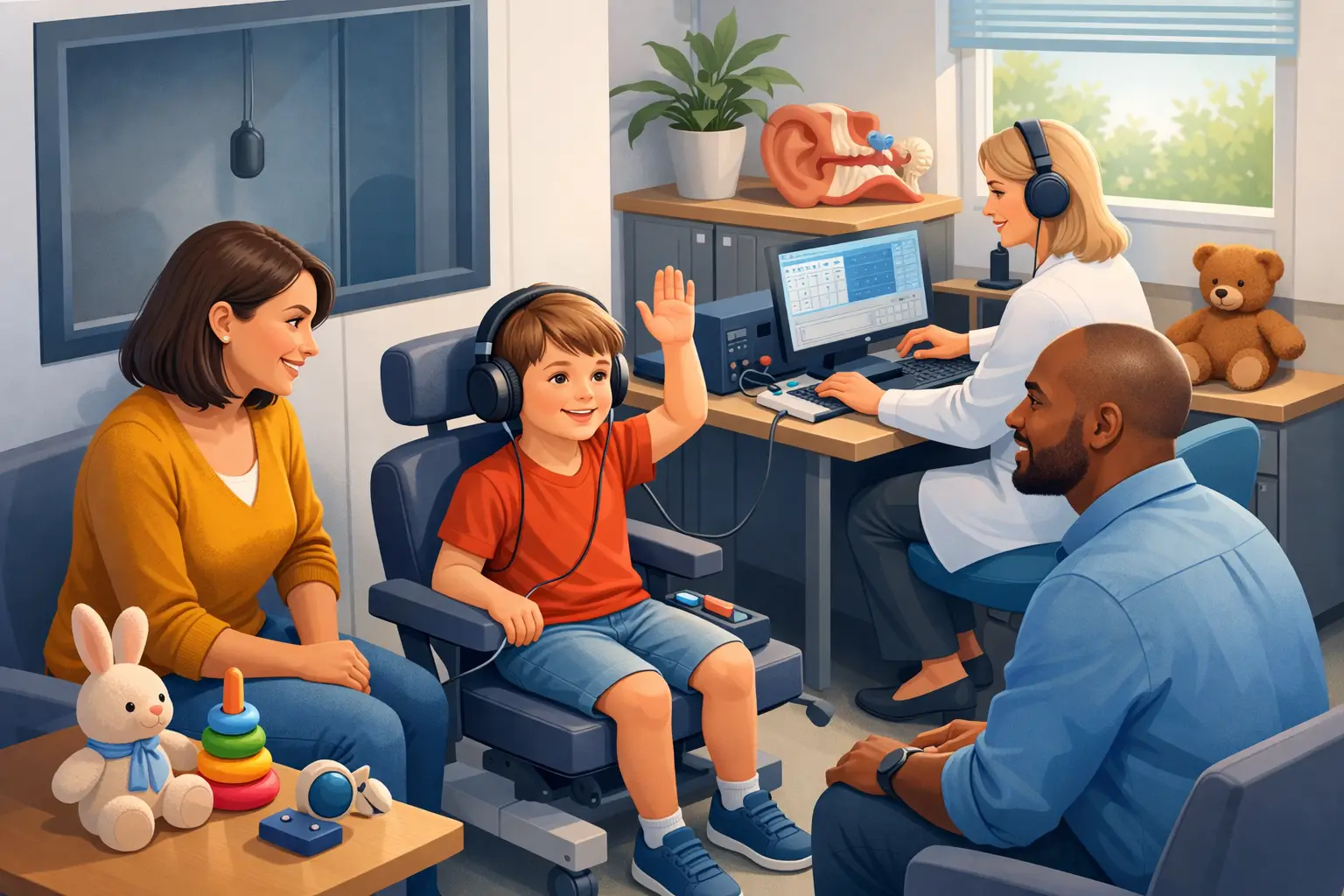
A paediatric hearing care example can be more useful than a checklist when you are worried about your child. Parents rarely arrive with a neat description of hearing loss. More often, they have noticed small changes: a child asking for repetition, becoming tired after nursery, turning one ear towards the television, or seeming to ignore instructions in busy places.
These signs do not automatically mean permanent hearing loss. They do, however, deserve an expert assessment. Children’s ears and hearing needs change quickly, and the right next step depends on their age, symptoms, medical history and everyday communication needs.
A paediatric hearing care example from first concern to support
Consider a fictional example of six-year-old Maya. Her parents had noticed that she often said “what?” at home and struggled to follow conversations when several people were speaking. Her teacher also mentioned that Maya was becoming quieter during carpet time and occasionally copied other children rather than responding to a question herself.
Maya had experienced several colds over the winter and no obvious ear pain. Her speech was clear, she enjoyed reading, and she could hear well in a quiet room. This is a common pattern: a child may appear to hear perfectly in some situations yet find soft speech, distance and background noise difficult.
At a specialist paediatric appointment, the clinician’s first task is not simply to test hearing. It is to understand Maya’s wider picture. Her parents are asked when they first noticed the changes, whether she has had ear infections, if there is a family history of hearing loss, and how she manages at home and school. The clinician also considers speech and language development, concentration, sensory sensitivities and any concerns raised by teachers.
This conversation matters because hearing is functional. A result on a graph is only part of the answer. A child who can detect sounds in a calm testing room may still need support if listening at school is difficult.
The assessment is adapted to the child
A qualified audiologist chooses age-appropriate tests and explains each activity in reassuring, child-friendly language. For a six-year-old, this may include play-based or standard pure-tone audiometry, where the child responds when they hear carefully presented sounds through headphones or inserts. Speech testing may also help show how well spoken words are understood.
The appointment can include an examination of the ear canal and eardrum, provided it is clinically appropriate and the child is comfortable. Tympanometry is often used to assess how the middle ear is functioning. It can help identify patterns consistent with fluid behind the eardrum, commonly called glue ear, or changes in pressure that may affect hearing temporarily.
Maya’s results show a mild conductive hearing loss in both ears, with tympanometry findings suggesting middle-ear fluid. In plain terms, sound is being held back before it reaches the inner ear. This finding fits with her recent colds and the listening difficulties reported by her family and teacher.
The clinician explains the result without alarm. Glue ear is common in childhood and can improve, particularly after a period of observation. Yet “common” should not mean dismissed. If reduced hearing is affecting learning, language, confidence or behaviour, it needs a clear plan and appropriate monitoring.
What a good care plan looks like
For Maya, the immediate recommendation is not an off-the-shelf solution. It is a proportionate plan based on the severity of her hearing change, her symptoms and the impact on daily life. Her parents receive a clear explanation of what has been found, what may happen next and when to seek further advice.
The plan may include communication strategies at home and school. Maya’s teacher can be asked to gain her attention before speaking, face her when giving instructions and seat her where she has a clear view of the teacher. Reducing unnecessary background noise and checking that she has understood key tasks can also make a meaningful difference.
Her parents may be advised to monitor whether she is asking for more repetition, increasing the television volume, appearing frustrated, or withdrawing from group activities. A review appointment allows the clinician to check whether middle-ear function and hearing thresholds have improved, stayed the same or changed.
Where results, symptoms or examination findings indicate the need for medical input, the family should be directed to the appropriate GP, ENT or paediatric service. Specialist audiology is not about making every concern more complicated. It is about recognising when watchful waiting is sensible, when further assessment is needed, and when a child should be referred without delay.
When the example would lead to a different pathway
Not every child follows Maya’s route. A child with sudden hearing change, persistent one-sided hearing difficulty, ear discharge, severe pain, dizziness or concerns about developmental regression requires timely medical advice. Equally, a child whose hearing test suggests a sensorineural hearing loss needs a more detailed diagnostic and rehabilitation pathway.
In that situation, care may involve repeat testing to confirm results, referral to specialist medical services, and discussion of hearing technology or other support where appropriate. Families should also receive guidance on education and communication. The goal is not merely to label a hearing level. It is to protect the child’s access to language, learning, relationships and confidence.
For babies and very young children, the assessment approach is different again. Audiologists may use behavioural observation methods, visual reinforcement techniques or objective measures depending on developmental stage and clinical need. A high-quality paediatric service adjusts the appointment to the child rather than expecting the child to fit an adult testing process.
Why early assessment can change everyday life
Children do not always have the words to explain that listening feels difficult. They may seem distracted, tired, shy or challenging when the real issue is that they are working harder than everyone else to make sense of sound. Background noise in classrooms, playgrounds and family gatherings can expose difficulties that are easy to miss at home.
An expert assessment gives parents evidence rather than guesswork. If hearing is within expected limits, that reassurance is valuable and can help focus attention on other possible explanations. If a hearing difficulty is identified, early advice can reduce the risk of avoidable strain at school and at home.
It also helps to avoid two unhelpful extremes: assuming a child will simply grow out of every concern, or treating one uncertain observation as proof of a lifelong problem. The right response is careful, clinically informed and individual.
Preparing your child for a hearing appointment
Parents do not need to rehearse answers or persuade a child to perform. It is usually enough to explain that they will meet someone who wants to learn how their ears hear sounds. For younger children, describe the test as a listening game. Bring glasses, hearing devices or relevant medical information if used, and tell the clinician if your child is anxious, neurodivergent, sensitive to touch or finds unfamiliar environments difficult.
A good clinic will work at the child’s pace. Sometimes testing is completed in one visit; sometimes a second appointment produces more reliable information. That is not a failure. Reliable results matter more than rushing through a test a child cannot comfortably engage with.
At Tragus-The Ear Specialists, paediatric hearing assessments are delivered with the clinical care families expect from qualified audiologists. For parents in Kent who have noticed changes in how a child hears, responds or copes in noise, a timely expert assessment can replace uncertainty with a clear next step. Do not wait for a child to fall behind before asking whether hearing could be part of the picture.