
You may first notice it at the breakfast table. Your child answers the wrong question, turns the television up, or seems to hear well one day and miss things the next. A child glue ear hearing check is often the clearest way to work out whether this change is simply distraction, a short-lived cold, or hearing affected by fluid behind the eardrum.
Glue ear is very common in children, particularly in the early years, and it can be deceptively subtle. Some children complain that their ears feel blocked. Others say nothing at all, yet begin to struggle with listening in noise, following instructions, or keeping up with speech sounds. Because hearing may fluctuate, parents are sometimes told to wait and see. That can be reasonable in some cases, but it should not replace proper assessment when symptoms persist or begin to affect communication, behaviour or learning.
What is glue ear?
Glue ear happens when fluid collects in the middle ear space behind the eardrum. Unlike an acute ear infection, it does not always cause pain or fever. The issue is more often muffled hearing, pressure, or a sense that sound is dull. In young children, that can look like inattentiveness when the real problem is reduced access to speech.
The hearing loss linked with glue ear is usually conductive. That means sound is being blocked from travelling efficiently through the middle ear, rather than there being damage to the inner ear itself. For many children the condition improves over time, especially after colds settle or as the structure of the ear matures. The difficulty is that waiting without checking can leave a child hearing poorly for weeks or months during a period when speech, language and classroom listening matter a great deal.
When a child glue ear hearing check is worth arranging
Parents often ask whether a hearing test is necessary if glue ear has already been mentioned by a GP or school nurse. In practice, a child glue ear hearing check does more than confirm a label. It helps show whether hearing is actually reduced, how much it is reduced, whether one or both ears are affected, and whether the picture fits glue ear or points to something else.
Assessment is especially worthwhile if your child is asking for repetition, seeming tired after nursery or school, speaking more loudly than usual, or becoming frustrated in group settings. It is also sensible if speech development seems unclear, if there is a history of repeated ear infections, or if symptoms have lasted beyond a few weeks. Even mild hearing changes can have a disproportionate effect in noisy classrooms, where children need to hear soft speech sounds against constant background noise.
There is no single rule for every family. Some children with very recent symptoms can be monitored initially. Others need a more urgent assessment, particularly if there are developmental concerns, school difficulties, or uncertainty about how long the hearing problem has been present.
What happens during a child glue ear hearing check?
A proper paediatric hearing assessment should be adapted to your child’s age, attention and developmental stage. The aim is not simply to complete a test, but to build a reliable picture of ear health and hearing function.
The appointment usually starts with a detailed case history. A qualified audiologist will ask about recent colds, ear infections, speech development, school concerns, family observations and any previous hearing results. This context matters because glue ear can come and go, and hearing may vary from one week to the next.
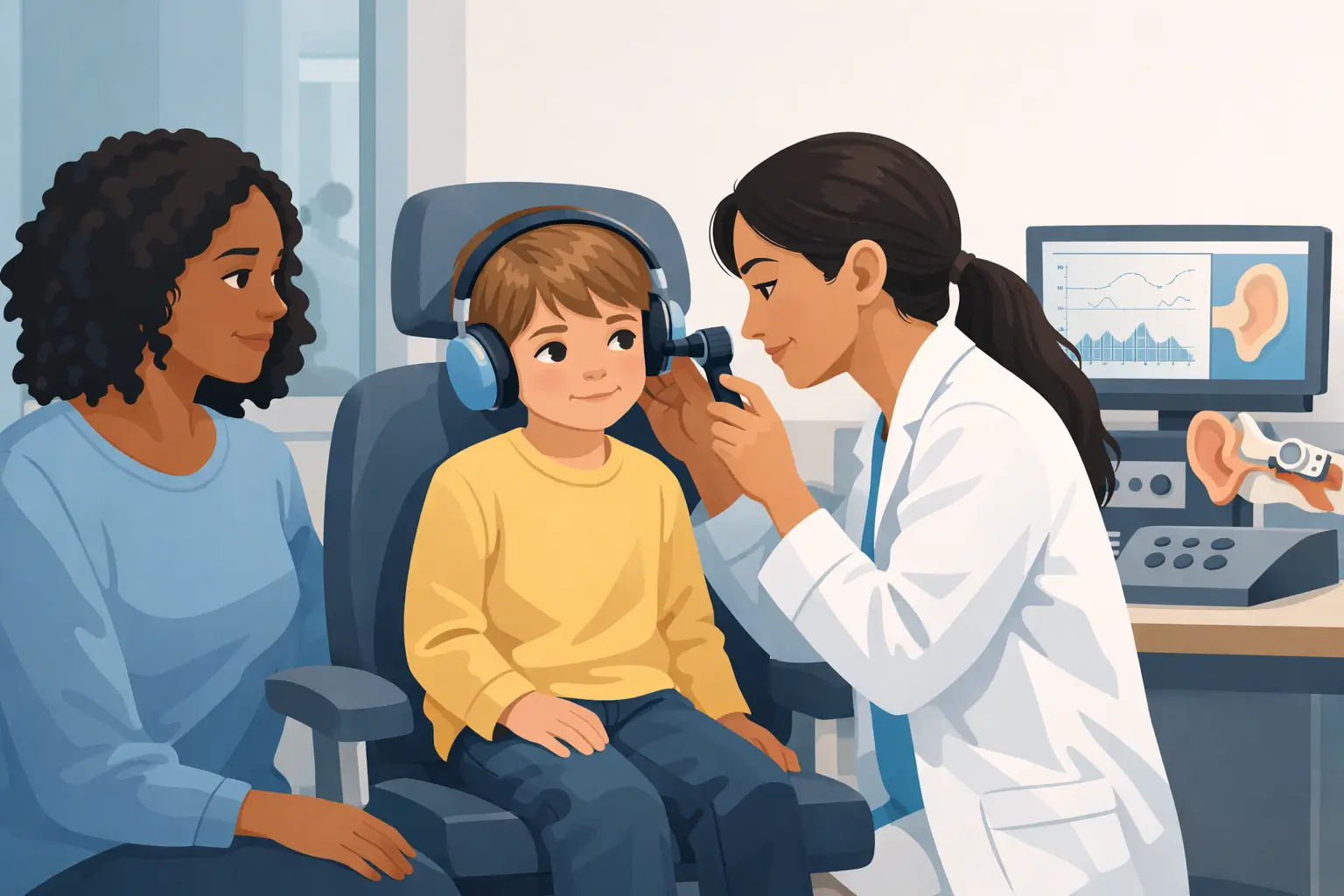
An ear examination is then carried out to look at the ear canal and eardrum. This helps identify whether there is wax, visible inflammation, or changes in the eardrum that may be consistent with middle ear fluid. While the eardrum cannot always tell the whole story on sight alone, it gives useful clinical clues.
Tympanometry is often a key part of the process. This test measures how the eardrum moves in response to slight changes in air pressure. In children with glue ear, the eardrum may move less freely because fluid in the middle ear is restricting it. Tympanometry is quick and objective, so it is particularly valuable in paediatric assessment.
Hearing testing itself depends on age. Younger children may complete play-based tasks, such as placing a toy in a bucket when they hear a sound. Older children can usually manage more formal pure tone audiometry with headphones. The result helps show the degree and pattern of hearing loss. That matters because mild conductive hearing loss may need a different management plan from more significant or prolonged hearing reduction.
In some cases, speech testing may also be useful, especially where parents report that the child hears sounds but struggles with words. This can help explain real-world listening difficulties more clearly than a simple pass or fail approach.
Why accurate diagnosis matters
Glue ear is common, but not every blocked or muffled ear is glue ear. Children can also have hearing affected by wax, ear canal problems, acute infection, Eustachian tube dysfunction, or less common causes that need medical review. A specialist hearing check helps avoid assumptions.
Accurate diagnosis also matters because hearing changes do not affect every child in the same way. One child with a mild temporary loss may cope well. Another may begin withdrawing in class, missing phonics, or developing unclear speech patterns. The right next step depends not only on test results, but on the child sitting in front of you.
This is where specialist paediatric audiology makes a difference. Children are not small adults, and hearing assessment must be interpreted in the context of development, listening demands and family concerns. An expert assessment should leave parents with a clear explanation, not simply a graph.
What happens if glue ear is confirmed?
If the hearing check suggests glue ear, management depends on severity, duration and impact. In many cases, careful monitoring is appropriate because the fluid may resolve naturally. But monitoring should still be active. That means knowing when to review hearing, what changes to watch for, and when onward medical referral is needed.
Some families are advised to observe symptoms over a defined period, especially if glue ear appears linked to a recent upper respiratory infection. Others may need referral to ENT, particularly if the condition is persistent, both ears are affected, or hearing loss is having a meaningful effect on speech, language or school performance.
There can be trade-offs. Immediate intervention is not always necessary, and over-treating short-lived glue ear is not the goal. Equally, prolonged waiting can leave a child functioning below their best at a crucial stage of learning. The sensible approach is one based on evidence, repeat assessment where needed, and the child’s day-to-day difficulties.
Parents can also help at home and school by reducing distance when speaking, gaining the child’s attention before giving instructions, and letting teachers know if hearing is fluctuating. These are supportive steps, but they should not replace proper review when symptoms continue.
Signs parents often miss
Children do not always say, “I cannot hear.” More often, they adapt. They may watch faces closely, copy others, lose track in noisy places, or seem oddly inconsistent. A teacher may notice they are fine one-to-one but less responsive in a group. These patterns are common with fluctuating conductive hearing loss.
Behaviour changes can be part of the picture as well. Fatigue, irritability and reduced concentration sometimes reflect the effort of listening with muffled hearing. When a child is working hard to decode speech all day, it can look like poor attention rather than an ear problem.
That is why a careful child glue ear hearing check can be so helpful. It moves the conversation from guesswork to clinical evidence.
Choosing the right clinic for a child glue ear hearing check
For parents seeking private assessment in Kent or South East London, expertise matters. A child who is anxious, distracted or very young needs an audiologist who knows how to obtain reliable results without rushing the process. The clinic should offer age-appropriate testing, middle ear assessment, and clear guidance on whether monitoring, medical referral or follow-up testing is the right next step.
It is also worth asking who will be carrying out the assessment. Qualified audiologists with paediatric experience are better placed to interpret results properly, particularly where hearing fluctuates or symptoms do not fit a simple pattern. Premium care is not about unnecessary complexity. It is about getting a dependable answer and a plan you can act on.
At Tragus-The Ear Specialists, that standard of assessment is central to how paediatric hearing care is delivered. Families need clarity, not mixed messages, and children need hearing checks that are both clinically thorough and handled with care.
If you suspect glue ear, the key is not to panic and not to ignore it. Children often recover well, but they do best when reduced hearing is recognised early and followed up appropriately. A timely assessment can protect confidence, communication and learning – and sometimes that reassurance is just as valuable as the diagnosis itself.
If your child seems to be hearing the world as though someone has turned the volume down, trust what you are seeing and have it checked properly.