
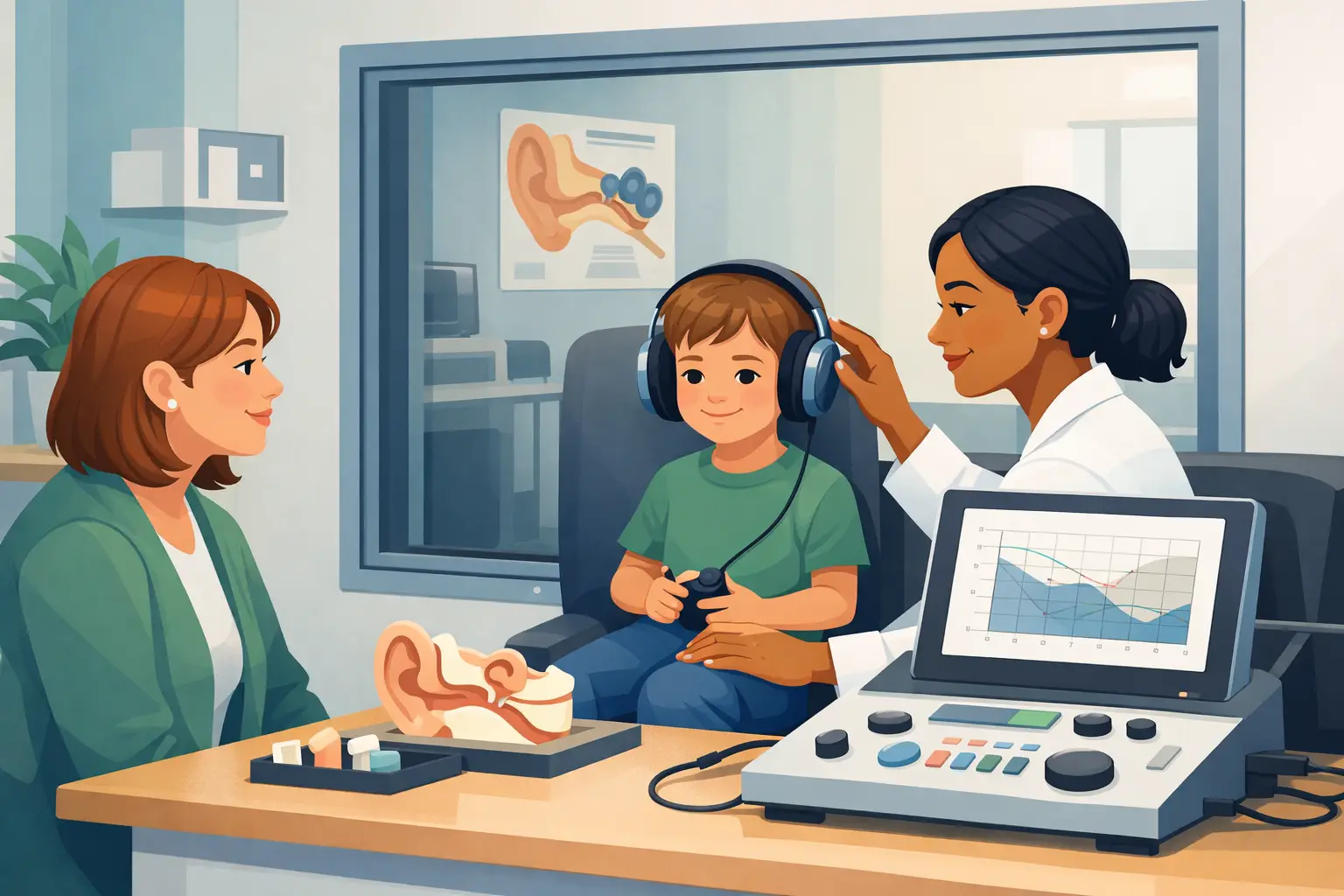
A child who says “what?” a little more often, turns the television up, or seems tired after school is not always being inattentive. Sometimes, they are working harder than expected to hear clearly. This guide to children’s audiology is for parents who want to understand when hearing should be checked, what a specialist assessment involves, and how expert support can make daily life easier for both child and family.
Why children’s hearing needs specialist assessment
Children are not simply small adults when it comes to hearing care. Their ears are still developing, their communication skills are changing quickly, and the impact of even mild hearing difficulty can be significant. A temporary hearing problem linked to glue ear may affect speech clarity, classroom listening and confidence. A permanent hearing loss may be present from birth or develop later, sometimes so gradually that it is first noticed through behaviour rather than obvious complaints.
That is why paediatric audiology is a specialist area. The audiologist must choose tests that match the child’s age, attention span and developmental stage. They also need to interpret results in context. A hearing test on its own is useful, but the real clinical value comes from understanding how the findings relate to speech, learning, listening effort and family concerns.
For many parents, the main question is simple: do we need to worry? Often, the answer is more measured than that. It may not be a cause for alarm, but it may well be a reason for assessment. Early clarity is usually better than prolonged uncertainty.
Signs that may suggest a hearing issue
Some children show very clear signs of hearing difficulty. Others compensate well, especially in familiar routines at home, which can delay recognition. The pattern matters as much as any single symptom.
A younger child may have delayed speech, unclear speech sounds, limited response to their name, or difficulty following simple instructions unless they can see your face. Older children may appear distracted, ask for repetition, misunderstand homework instructions, or struggle more in noisy places than in quiet one-to-one conversation.
There are also less obvious signs. Some children become frustrated, withdraw socially, or seem fatigued after school because listening takes so much concentration. Others develop inconsistent listening habits – hearing well one day and poorly the next – which is common with middle ear problems such as glue ear.
It depends on the whole picture. One missed instruction does not necessarily indicate hearing loss. A repeated pattern across home, nursery or school deserves proper assessment.
When to seek a paediatric hearing assessment
Parents often wonder whether to wait and watch or book an appointment promptly. If a child has failed a school screening, had repeated ear infections, shows delayed speech, or there are ongoing concerns from family or teachers, a hearing assessment is sensible. The same applies if your child says sounds are muffled, has tinnitus, or seems unusually sensitive to sound.
A family history of childhood hearing loss also matters. So does any concern after illnesses that can affect hearing, although the level of risk varies. In babies and very young children, lack of response to sound, absent babbling, or delayed communication milestones should always be taken seriously.
Private assessment can be particularly helpful when parents want faster answers, a more detailed explanation, or access to clinicians with specialist paediatric experience. In a premium ear clinic setting, the advantage is not simply speed. It is the quality of assessment, time spent with the family, and the ability to plan sensible next steps.
What happens during a children’s audiology appointment
A good paediatric appointment starts with history-taking, not equipment. The audiologist will ask about pregnancy and birth history if relevant, speech and language development, previous ear infections, school concerns, medical background and any family history of hearing problems. This helps shape the testing approach.
The ears are usually examined first. Sometimes the issue is straightforward, such as wax obscuring the ear canal, though ear care in children must be handled carefully and appropriately. In other cases, the ear drum may look healthy while middle ear function or inner ear hearing still needs investigation.
The hearing tests themselves depend on age. Babies may have objective tests that do not rely on spoken responses. Toddlers and pre-school children often complete play-based assessments designed to hold attention. Older children may carry out more conventional hearing tests with headphones and response buttons. Middle ear testing is also common, as this can show whether fluid, pressure problems or reduced ear drum movement are affecting hearing.
The best appointments do not feel rushed. Parents should leave understanding not only the result, but what it means. Is the hearing normal? Is there a temporary conductive problem? Is monitoring enough, or is onward referral needed? Clear explanation is part of good audiology care.
A guide to children’s audiology tests
The phrase “hearing test” sounds simple, but in paediatrics it usually refers to a group of tests rather than one single procedure. The combination is chosen according to the child’s age and what the clinician needs to find out.
Visual reinforcement audiometry is often used for infants and younger toddlers. The child learns to turn towards a sound and is rewarded with a visual stimulus. Play audiometry works well for many pre-school children, turning listening into a simple game, such as placing a block in a bucket each time a tone is heard.
For older children, pure tone audiometry may be possible, providing ear-specific information across different pitches. Tympanometry assesses middle ear function and can help identify glue ear or pressure problems behind the ear drum. Otoacoustic emissions can give information about inner ear hair cell function. In some cases, more advanced electrophysiological testing is needed, particularly if behavioural testing is unreliable or more detailed threshold information is required.
There is no single “best” test in isolation. The strongest assessment comes from combining methods and interpreting them carefully.
Common childhood hearing conditions
Glue ear is one of the most common reasons children are referred to audiology. It happens when fluid builds up in the middle ear, often after infections or because the Eustachian tube is not working efficiently. Hearing can fluctuate, which is why children may seem inconsistent. Many cases improve over time, but not all. Management depends on severity, duration and the impact on speech, education and wellbeing.
Permanent hearing loss is less common, but it is clinically significant and should never be missed. It may affect one ear or both. Unilateral loss can still create real difficulties, especially with sound localisation and hearing in classrooms or busy social settings.
Some children experience tinnitus or sound sensitivity. These symptoms can be distressing and are sometimes overlooked because adults assume they occur only later in life. Specialist assessment matters here too, particularly when symptoms affect sleep, concentration or emotional wellbeing.
What happens if a problem is found
Not every child with hearing difficulty needs the same plan. Sometimes reassurance is the right outcome. Sometimes monitoring is enough. In other cases, the child may need medical review, repeated testing, hearing technology, classroom adjustments, or support from speech and language services.
If glue ear is suspected, the audiologist may recommend review after a defined interval, particularly if hearing is only mildly affected and symptoms are recent. If the hearing loss is more marked, persistent or linked to speech and learning concerns, referral to ENT may be appropriate. If a permanent hearing loss is identified, prompt rehabilitation is essential. That may include hearing aids, communication strategies and coordinated support with education services.
This is where specialist care makes a difference. Families need more than raw test results. They need a clinically sound explanation and a practical route forward.
Choosing the right clinic for your child
Parents are right to be selective. Paediatric audiology requires specific experience, the right testing equipment and the confidence to work with children who may be anxious, shy or easily distracted. A general hearing test designed for adults is not enough.
Look for qualified audiologists with paediatric expertise, clear clinical standards and enough appointment time to assess properly. It is also worth asking how results are explained, whether onward referral can be arranged if needed, and how the clinic adapts testing for different ages.
For families in Kent and South East London, a specialist service such as Tragus-The Ear Specialists can offer the reassurance of clinician-led assessment within a dedicated ear and hearing setting. That level of expertise is especially valuable when symptoms are unclear, persistent or affecting school life.
How parents can help before and after assessment
Before the appointment, note specific examples of listening difficulties. Teachers’ observations are often useful too. Try to record when the problem is most noticeable – in noise, during group conversation, after colds, or all the time. Patterns help the clinician.
After the appointment, the most helpful step is usually consistency. If monitoring has been advised, keep track of symptoms. If recommendations have been made for school, pass them on clearly. If treatment or review is needed, do not delay because things seem “mostly fine”. Children often cope better than expected, but coping is not the same as hearing well.
A child does not need to be in obvious difficulty before their hearing deserves expert attention. If something feels off, trust that instinct and get it checked. Clear hearing supports language, learning, confidence and connection – and those are worth protecting early.