
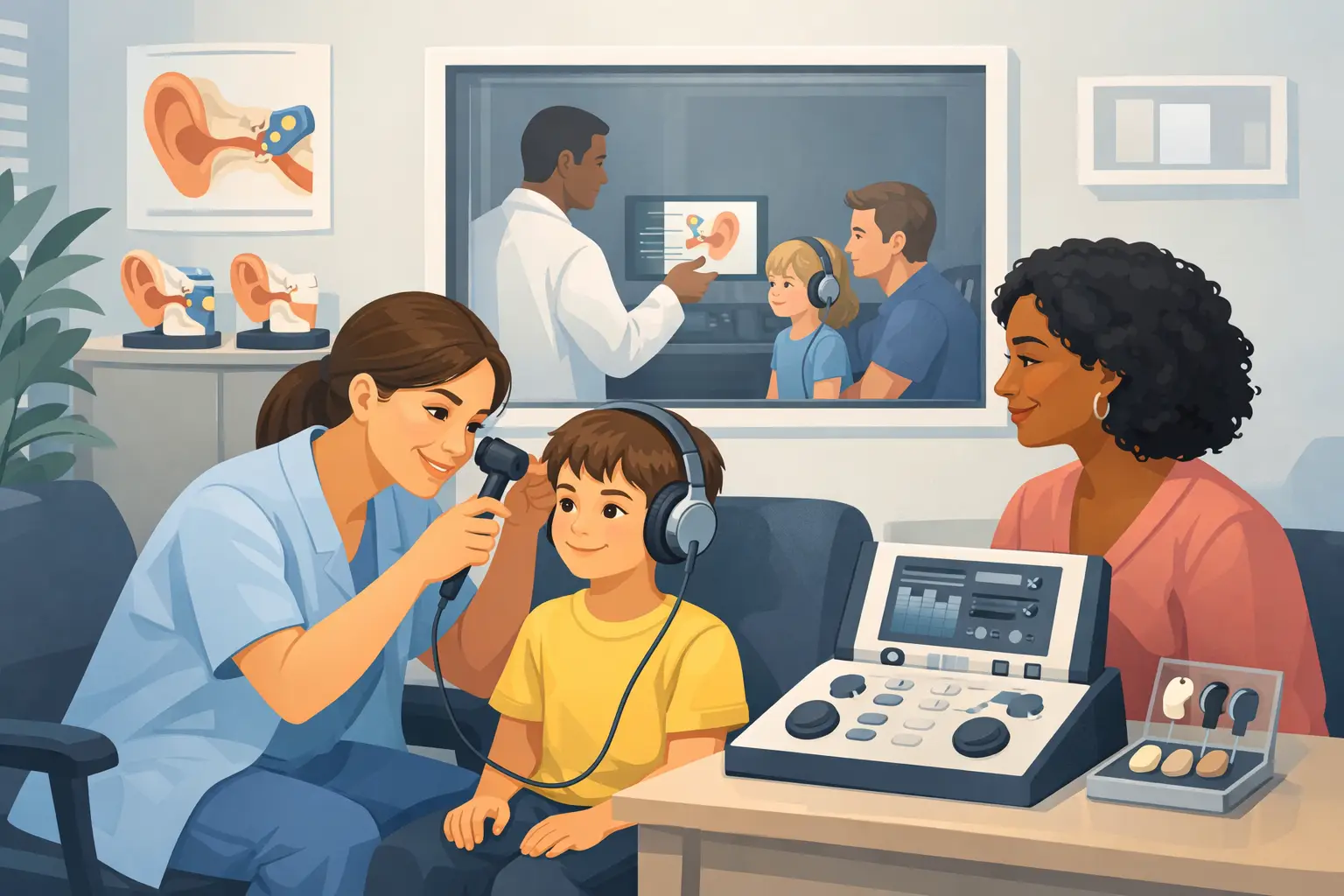
A child who misses parts of speech does not always say, “I can’t hear.” More often, parents notice the signs indirectly – unclear speech, difficulty following instructions, tiredness after school, or a sense that listening seems harder than it should be. When that happens, finding the best paediatric hearing clinics becomes less about convenience and more about getting the right answers quickly, accurately and with proper clinical care.
Paediatric audiology is a specialist area. Children are not simply small adults, and hearing assessment in children requires different equipment, different testing strategies and a different clinical approach. The right clinic should know how to obtain reliable results without rushing the child, and how to explain those results clearly to parents.
What sets the best paediatric hearing clinics apart
The best paediatric hearing clinics are defined by more than a pleasant waiting room or a short appointment lead time. The real difference is clinical depth. A specialist clinic should be able to assess hearing thoroughly, understand developmental context, and recognise when a child needs onward medical investigation, monitoring or rehabilitation.
That means looking closely at who delivers the assessment. Qualified audiologists with paediatric experience matter. So does experience gained in hospital or NHS specialist settings, because children’s hearing concerns can be complex. A premium private clinic should not feel like a retail hearing outlet adapted for children. It should feel like a clinical service built around expert assessment.
The quality of testing is equally important. Depending on a child’s age and stage of development, hearing assessment may involve visual reinforcement audiometry, play audiometry, tympanometry, otoacoustic emissions or other age-appropriate methods. A good clinic will choose the correct test battery rather than relying on a one-size-fits-all screen.
Why paediatric hearing assessment needs specialist handling
Children do not always engage with testing in a predictable way. Some are shy, some are highly active, and some are anxious in unfamiliar settings. A clinician assessing a toddler or school-age child needs technical knowledge, but also patience, pacing and strong observation skills. Results often depend on how well the audiologist adapts to the child in front of them.
This is one reason parents should be cautious about choosing purely on price. Lower-cost services can be suitable for straightforward adult hearing checks, but paediatric work is different. If a child gives inconsistent responses, if middle ear issues are suspected, or if speech and language development is being affected, the assessment needs enough time and expertise to reach a meaningful conclusion.
There is also the question of interpretation. A hearing test is only useful if the findings are placed in context. Is the issue likely to be temporary? Could glue ear be involved? Does the pattern suggest the need for ENT review, monitoring or support in school? Specialist paediatric clinics are better equipped to answer those questions properly.
What to look for when comparing the best paediatric hearing clinics
Parents often begin with the practical questions: how soon can we get an appointment, how much will it cost, and is the clinic local? Those things matter, especially when a child is struggling in the classroom or at home. Still, they should come after the clinical essentials.
Start with credentials. Look for clinics led by registered audiologists with paediatric assessment experience. If the clinicians also have experience from NHS services or academic specialist practice, that is a useful sign of depth. It usually means they are used to working with both routine and more complex presentations.
Next, consider whether the clinic offers true diagnostic assessment rather than a simple hearing screen. A screening test may only indicate that further investigation is needed. A diagnostic appointment should aim to define the nature of the problem, assess middle ear status where appropriate, and provide a clear explanation of what happens next.
Follow-up care is another marker of quality. Some children need only reassurance. Others need repeat testing, ear health management, hearing rehabilitation or onward referral. The best clinics do not treat the assessment as a standalone transaction. They see it as part of a wider care pathway.
Questions worth asking before you book
A reputable clinic should be comfortable answering direct questions. You may want to ask whether they routinely assess children of your child’s age, what tests are likely to be used, how long the appointment lasts, and whether the audiologist will provide a written explanation of findings.
It is also sensible to ask how the clinic manages children who are anxious or find formal testing difficult. A confident answer here tells you a great deal. Experienced paediatric clinicians know that flexibility is part of the job.
If your child has speech delay, recurrent ear infections, suspected glue ear, autism, sensory sensitivities or learning differences, mention this when booking. Not because it should lower expectations, but because it helps the clinic plan the right appointment structure and testing approach.
Red flags parents should not ignore
If a clinic’s paediatric service is described vaguely, that should give you pause. Children’s hearing assessment should not be presented as a generic add-on. You should be able to see evidence that the clinic understands paediatric ear and hearing care specifically.
Be cautious if there is no clear mention of diagnostic methods, clinician qualifications or what the appointment includes. The same applies if the service appears heavily retail-led, with more emphasis on products than on assessment. In children, the priority is accurate diagnosis and appropriate management, not a rushed pathway towards a device.
Very short appointments can also be a concern. While efficient services are welcome, a child’s assessment often requires time to build trust, adapt instructions and repeat measures where necessary. A clinic that leaves no room for this may struggle to obtain reliable results.
When private paediatric audiology can be especially helpful
Private assessment is not about replacing essential NHS care. In many cases, it is about access, speed and continuity. If parents are worried about hearing now, waiting can feel costly, particularly when school performance, behaviour or speech development may be affected.
A private specialist clinic can be valuable when a parent wants an expert opinion sooner, when symptoms are ongoing despite previous reassurance, or when a child needs a more focused hearing assessment than has been possible elsewhere. It can also help when families want the reassurance of a comprehensive ear and hearing review in one place.
For families in areas such as Dartford, Sevenoaks or the surrounding parts of Kent, choosing a local specialist clinic may reduce the strain of travel while still giving access to high-level expertise. That matters more than many parents expect, especially if follow-up appointments are needed.
The value of a clinic that can see the bigger picture
Hearing does not exist in isolation. A child with listening difficulties may also have middle ear dysfunction, sound sensitivity, delayed speech, attention concerns or classroom fatigue. The strongest clinics recognise that hearing assessment is one part of a broader picture affecting communication, learning and family life.
This is where a specialist ear and hearing clinic has a clear advantage. When audiology sits alongside wider ear health expertise, families are more likely to receive joined-up advice rather than fragmented opinions. If wax, middle ear pressure changes, tinnitus or sound intolerance are contributing factors, these can be considered properly rather than missed.
Tragus-The Ear Specialists reflects this kind of model – a clinically led service where paediatric hearing assessment sits within a broader specialist understanding of ear and hearing health. For parents, that usually means a more coherent experience and a clearer next step.
Choosing confidently, not hurriedly
The best paediatric hearing clinics are not always the ones with the loudest marketing. They are the ones that combine specialist knowledge, child-appropriate testing, careful interpretation and genuine follow-through. Parents do not need perfection. They need a clinic that takes children’s hearing seriously and knows how to investigate it properly.
If you are comparing options, look beyond convenience alone. A nearby appointment is useful, but expertise is what gives the result value. When a child’s hearing affects communication, confidence or development, careful assessment is not a luxury. It is the foundation for the right support.
If something about your child’s hearing does not feel quite right, trust that instinct and act on it. The right clinic should leave you with more than a test result – it should give you clarity, reassurance and a sensible plan for what comes next.