
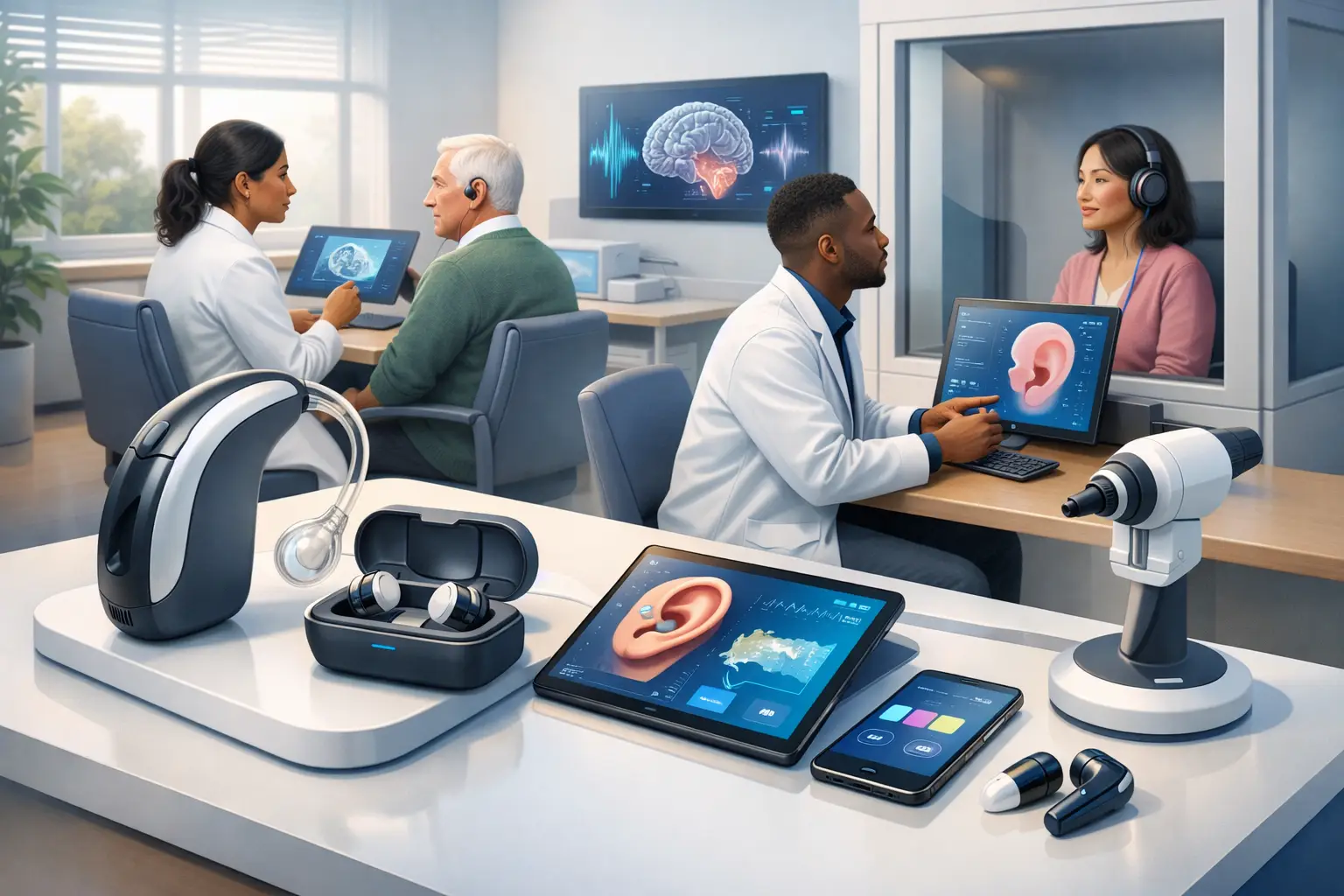
A hearing aid that makes speech clearer in a busy restaurant, a remote adjustment made after a difficult week at work, or more detailed testing for a child who cannot yet describe what they hear – these are the practical changes behind audiology technology trends 2026. The technology is becoming more capable, but it is not replacing the clinical judgement required to diagnose hearing concerns, fit devices safely or support people living with tinnitus and sound sensitivity.
For patients, the most useful question is not which feature sounds most impressive. It is whether a new tool can make conversation, concentration, comfort and confidence better in real life. That depends on the quality of the assessment, the suitability of the technology and the ongoing care around it.
Audiology technology trends 2026: intelligence with a clinical purpose
The headline trend is more intelligent sound processing in modern hearing aids. Devices increasingly use advanced algorithms to identify speech, background noise, wind, music and different listening environments, then adjust their settings accordingly. This can reduce the constant need to change programmes manually and may improve listening comfort in changing environments.
The greatest potential benefit is in complex settings: family meals, cafés, meetings, places of worship and social occasions where several voices compete. Rather than simply making everything louder, newer systems aim to preserve speech while managing unwanted noise.
However, no hearing aid can remove all background sound without affecting the natural quality of a listening environment. A device that is too aggressive in reducing noise may make speech sound artificial, reduce awareness of surroundings or remove elements of music that matter to the wearer. The best settings are therefore personal. They should be informed by hearing test results, listening needs, dexterity, lifestyle and the individual’s tolerance for amplification.
Artificial intelligence is supporting, not replacing, the audiologist
Artificial intelligence is increasingly used within hearing technology to classify sound environments and make rapid processing decisions. Some systems also use data gathered from the wearer’s own adjustments to suggest more suitable settings over time. This can make technology feel less intrusive and more responsive to day-to-day life.
Yet an algorithm cannot look in the ear, establish whether hearing loss has changed suddenly, identify a conductive problem caused by wax or middle-ear dysfunction, or assess the emotional impact of tinnitus. It cannot determine whether dizziness, one-sided symptoms, pain or discharge require medical attention. Those decisions require a qualified clinician and an appropriate referral pathway.
For this reason, intelligent hearing aids work best as part of rehabilitation, not as a standalone consumer purchase. A premium clinical fitting includes accurate measurement, counselling, verification of how the device performs for the wearer and follow-up adjustments based on genuine experience.
Hearing aids will become more connected
Bluetooth connectivity has moved from a convenient extra to a central part of many hearing aid fittings. Direct streaming from a mobile phone, television accessory or laptop can make calls and media more accessible, particularly when a person has difficulty following voices through a speaker.
In 2026, wider adoption of newer broadcast audio standards is likely to increase the number of public and personal listening situations where sound can be received more clearly. The promise is straightforward: a person may be able to hear an announcement, presentation or television audio sent directly to compatible hearing devices, rather than relying only on room acoustics.
Compatibility still matters. Not every phone, operating system, television or venue will support the same technology, and streamed sound is not automatically the best choice for every patient. Battery use, connectivity reliability and ease of control should be discussed before choosing a device. For some people, simple and dependable operation will be more valuable than a long list of connected features.
Rechargeable power and discreet controls
Rechargeable hearing aids continue to improve, reducing the need to handle small disposable batteries. This is particularly helpful for people with reduced vision, arthritis or tremor. Portable charging cases can also offer reassurance during long working days or travel.
There is a trade-off. Rechargeable models need a reliable charging routine, while battery-powered devices may be preferable for someone who spends long periods away from mains electricity or wants to carry spare batteries easily. A careful discussion of routine is often more useful than choosing the newest charging option by default.
Remote care will complement face-to-face appointments
Remote fine-tuning allows an audiologist to adjust compatible hearing aids without the patient necessarily attending the clinic for every change. This can be valuable when an initial fitting is broadly successful but a small adjustment is needed after using the aids at home, at work or in social environments.
For patients across Kent, remote support can reduce unnecessary travel and make rehabilitation feel more responsive. It is especially useful when a person can describe a specific difficulty, such as harsh clattering sounds in the kitchen or poor speech clarity during video calls.
Remote care has limits. The first assessment, ear examination and initial fitting should not be treated as optional simply because technology can be adjusted at a distance. Physical checks may be needed if there is discomfort, feedback, blocked sound, a suspected wax problem or a change in hearing. In-person appointments also allow clinicians to carry out real-ear measurements, which assess whether amplification is reaching appropriate levels in the individual ear.
The most effective model is usually blended care: detailed face-to-face assessment and fitting, backed by convenient remote support where it is clinically appropriate.
Better diagnostics will mean more personalised decisions
Advances in audiology are not limited to hearing aids. Diagnostic technology is becoming more detailed, quicker to interpret and better integrated into patient records. Tests of middle-ear function, cochlear responses and speech understanding can help build a clearer picture of where a difficulty may be arising.
Speech-in-noise testing is particularly relevant because many people report that they can hear sounds but struggle to follow conversation in groups. A standard hearing test remains essential, but it does not always capture the full experience of listening in a demanding environment. Additional testing can help guide realistic advice, rehabilitation and hearing aid programming.
For children, age-appropriate technology and skilled observation are equally important. Paediatric hearing assessment is not simply an adult hearing test conducted in a smaller room. The approach must be tailored to development, attention, communication stage and the child’s ability to respond. Objective tests can provide valuable information when behavioural responses are limited, but results should always be interpreted in the context of the child and their family.
Tinnitus technology needs careful expectations
Digital tools are expanding the options available for tinnitus support. Hearing aids may provide amplification that reduces the contrast between tinnitus and everyday sound for people with hearing loss. Some devices offer sound therapy options, while smartphone-based resources can support relaxation, sleep routines and symptom tracking.
These tools can be helpful, but tinnitus is not a one-size-fits-all condition. The goal is rarely to find a single sound that makes tinnitus disappear. Effective care may involve education, hearing assessment, sound enrichment, therapeutic strategies and support for the anxiety or sleep disruption that can keep tinnitus in the foreground.
The same caution applies to hyperacusis, where ordinary sounds can feel uncomfortably loud or distressing. Technology must be introduced thoughtfully. Overprotecting the ears in everyday safe sound environments can sometimes maintain sound sensitivity, while unsuitable amplification can worsen discomfort. A specialist assessment is the right starting point when sound tolerance has changed.
Privacy, evidence and safety will matter more
As hearing devices become more app-connected, patients should expect clearer conversations about data. Usage information can help clinicians understand how technology is being used, but personal data should be handled securely and with appropriate consent. Convenience should never come at the expense of confidentiality.
There will also be more direct-to-consumer hearing products and online hearing checks. These may have a role for some adults, particularly as a prompt to seek further help, but they do not replace a full diagnostic assessment. They cannot reliably rule out earwax blockage, infection, middle-ear conditions or other causes of hearing change. They are not suitable for children, and sudden, one-sided or rapidly changing hearing loss needs urgent medical assessment rather than an online solution.
At Tragus-The Ear Specialists, technology is chosen to serve the clinical outcome: clearer communication, safer listening, reduced distress and a plan that fits the person rather than the product. If hearing, tinnitus or sound sensitivity is affecting your daily life, an expert assessment can identify what is happening and whether modern technology is genuinely likely to help.