
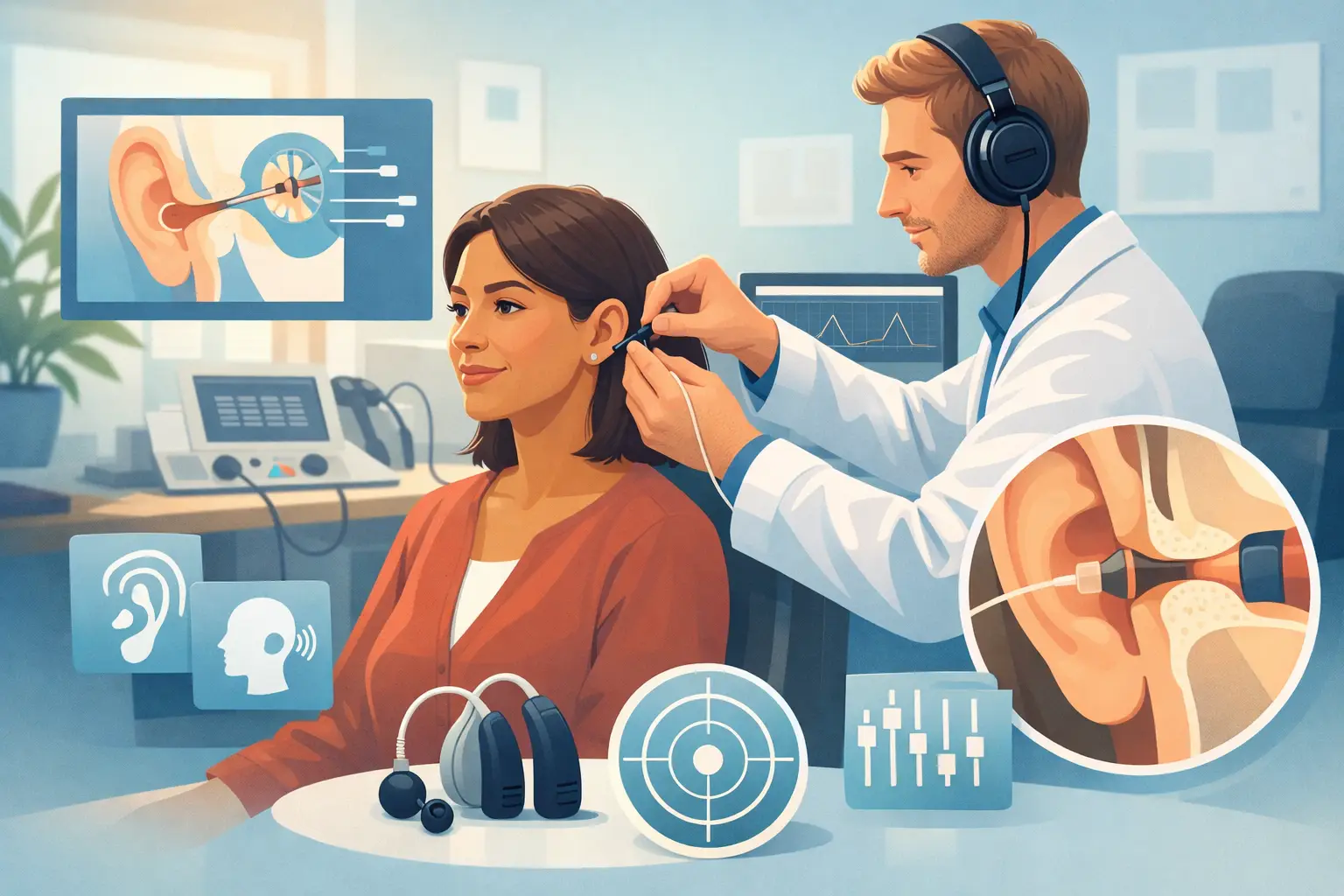
A hearing aid can be technically excellent and still perform poorly in your ear. That is the problem real ear measurement is designed to solve. When patients ask about real ear measurement benefits, the short answer is simple: it helps ensure your hearing aids are adjusted to your hearing loss, your ear shape and your real listening needs, rather than set to a generic estimate.
For anyone investing in hearing care, that difference matters. A hearing aid fitting should not be treated as a box-ticking exercise. It should be a clinical process that checks whether the sound reaching your eardrum is actually appropriate for you.
What is real ear measurement?
Real ear measurement is a clinical verification test used during hearing aid fitting. A very fine probe tube is placed gently into the ear canal alongside the hearing aid. This allows the audiologist to measure the level of sound delivered close to the eardrum while the hearing aid is in place and switched on.
That measured response is then compared with a prescription target based on your hearing test results. If the hearing aid is giving too little amplification, too much, or the wrong balance across pitches, the settings can be adjusted there and then.
Without this step, a fitting often relies on the manufacturer’s software prediction. Those predictions can be useful, but they are still estimates. Human ear canals vary in shape, size and acoustics, and those differences can change how sound behaves once the hearing aid is worn.
Why real ear measurement benefits matter
The main value of real ear measurement is precision. Hearing aids are not simply made louder until they sound acceptable. They need to deliver the right amount of amplification for soft, average and louder sounds, across different frequencies, in a way that improves audibility without creating discomfort.
That is where many people notice the gap between a basic fitting and a specialist one. A hearing aid may seem fine in a quiet consulting room, yet feel sharp, muffled or disappointing in daily life. Verification helps reduce that mismatch from the outset.
Better speech clarity
One of the clearest real ear measurement benefits is improved speech understanding. If certain speech frequencies are under-amplified, speech can remain unclear even when overall volume seems loud enough. Patients often describe this as hearing that people are talking, but not catching the words properly.
By measuring the actual sound in the ear canal, an audiologist can fine-tune the frequencies most important for speech. That does not mean every conversation suddenly becomes effortless, especially in noisy places, but it does give the hearing aid a far better chance of delivering useful speech information.
More comfortable sound levels
Too much amplification can be just as problematic as too little. A poorly verified hearing aid may make cutlery, traffic, paper rustling or your own voice feel intrusive. Some patients then wear the aids less often or turn them down, which can undermine the whole fitting.
Real ear measurement helps control this balance. It allows the audiologist to check whether soft sounds are audible, average speech is clear and louder sounds remain tolerable. Comfort is not a luxury in hearing rehabilitation. It is part of what makes consistent use possible.
A fitting tailored to your ears, not an average ear
No two ear canals are identical. Even your left and right ears may behave differently. That matters because hearing aid software cannot fully account for every anatomical difference by prediction alone.
This is one of the most overlooked real ear measurement benefits. It personalises the fitting using measured acoustics from your ears, not assumptions based on population averages. In a specialist clinic, that level of verification is part of delivering medically credible care rather than a retail-style transaction.
Real ear measurement benefits for first-time hearing aid users
If you are new to hearing aids, the first few weeks are often when confidence is won or lost. A poor initial fitting can leave you wondering whether hearing aids simply do not work for you, when the real issue is that they were not properly verified.
With real ear measurement, the starting point is usually stronger. You are more likely to hear speech as intended, less likely to be over-amplified and less likely to spend weeks adapting to settings that were never right in the first place. There is still an adjustment period, of course. Hearing rehabilitation is not instant. But a verified fitting gives that adjustment process a sound clinical foundation.
It can reduce unnecessary follow-up frustration
Follow-up appointments remain important because listening needs change once you start using hearing aids in the real world. Even so, there is a difference between fine-tuning a well-verified fitting and trying to rescue an avoidably poor one.
When verification is done at the fitting stage, follow-up care tends to be more focused. Patients can report genuine lifestyle observations rather than vague discomfort caused by inaccurate initial programming. That makes later adjustments more efficient and more meaningful.
Are the benefits the same for everyone?
Not entirely. The degree of benefit depends on several factors, including the type of hearing loss, the hearing aid style, the prescription used and the patient’s listening demands. Someone with a mild high-frequency loss may notice improvement mainly in speech crispness. Someone with a more complex loss may benefit from careful balancing of audibility and comfort.
Children, adults with significant communication demands, and anyone with previous difficulty getting on with hearing aids often have the most to gain from a properly verified fitting. For paediatric cases in particular, precision matters greatly because children are still developing speech and language skills and cannot always describe what they are missing.
There are also practical limits. Real ear measurement does not remove background noise from a busy restaurant, restore normal hearing or guarantee that every listening situation becomes easy. What it does is ensure the hearing aid is performing as accurately as possible for your ears, which is the basis for better results.
Why some providers skip it – and why that matters
Despite strong clinical support for verification, not every provider uses real ear measurement routinely. Sometimes this comes down to time, equipment, training or a more sales-led approach to hearing aid fitting.
That matters because hearing aids are often a significant financial and personal investment. If the fitting is based largely on software estimates and patient impressions alone, there is more room for inaccuracy. Patients may be told to “see how you get on” when objective verification could have identified the problem immediately.
In a premium audiology setting, hearing aid fitting should be evidence-based. That means not only selecting suitable technology, but also proving that it is delivering the prescribed output in the ear.
Real ear measurement benefits and long-term hearing aid success
The longer-term advantage is not just better sound on day one. It is better odds of ongoing use. People are more likely to wear hearing aids consistently when speech is clearer, sharpness is controlled and listening feels manageable across the day.
Consistent use supports adaptation. Your brain needs time and regular sound exposure to make the most of amplification, especially if hearing loss has been present for a while. A precise fitting helps that process because the signal reaching the ear is more appropriate from the beginning.
There is also a trust factor. Patients tend to feel more confident when they know their hearing aids have been measured and verified rather than set by approximation. That confidence can make a real difference, particularly for those who have delayed treatment or feel anxious after a disappointing previous experience.
What to ask before your hearing aid fitting
If you are considering hearing aids, it is reasonable to ask whether real ear measurement is included as part of the fitting process. You can also ask who will carry out the fitting, what verification equipment is used and how follow-up adjustments are approached.
These are not awkward questions. They are sensible ones. The quality of fitting can influence your outcome just as much as the brand or model of hearing aid.
For patients seeking specialist care in Kent and South East London, this is often one of the clearest distinctions between a medically focused audiology clinic and a more transactional provider. Expertise is not only about diagnosis. It is also about how carefully treatment is verified.
The real value of verification
The strongest of all real ear measurement benefits is simple: it replaces guesswork with evidence. In hearing care, that should be the standard, not an optional extra.
If you are ready to hear the world in better focus, choose a clinic that treats hearing aid fitting as a clinical procedure rather than a quick handover. The right technology matters, but the precision behind it is often what determines whether you truly benefit from wearing it.