
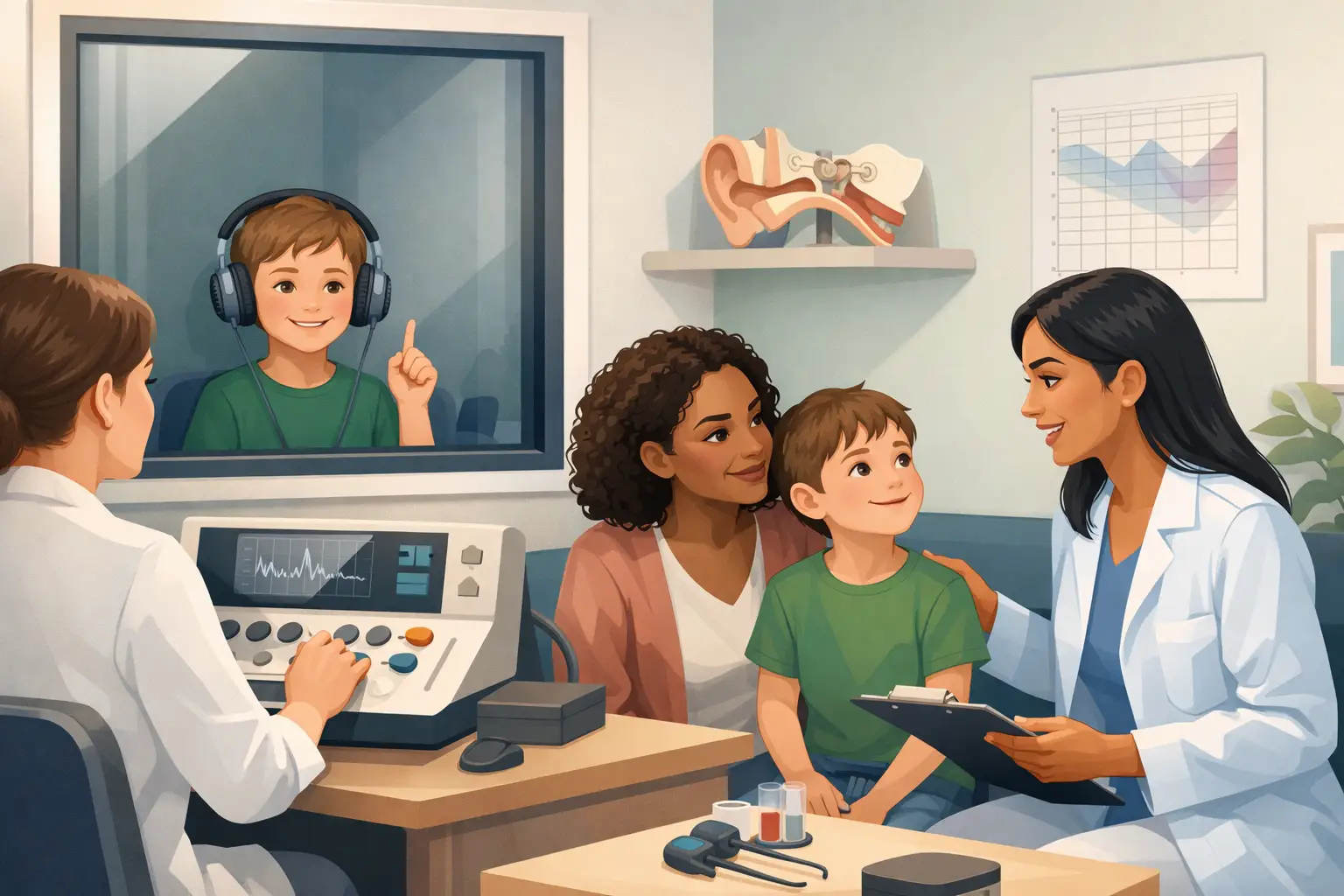
A teacher mentions that your child often misses instructions in class. At home, they keep turning the television up or asking for words to be repeated. Sometimes the signs are subtle, and sometimes they are not, but either way parents usually want the same thing – a clear answer from a qualified clinician.
A children’s hearing assessment is designed to find out how well a child is hearing, whether there is any hearing loss, and what should happen next if a problem is identified. That may sound straightforward, but in practice a good assessment is carefully adapted to the child’s age, development, attention and symptoms. For families, that matters. Accurate testing avoids guesswork and provides a sound clinical basis for treatment, monitoring or reassurance.
Why a children’s hearing assessment matters
Hearing plays a central role in speech and language development, learning, attention and social confidence. Even a mild hearing difficulty can affect how a child follows conversation, copes in background noise or keeps up at school. In younger children, temporary hearing changes linked to middle ear problems can also influence speech clarity and listening behaviour.
Not every child with listening difficulties has permanent hearing loss. Sometimes the issue is wax, congestion, glue ear, recurrent ear infections or fluctuating hearing linked to colds. In other cases, a child may hear well in quiet but struggle in busy environments. This is why specialist assessment is so valuable. The aim is not simply to say whether hearing is “normal” or “not normal”, but to understand what is happening and how it affects daily life.
Early assessment usually leads to better decisions. If a problem is found, support can begin sooner. If hearing is normal, families can move on to consider other explanations with confidence.
What happens during a children’s hearing assessment
A high-quality appointment starts before any test is performed. The audiologist will take a careful history, asking about speech development, school concerns, ear infections, family history of hearing loss, noise sensitivity and any recent illnesses. Parents are often the best source of detail here, particularly when a child’s hearing seems to change from one week to the next.
The ears are then examined. This helps identify obvious factors such as wax blockage, inflammation or anatomical features that may affect testing. From there, the assessment is tailored to the child.
Tests are chosen by age and development
Babies, toddlers, school-age children and teenagers cannot all be tested in the same way. A specialist paediatric audiologist selects methods that are reliable for that child, rather than forcing a one-size-fits-all approach.
For younger children, assessment may involve observation of responses to sound through play-based methods. These techniques are structured and clinically useful, but they depend on engagement and timing. Some children respond beautifully; others are tired, shy or distracted. That does not mean testing has failed, only that the clinician may need to adapt the approach or combine several measures.
Older children can usually complete headphone-based hearing tests that check responses across different pitches and volumes. This gives a clearer picture of hearing thresholds in each ear and is often combined with speech testing when appropriate.
Middle ear testing is often part of the picture
Many children referred for hearing concerns do not have inner ear hearing loss at all. Instead, the issue lies in the middle ear – commonly fluid behind the eardrum, pressure problems or a recent infection. Tests such as tympanometry help assess how the eardrum and middle ear system are working.
This is particularly useful when a child’s hearing seems inconsistent. They may hear well on some days and poorly on others, especially after coughs, colds or repeated ear infections. Identifying a middle ear problem can explain a great deal and helps determine whether monitoring, medical review or further investigation is needed.
Objective measures can support the assessment
In some cases, especially with very young children or when behavioural responses are limited, objective tests are used to gather more information. These do not rely on the child pressing a button or giving a verbal answer. They can be extremely valuable when confirmation is needed or when the clinical picture is more complex.
The exact test battery depends on the concern, the child’s age and how they engage during the appointment. This is one reason families often benefit from being seen in a specialist clinic rather than a general hearing centre.
Signs your child may need a hearing assessment
Some children are referred because a school screening has raised a concern. Others have no formal referral at all, but parents feel something is not right. Common reasons to arrange a children’s hearing assessment include delayed speech, unclear speech, frequent requests for repetition, difficulty hearing in noise, a history of glue ear, recurrent ear infections, poor attention linked to listening, and needing the television or tablet louder than others prefer.
There are also quieter signs. A child may seem tired after school because listening has been hard work all day. They may appear withdrawn in group settings, or they may watch faces closely because they are relying on visual cues. None of these signs proves hearing loss, but they do justify proper assessment.
What parents can expect from the results
Parents often hope for an immediate yes-or-no answer, but paediatric audiology is sometimes more nuanced than that. In many cases, the results are clear and the next step is straightforward. In others, the findings suggest monitoring, repeat testing or onward referral.
If hearing is within normal limits, that is useful information, not a dead end. It helps rule out one possible cause of speech, behaviour or learning concerns. If a hearing issue is found, the recommendation will depend on the type, degree and likely cause.
For example, temporary middle ear problems may call for review after a set period, especially if symptoms fluctuate. Persistent conductive hearing issues may need medical input. Permanent hearing loss requires a more structured plan, which could include further diagnostics, hearing technology, rehabilitation and communication support.
A specialist clinic should explain results in plain English, not simply hand over a graph. Parents need to understand what was tested, how reliable the responses were and what the findings mean for home and school.
Why specialist paediatric audiology makes a difference
Testing children well is not just about equipment. It is about judgement, technique and experience. A clinician needs to know when a response is meaningful, when fatigue is affecting performance, and when a child needs a different method altogether.
That is where specialist expertise matters. At a premium ear clinic such as Tragus-The Ear Specialists, paediatric hearing assessments are carried out with a clinical standard shaped by NHS and specialist audiology experience. For families, that means the assessment is built around diagnostic accuracy and appropriate next steps, rather than a quick screening model.
This can be especially important when a child has additional needs, a history of repeated ear disease, tinnitus symptoms, sound sensitivity or unclear previous test results. These are not situations where a rushed appointment is helpful.
Preparing your child for a hearing appointment
Parents often worry that their child will be anxious or unable to complete the test. A little preparation can help. It is usually best to describe the appointment simply and positively. Younger children do well when told they will be listening for beeps or playing listening games. Avoid presenting it as something to fear or something they can fail.
Try to book a time when your child is usually alert. If they are unwell, congested or exhausted, results may be harder to interpret. Bringing comfort items for younger children can make the experience easier, and older children often benefit from knowing that the tests are painless.
It also helps to arrive with a clear sense of the concerns you have noticed. Examples from home or school are useful because they help the audiologist link test findings to real-world listening difficulties.
When not to wait
Some situations call for prompt assessment. If a child has sudden hearing change, ongoing ear pain, ear discharge, significant balance symptoms, distressing tinnitus or a marked drop in responsiveness, it is sensible to seek advice quickly. The same applies if speech and language development seems to be stalling and hearing has not yet been properly checked.
Waiting can be tempting when symptoms come and go, but fluctuating hearing still affects development and day-to-day communication. If there is a pattern, it is worth investigating.
Parents know when something has changed, even if they cannot yet name it. A well-run children’s hearing assessment brings structure to that concern. It replaces uncertainty with evidence and helps you make the next decision with confidence. If you are questioning whether your child is hearing clearly, that question on its own is reason enough to seek expert assessment – because children do best when they can hear the world in high-definition once more.