
A child who says “what?” a little more often than usual does not always have hearing loss. They may be tired, distracted, full of cold, or simply ignoring you. But when parents start wondering when should a child have hearing checked, that question is usually coming from a real pattern they have noticed at home, at nursery, or in school.
The right answer is not “wait and see” in every case. Hearing supports speech, language, learning, behaviour and social confidence. If there is any concern, an expert assessment gives you clarity. Sometimes the result is reassuring. Sometimes it identifies a temporary issue such as glue ear or wax build-up. And sometimes it picks up a hearing difficulty early enough to make a real difference.
When should a child have hearing checked?
In clinical practice, a child should have their hearing checked whenever there are concerns about hearing, speech and language development, listening behaviour, school performance, or repeated ear problems. You do not need to wait until a problem becomes severe.
There are also routine points in a child’s early life when hearing is assessed. Most babies in the UK are offered newborn hearing screening shortly after birth. That is an important first step, but it does not rule out all future hearing problems. Some children develop hearing difficulties later, and others may have fluctuating hearing linked to middle ear conditions.
A hearing check is especially sensible if your child is not responding consistently to sound, seems to hear only when facing you, turns one ear towards the television, asks for repetition, or appears to struggle more in noisy places than in quiet ones. For older children, teachers may notice inattentiveness, misunderstanding instructions, or slower progress with phonics and classroom listening.
Signs a child may need a hearing test
The signs are not always obvious, particularly in younger children who cannot explain what they are experiencing. In babies, you may notice limited response to voices or household sounds, or a delay in babbling. In toddlers, the clues often sit around speech development, unclear words, or frustration during communication.
In school-aged children, hearing difficulties can look like something else. A child may seem dreamy, distracted, shy, or reluctant to join group conversations. They may cope quite well one-to-one but struggle in the classroom, where background noise makes listening much harder. Some children become tired or irritable because they are working harder than expected just to follow what is being said.
Ear infections also matter. If your child has repeated ear infections, recurring blocked ears, or long periods of congestion after colds, it is worth considering hearing assessment. Temporary hearing loss from middle ear fluid is common in children, but “temporary” can still last long enough to affect communication and learning.
Signs in babies and toddlers
A baby may not startle to loud sounds, may not settle at the sound of a familiar voice, or may be slower to develop early sound awareness. A toddler may not respond reliably when called, especially from another room, or may have fewer words than expected for their age.
These signs do not always mean permanent hearing loss. Development varies, and some children are simply progressing at their own pace. Even so, hearing is too important to leave to guesswork.
Signs in older children
Older children are often better at masking difficulties. They use visual cues, watch what others are doing, and fill in the gaps. That can delay recognition of a hearing problem.
Look out for turning the volume up, mishearing words, trouble following multi-step instructions, saying that people mumble, or complaining that they can hear but cannot make out what is being said. If school reports mention listening or attention concerns, hearing should be part of the picture.
Why hearing problems can be missed
Many childhood hearing issues are mild, fluctuating, or affect only one ear. That means a child may still hear enough to get by, particularly in familiar settings. Parents can understandably assume everything is fine because the child responds sometimes.
This is one reason the question of when should a child have hearing checked matters so much. Waiting for a child to clearly fail to hear is not a reliable approach. Children adapt quickly. They may also not realise that what they are hearing is different from what others hear.
There is also a common misconception that if newborn screening was passed, hearing can be taken for granted. In reality, hearing can change over time. Infections, fluid behind the eardrum, congenital factors that emerge later, and less commonly progressive conditions can all affect hearing after infancy.
What happens at a paediatric hearing assessment?
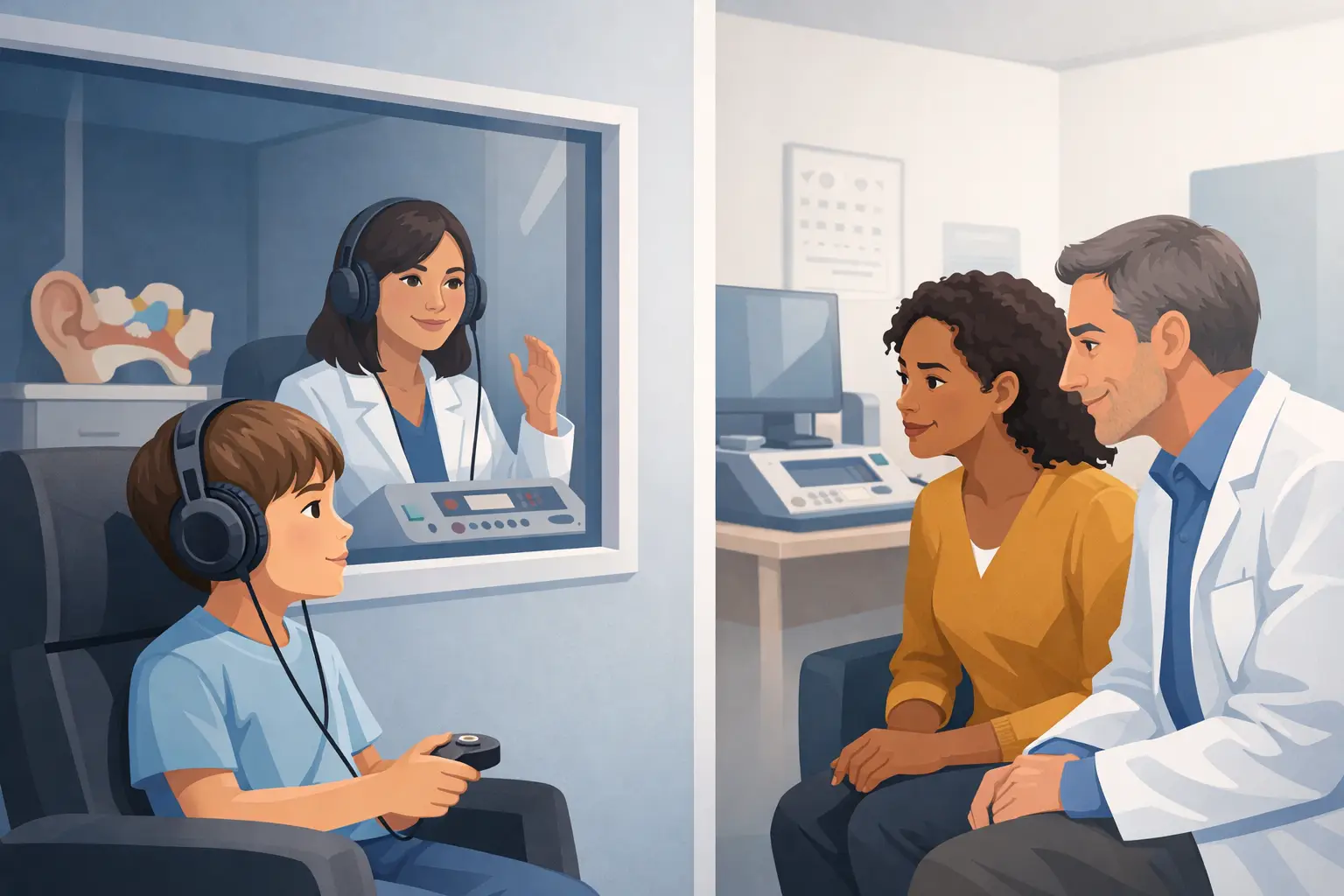
A specialist paediatric hearing assessment is designed around the child’s age, development and attention span. It is not a one-size-fits-all test. Qualified audiologists use child-friendly methods to gather accurate information without making the experience intimidating.
The appointment usually begins with a careful history. This includes speech and language development, school concerns, previous ear infections, family history, and whether symptoms are constant or intermittent. The ears may be examined, and middle ear function can be assessed to check for issues such as fluid or pressure changes.
The hearing test itself varies by age. Babies and very young children may be assessed through observation-based methods that measure how they respond to sound. Older children can usually take part in more structured tests through headphones. The aim is not simply to produce numbers on a chart, but to understand how well the child hears across different pitches and in practical listening situations.
At a specialist clinic, the real value lies in interpretation. If there is hearing loss, the next step depends on the cause, degree and pattern. If hearing is normal, that is useful too, because it allows families and clinicians to look at other explanations with confidence.
When to act sooner rather than later
Some situations call for prompt assessment rather than routine observation. One is a sudden change in hearing, especially after illness, injury, or ear pain. Another is when a child’s speech appears to stall or regress. A child who starts missing more and more of what is said at home or in school should also be seen without delay.
Unilateral symptoms matter as well. If your child seems to hear worse on one side, consistently turns the same ear towards you, or localises sound poorly, this should be checked. Hearing loss in one ear can still affect learning, listening in noise and spatial awareness.
If there is tinnitus, sound sensitivity, dizziness, ongoing ear discharge, or persistent discomfort, specialist review is sensible. These symptoms do not always point to a serious problem, but they deserve proper assessment by clinicians who work with children regularly.
Does it ever make sense to wait?
Sometimes, yes – but only with a clear reason and a sensible timescale. If a child has a heavy cold, recent ear infection, or short-lived congestion, hearing can dip temporarily. In those cases, a clinician may advise review after the acute illness settles.
What is less helpful is open-ended waiting. If concerns continue for more than a few weeks, if school has raised questions, or if the pattern keeps returning, assessment is the better option. Parents know when something feels slightly off. That instinct should not be dismissed.
The value of specialist paediatric audiology
Children are not simply small adults, and hearing assessment should reflect that. A specialist paediatric service brings the right equipment, testing methods and clinical judgement to interpret subtle signs properly. That matters when symptoms are inconsistent, when a child is very young, or when the issue may involve both hearing and middle ear health.
For families seeking private care in Kent and south east London, a premium ear clinic can also offer faster access to expert assessment, which may reduce weeks or months of uncertainty. At Tragus-The Ear Specialists, paediatric hearing assessments are built around clinically rigorous testing and clear explanations, so parents leave knowing what has been found and what should happen next.
If you are unsure, clarity is worth it
Parents are often told not to worry, and sometimes that reassurance is correct. But reassurance is most useful when it comes after proper assessment, not before it. Hearing affects far more than the ears. It shapes communication, confidence, education and day-to-day ease.
If you have found yourself asking when should a child have hearing checked, that is usually the moment to consider booking one. A careful assessment may show that everything is normal. If it does not, early action gives your child the best chance to hear the world in high-definition once more.