
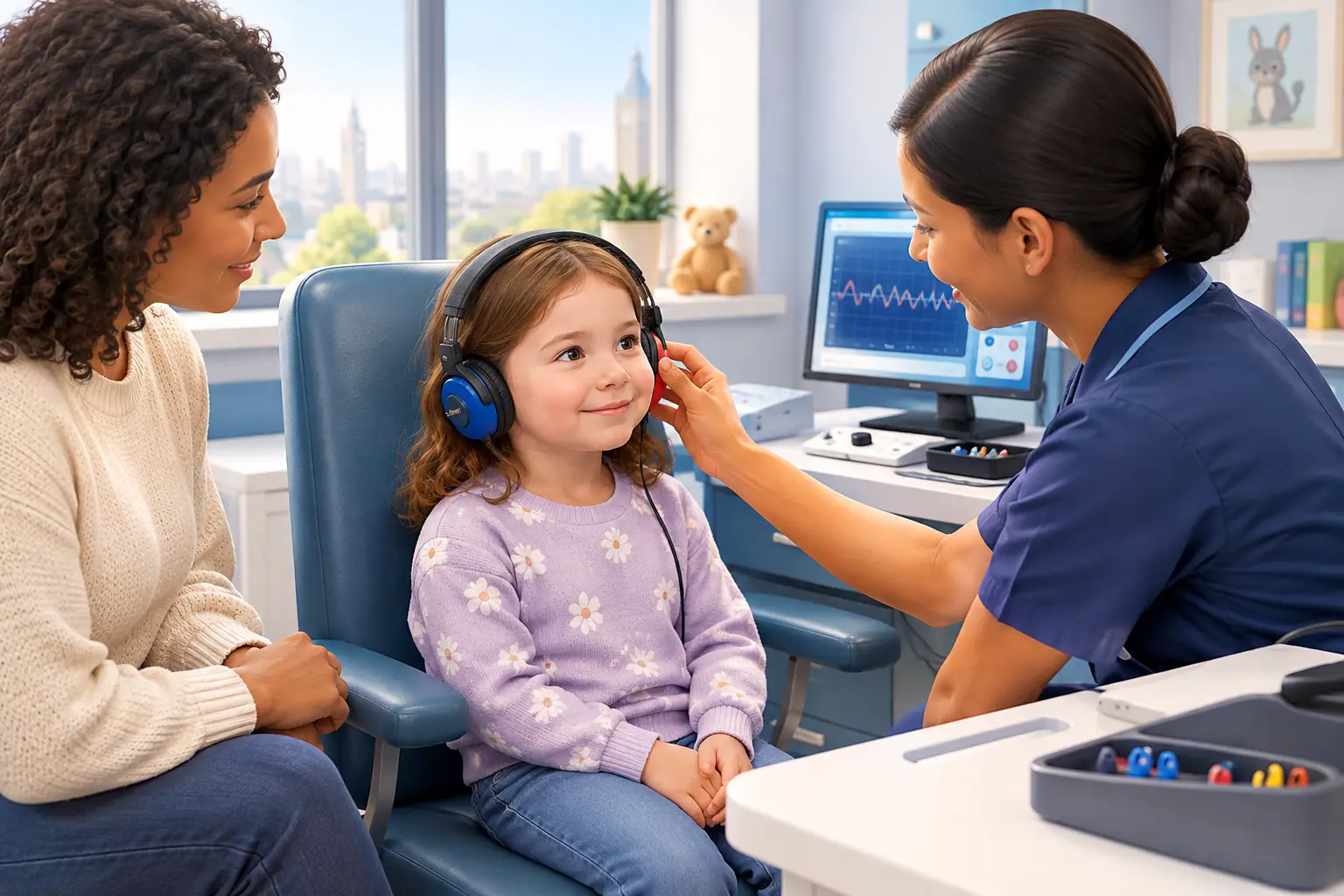
A child does not need to be unable to hear before hearing concerns begin to affect them. Difficulty following classroom instructions, asking for repetition, turning one ear towards a speaker or seeming tired after nursery can all matter. Current paediatric audiology trends are placing greater emphasis on recognising these quieter signs early, then giving families a clear, clinically sound route to assessment and support.
For parents, the most useful change is not simply newer technology. It is a more complete view of hearing: how a child hears speech in noise, how their ears are functioning today, and whether hearing is affecting communication, learning, confidence or behaviour.
Paediatric audiology trends: earlier, more precise care
Newborn hearing screening remains an important starting point in the UK, but it is not a lifetime guarantee of normal hearing. Some children develop hearing changes later because of recurrent middle-ear problems, infections, genetic factors, certain medicines, illness or noise exposure. Others may have passed a screening yet experience difficulties that only become apparent as listening demands increase.
This is why clinicians are increasingly focused on hearing surveillance beyond infancy. A child who struggles in a busy reception class may need a different assessment from a baby who has not responded consistently to sound at home. The aim is not to label every listening difficulty as hearing loss. It is to investigate properly, rule out treatable causes and avoid leaving a child to compensate alone.
Earlier assessment can be particularly valuable when speech and language development is delayed, school staff have raised concerns, or there is a family history of childhood hearing loss. It can also bring reassurance where hearing is found to be within expected limits.
Testing is becoming more child-centred
A high-quality paediatric hearing assessment is tailored to the child’s age, development and ability to engage. Very young children may be assessed through visual reinforcement audiometry, where they learn to respond to sounds with an engaging visual reward. Older children may take part in play audiometry, turning a test into a simple game, before progressing to conventional hearing tests.
Objective tests also play a central role. Tympanometry assesses how the middle ear is functioning and can identify patterns associated with fluid behind the eardrum. Otoacoustic emissions can provide information about inner-ear function. In some circumstances, more specialist electrophysiological testing may be appropriate.
The trend is towards combining these findings rather than relying on one result in isolation. A hearing threshold alone does not always explain how a child manages in a noisy classroom, nor does a normal-looking ear necessarily rule out a genuine listening concern. Qualified audiologists interpret results alongside history, symptoms and day-to-day impact.
Greater attention to glue ear and fluctuating hearing
Glue ear is one of the most common reasons for fluctuating hearing in childhood. It occurs when fluid builds up in the middle ear, often after coughs, colds or ear infections. The hearing effect may be mild or temporary, but a child can still find speech less clear, especially when there is background noise.
One of the most helpful paediatric audiology trends is a move away from assuming that all middle-ear fluid has the same impact. For one child, a short period of reduced hearing may cause little disruption. For another, particularly a child with speech, language, learning or developmental needs, it may add a significant barrier.
Management depends on the duration of symptoms, hearing test results, ear health and functional impact. Monitoring may be appropriate, while some children need referral for medical review or additional support. Parents should be wary of quick fixes or attempts to remove earwax at home when the problem may be behind the eardrum. A proper assessment distinguishes wax blockage, middle-ear fluid and other causes of reduced hearing.
Hearing technology is smaller, smarter and better connected
For children with permanent hearing loss, hearing aids continue to develop in ways that support real life rather than quiet test conditions alone. Modern paediatric devices can offer improved management of background noise, directional microphone systems and wireless connectivity with compatible classroom equipment.
However, technology is only as effective as the assessment, fitting and follow-up behind it. Children’s ear canals grow, listening needs change, and settings must be verified carefully. Real-ear measurement, where appropriate, helps clinicians check that the hearing aid is delivering the intended sound safely and accurately in the child’s own ear.
Remote microphones are receiving increasing attention in educational settings. A teacher wears a small microphone and the child receives the voice directly through their hearing technology, reducing the effect of distance and classroom noise. This can be highly beneficial, but it is not a replacement for good classroom acoustics, seating, clear communication and support from the school.
Families are also asking more questions about headphones, streaming and recreational noise. This is sensible. Hearing protection should be proportionate: children do not need to live in silence, but they should avoid sustained loud sound. Custom earplugs may be useful for particular activities, including swimming where recommended, music or specific noise exposure, following individual clinical advice.
School support is part of hearing care
A paediatric hearing assessment should not end with a graph of test results. The practical question is what those results mean at home, in nursery and at school. Children may hear well in a quiet clinic room yet struggle when several people are talking, instructions are given from across the room or the teacher faces a whiteboard.
When hearing concerns are identified, clear communication between parents, clinicians and education professionals can prevent small difficulties from becoming persistent frustrations. Depending on the child’s needs, helpful adjustments may include sitting closer to the main speaker, gaining the child’s attention before speaking, reducing avoidable background noise and checking understanding without putting the child on the spot.
Hearing loss is not always obvious from behaviour. Some children become quiet and withdrawn; others appear inattentive, frustrated or overly energetic. These behaviours have many possible explanations, so hearing should be considered as part of a wider picture rather than used as a catch-all answer.
Families are being treated as active partners
The strongest clinical shift is towards family-centred care. Parents know their child’s normal responses, routines and communication style. Their observations can be crucial, particularly where a child is too young to describe a hearing change or cannot complete a conventional test.
It also means providing explanations that are useful beyond the appointment. Families should understand what was tested, what the findings do and do not show, whether follow-up is needed, and what signs should prompt an earlier review. A technical diagnosis without this context rarely reduces anxiety.
At Tragus-The Ear Specialists, paediatric care is approached with this combination of clinical precision and practical reassurance. An expert assessment can clarify whether a child’s difficulties relate to hearing, middle-ear function or another issue requiring onward support.
When should you arrange a hearing assessment?
Consider a specialist paediatric hearing assessment if your child frequently asks for repetition, does not respond reliably when called, turns the television up, has repeated ear infections, finds group settings difficult, or if a teacher has noticed listening concerns. Sudden hearing change, ear pain, discharge, dizziness or a marked change in responsiveness should be assessed promptly through the appropriate clinical route.
There is no benefit in waiting for a child to fall behind before asking questions. Equally, an assessment is not a prediction that something serious will be found. It is a practical way to replace uncertainty with evidence and give your child the best opportunity to hear, communicate and participate with confidence.