
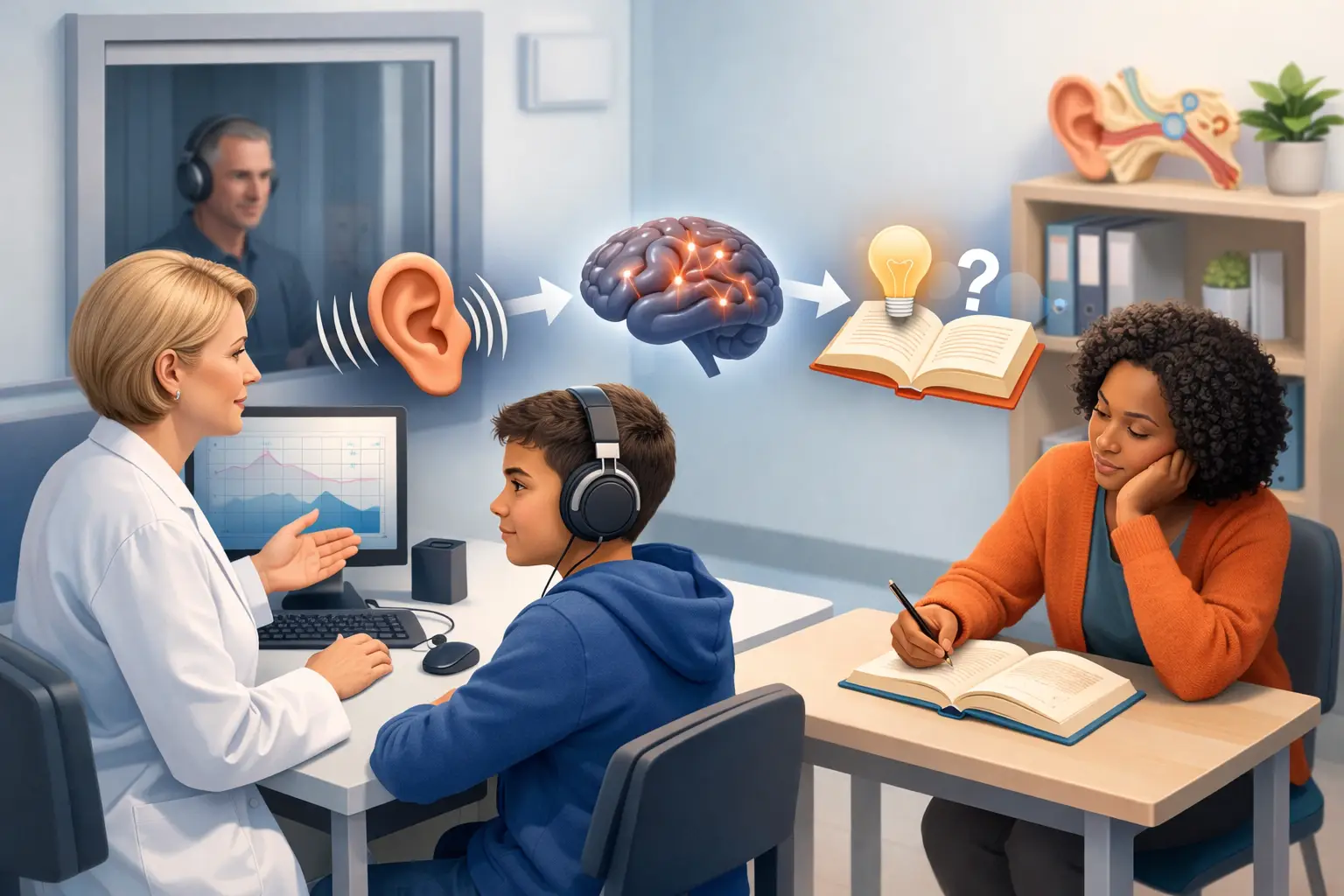
A child who appears to ignore instructions, loses their place in class or comes home exhausted after school may not be inattentive or struggling academically. They may be working exceptionally hard to hear. Hearing loss and learning are closely connected because spoken information underpins so much of education, from early language development to classroom discussion, lectures and workplace training.
The effect is not always obvious. Many people with hearing difficulty hear well in quiet one-to-one conversations, yet miss key words when there is background noise, distance, fast speech or several people talking. An expert hearing assessment can identify whether hearing is contributing to these challenges and provide a clear, personalised route forward.
Why hearing loss and learning are so closely linked
Learning relies on more than simply detecting sound. The brain must receive clear enough speech to distinguish similar words, follow sentence structure, interpret tone and retain information while the next instruction is being given. If parts of speech are unclear, the listener is continually filling in gaps. That effort uses attention and working memory that would otherwise be available for learning.
For children, this can affect the building blocks of literacy and communication. They may mishear sounds within words, find phonics harder, use less precise vocabulary or struggle to follow group discussion. A child may be bright, engaged and eager to learn, while still missing enough detail to fall behind in particular situations.
For teenagers and adults, the pattern can look different. Someone may understand the subject matter but find meetings, university seminars, professional exams or training sessions disproportionately tiring. They might avoid asking for clarification, withdraw from discussion or leave with an incomplete understanding of what was agreed. This is not a lack of ability. It is the cognitive cost of listening under difficult acoustic conditions.
Signs that hearing may be affecting learning
Hearing loss does not always present as a request to turn up the television. In a classroom or workplace, the clues are often more subtle. A person may watch faces closely, favour one ear, ask for repetition, answer a question inaccurately, or seem to lose concentration in busy rooms. Children may sit very near the teacher, copy others before starting a task or report that school is “too loud”.
Listening fatigue is another meaningful sign. By the end of the day, a child may be irritable, tired or reluctant to talk about school. An adult may cope through meetings but have little energy left for conversation at home. Fatigue alone does not diagnose hearing loss, but it deserves attention when it sits alongside communication difficulties.
Speech and language delay, changes in academic progress, recurrent ear infections, tinnitus, ear fullness and sensitivity to sound can also justify a specialist assessment. Equally, a child who seems distracted should not be assumed to have a behavioural or attention difficulty before their hearing has been properly checked. More than one factor can be present, so a careful assessment helps avoid simplistic explanations.
Fluctuating hearing can be particularly disruptive
Not all hearing loss is permanent or constant. In children, fluid behind the eardrum, often called glue ear, can cause temporary or fluctuating conductive hearing loss. One week a child may appear to hear well; the next, they may struggle in noise or at a distance. This inconsistency can be confusing for families and teachers, and may lead others to believe the child is choosing not to listen.
Earwax blockage, infection and changes in middle-ear pressure can also reduce hearing temporarily. These causes need the right clinical assessment rather than guesswork. Removing wax may be helpful where it is genuinely blocking the ear canal, but it will not address difficulties caused by the inner ear, auditory processing or another medical issue.
The classroom is often the hardest place to hear
Classrooms are rarely quiet. Chairs move, pupils talk, ventilation systems hum and speech may come from across the room. Even mild hearing loss can have a greater effect in this setting than at home. The same applies to lecture theatres, open-plan offices and training rooms.
Distance matters too. Sound becomes less clear as a speaker moves away, while background noise remains. When a teacher turns to write on a board or speaks while walking around the room, visual cues are reduced. Children and adults with hearing difficulty may catch the main point but miss the short connecting words that make instructions precise.
Good support is therefore not only about volume. A louder classroom can also be an uncomfortable or distorted classroom. Better outcomes often come from clearer speech, reduced competing noise, a favourable seating position and confirmation that the listener has understood the task.
What an expert hearing assessment should establish
A proper assessment goes beyond a quick screening check. It should explore the concerns of the individual or family, relevant medical and listening history, ear health and the situations where communication breaks down. Depending on age and clinical need, testing may assess hearing thresholds, middle-ear function and the ability to understand speech.
Paediatric assessment needs particular care. Children do not always describe their experience accurately, and test methods must suit their developmental stage. Qualified audiologists can use age-appropriate techniques and explain results in practical terms: what the hearing profile may mean at home, in nursery, at school or in social settings.
The result may show normal hearing, a temporary conductive issue, permanent hearing loss or a need for further medical investigation. Normal test results can still be useful. They allow the clinician and family to consider other reasons for listening or learning difficulties, rather than leaving concerns unanswered.
At Tragus-The Ear Specialists, assessments are delivered by qualified clinicians with specialist audiology experience. The aim is not simply to produce an audiogram, but to understand how a person hears in the situations that matter to them.
Support that makes learning more accessible
The right plan depends on the type, degree and pattern of hearing difficulty. Some people need medical referral or treatment for an ear condition. Others may benefit from hearing aids, which can improve access to speech when professionally selected, fitted and reviewed. Hearing aids are not an instant cure for every listening environment, but carefully managed hearing rehabilitation can reduce listening effort and improve confidence.
For a child, collaboration matters. Parents, teachers, special educational needs staff and clinicians each see different parts of the picture. With consent and appropriate guidance, the school can make practical adjustments that help the child access teaching without being singled out.
Useful adjustments often include sitting where the speaker’s face is visible, reducing unnecessary background noise, providing written instructions alongside spoken ones and checking understanding privately rather than repeatedly asking, “Can you hear me?” Teachers can gain attention before speaking, use clear natural speech and avoid giving key information while facing away from the class. For older students and adults, meeting notes, captions and advance access to materials can be equally valuable.
These measures are not a substitute for assessment or treatment when hearing loss is present. They are part of a wider approach that recognises the reality of listening in busy environments.
Hearing, confidence and wellbeing
The educational effect of hearing loss is not confined to grades. Communication is central to friendships, participation and self-esteem. A child who repeatedly mishears jokes or group instructions may become quieter, anxious or labelled as shy. An adult may stop contributing in meetings because the risk of misunderstanding feels too high.
Sensitive support changes that experience. The goal is not to make someone “try harder” to listen. It is to reduce unnecessary barriers so that their ability, personality and knowledge can be heard properly.
If learning, concentration or confidence has changed alongside hearing concerns, arrange an expert hearing assessment rather than waiting for the problem to become entrenched. Clearer hearing can bring back more than sound: it can restore participation, ease and the confidence to raise a hand, join the conversation and keep learning.