
A child can seem to hear perfectly in a quiet room yet miss key parts of a teacher’s instructions, muddle similar-sounding words or become exhausted by busy social settings. So, do children need hearing tests? Not every child needs frequent testing without a reason, but a specialist assessment is the right next step whenever hearing, speech, learning or listening confidence raises a concern.
Hearing supports far more than responding when their name is called. It helps children develop clear speech, build vocabulary, follow conversation, learn phonics and feel included with friends. Identifying a difficulty early does not mean assuming the worst. It gives parents clear answers and, where needed, a plan to support their child’s hearing and wellbeing.
Do children need hearing tests after newborn screening?
Most babies in the UK are offered a newborn hearing screen shortly after birth. This is valuable, but it is not a lifetime guarantee that hearing will remain unchanged. Some forms of hearing loss are delayed in onset, progress over time or develop after illness, injury or repeated ear infections.
A child may also pass a newborn screen but later experience temporary conductive hearing loss. This often happens when fluid collects behind the eardrum, commonly called glue ear. The fluid can reduce the clarity and volume of sound reaching the inner ear, even when there is no obvious ear pain or fever.
For this reason, children should have their hearing assessed when concerns arise, rather than relying solely on an earlier screening result. A parent’s instinct matters, particularly when they notice a consistent change in how their child listens or communicates.
Signs your child may benefit from a hearing assessment
Children do not always say that they cannot hear. Younger children may not have the language to explain the problem, while older children can adapt by watching faces, copying classmates or avoiding situations where listening feels difficult. These strategies can mask a hearing issue for some time.
Look for patterns rather than one isolated moment. A child who does not respond while absorbed in play may simply be concentrating. However, it is sensible to arrange an expert assessment if they regularly ask for repetition, turn the television up, seem to hear better on one side, or struggle to follow speech in background noise.
Speech and language changes can be another clue. This may include unclear pronunciation, slower-than-expected language development or difficulty distinguishing similar sounds. At school, a child may appear distracted, lose track of multi-step instructions, sit very close to the teacher or return home unusually tired after a day of concentrated listening.
Behaviour can be misread too. Frustration, withdrawal, reduced confidence or apparent inattention can sometimes reflect the effort required to hear clearly. Hearing is not the explanation for every learning or behavioural concern, but it should be considered and assessed rather than guessed at.
Situations that warrant prompt advice
Contact a qualified audiologist or your GP promptly if your child develops a sudden change in hearing, persistent ear pain, ear discharge, dizziness, troubling tinnitus, or hearing difficulties after a head injury. Sudden hearing loss needs urgent medical attention.
Repeated ear infections, a family history of childhood hearing loss, neonatal intensive care treatment, certain infections during pregnancy and some medicines can also increase the value of ongoing hearing monitoring. Your clinician can advise on the appropriate timetable for your child.
What can affect a child’s hearing?
The cause matters because the right support depends on where the difficulty occurs and whether it is temporary or permanent. A professional hearing assessment is designed to distinguish between common possibilities.
Wax can occasionally block the ear canal, although it should never be removed with cotton buds or home instruments. Ear infections and glue ear are particularly common in younger children and may fluctuate, meaning a child can hear better on some days than others. In many cases, glue ear resolves without intervention, but persistent fluid or a meaningful impact on communication and education deserves careful review.
Sensorineural hearing loss affects the inner ear or hearing nerve. It may be present from birth, hereditary, associated with illness, or occur for other reasons. Some children have hearing that is normal in quiet but find speech in noise disproportionately difficult. Others may have a hearing loss in one ear only, which can still affect sound localisation, classroom listening and confidence in group situations.
The aim is not to label a child prematurely. It is to understand what they are hearing, what may be contributing to the difficulty and what support will make daily life easier.
What happens in a paediatric hearing assessment?
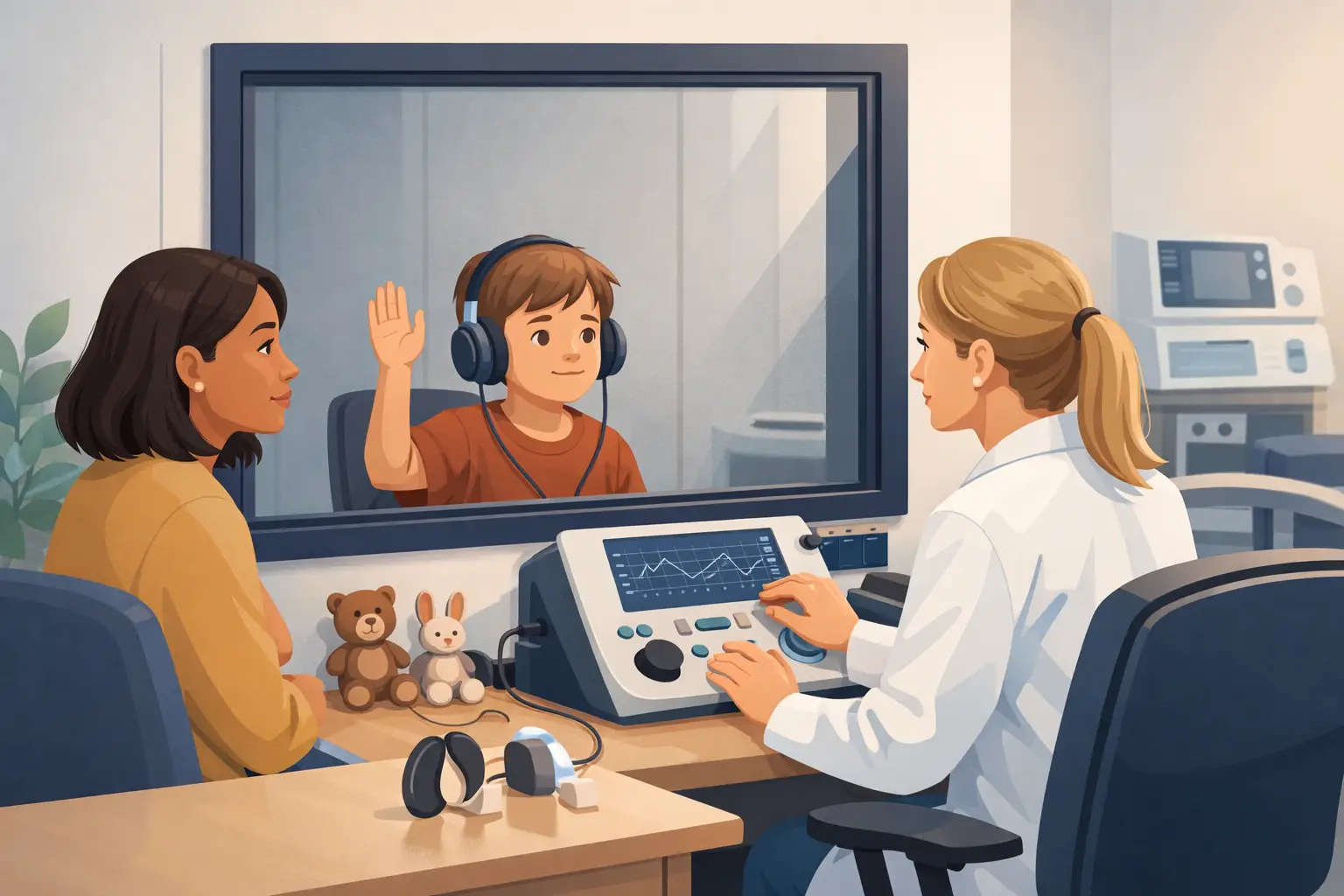
A paediatric hearing assessment should be adapted to a child’s age, development and ability to engage. It is not simply an adult test delivered in a smaller chair. Experienced clinicians use age-appropriate techniques and make time for the child to settle, play and respond naturally.
The appointment usually begins with a detailed history. Parents may be asked about pregnancy and birth, ear infections, speech and language development, school feedback, family hearing history and the situations in which listening is hardest. The clinician will examine the outer ear and eardrum, where appropriate, to look for wax, infection, fluid or other visible concerns.
Testing may involve headphones, small inserts in the ears, play-based responses or visual rewards for younger children. Middle-ear measurements can help assess eardrum movement and detect signs consistent with fluid behind the eardrum. Depending on age and the clinical question, further specialist testing may be recommended.
A good assessment does more than produce a graph. It explains the result in plain language: whether hearing is within expected limits, whether there is evidence of a middle-ear problem, whether one ear differs from the other, and what should happen next. If hearing loss is identified, the clinician should discuss appropriate medical referral, monitoring, classroom strategies, hearing technology or rehabilitation support.
When is the right time to book?
The best time is when a concern becomes consistent enough to affect everyday life. Parents do not need to wait until a child is failing at school, falling behind with speech or visibly distressed. Early assessment often provides reassurance, and reassurance is useful when it is based on a thorough clinical evaluation.
Equally, there is a balance to strike. A recent cold can temporarily affect the middle ear, and some listening changes resolve as the child recovers. If symptoms are mild and clearly linked to a short-lived illness, monitoring for a brief period may be reasonable. But if concerns persist beyond the illness, recur repeatedly or affect communication, a hearing assessment is preferable to continued uncertainty.
Teachers and nursery staff can provide helpful observations because they see children in group listening environments. Share what they have noticed, but do not assume that a child who appears to cope in class has no hearing difficulty. Many children work hard to compensate, especially when they are bright, observant or reluctant to stand out.
Supporting your child before and after testing
While waiting for an appointment, make listening easier without making your child feel singled out. Get their attention before speaking, face them when giving instructions, reduce competing noise where possible and break longer requests into shorter steps. At school, a position close to the teacher and away from noisy equipment can help, particularly if hearing is fluctuating.
Avoid telling a child they are “not listening” when you are unsure whether they have heard. A calmer approach is to check understanding and repeat information clearly. This protects confidence while you seek answers.
At Tragus-The Ear Specialists, paediatric hearing assessments are delivered by qualified audiologists who understand that children need both clinical accuracy and a calm, reassuring approach. Families across Kent can access expert assessment when listening, speech, school or recurrent ear concerns need clearer answers.
A child should not have to work harder than everyone else simply to follow a conversation. If you have noticed a change, arranging an assessment can replace uncertainty with practical, compassionate support at the point it can make the greatest difference.