
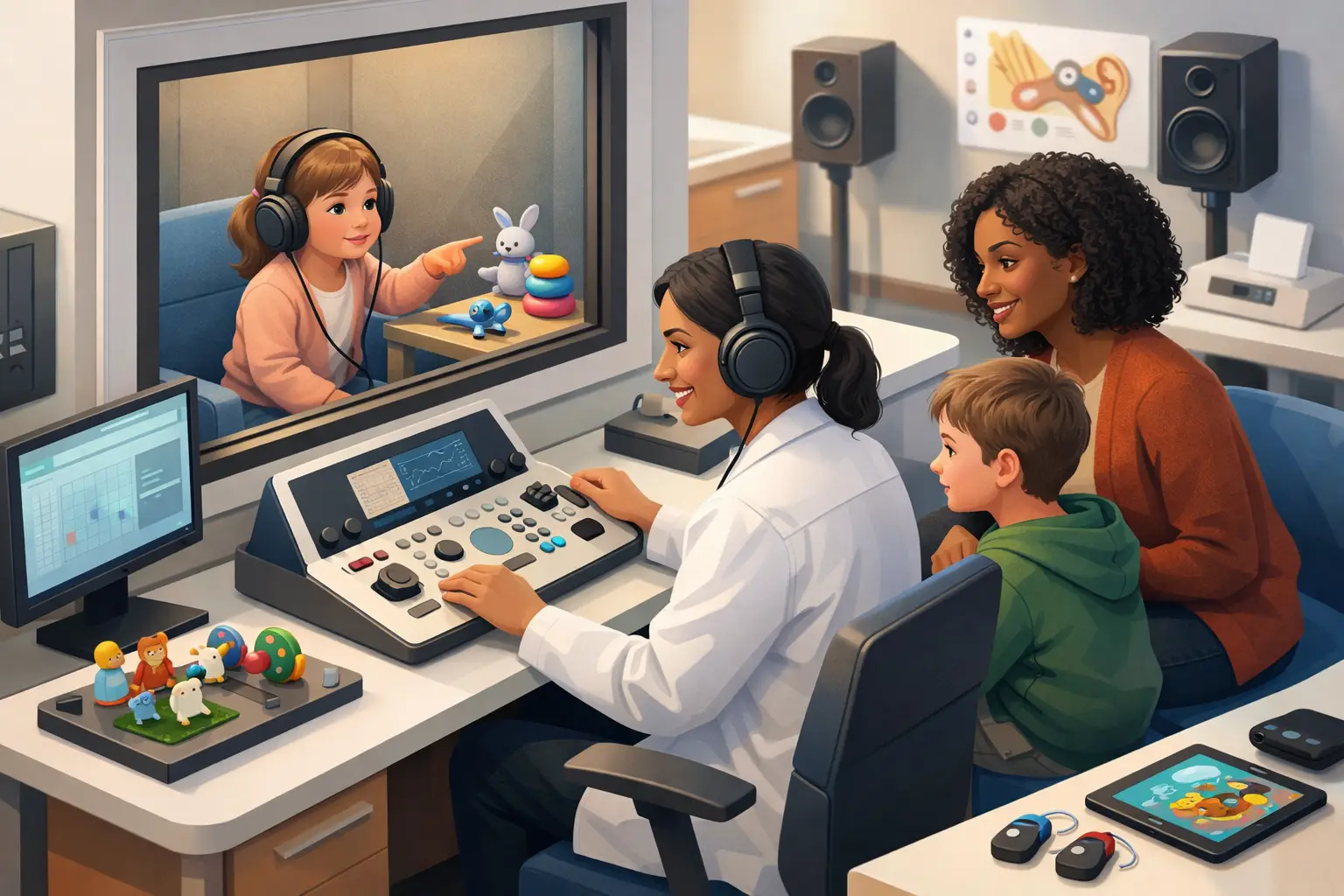
A child may hear some sounds perfectly well yet miss parts of speech in a busy classroom, ask for repetition at home, or seem distracted when the real issue is listening effort. The best hearing tests for children are not a single test chosen from a menu. They are age-appropriate assessments selected by a qualified audiologist to establish how well a child hears, how their middle ear is functioning, and whether hearing could be affecting communication, learning or confidence.
A good paediatric assessment should feel calm and engaging, not intimidating. It should also produce reliable clinical information that leads to clear next steps, whether that means reassurance, monitoring, medical referral or a personalised hearing plan.
Why children need a different approach to hearing tests
Children are not simply smaller adults. Their attention, language development, ability to follow instructions and willingness to participate all change rapidly with age. A test that gives excellent results for a ten-year-old may not be suitable for a toddler, while a newborn requires objective measurements that do not rely on a response at all.
Children can also compensate remarkably well. They may watch faces closely, copy classmates or appear to hear adequately in quiet settings. This can mask mild hearing loss, fluctuating hearing caused by middle-ear fluid, or difficulty understanding speech against background noise. An expert assessment looks beyond whether a child reacts to sound and considers how hearing is working in everyday life.
The best hearing tests for children by age and need
The most suitable testing method depends on the child’s developmental stage and the clinical question. Audiologists often combine several tests, because each one examines a different part of the hearing system.
Newborn hearing screening and objective testing
Most babies in the UK are offered newborn hearing screening shortly after birth. This is an important first check, but it does not replace further assessment if parents, health visitors or nursery staff later have concerns.
For babies and children who cannot reliably respond to sounds, audiologists may use otoacoustic emissions, usually called OAEs. A small soft probe is placed at the entrance to the ear and measures a sound produced by healthy inner-ear hair cells. OAEs are quick, painless and particularly useful for screening cochlear function. However, wax, fluid or noise can affect the result, so an absent response does not by itself diagnose permanent hearing loss.
Auditory brainstem response testing, or ABR, measures how the hearing nerve and brainstem respond to sound. Small sensors are placed on the skin while sounds are presented through earphones. This test is especially valuable for very young babies, children with complex needs, or when a more detailed objective estimate of hearing levels is required. A child must be very still or asleep, which can mean careful appointment planning and, in some cases, testing in a specialist hospital setting.
Visual reinforcement audiometry for babies and toddlers
Visual reinforcement audiometry, often known as VRA, is commonly used from around six months to two and a half years, although developmental ability matters more than a strict age cut-off. The child is taught that turning towards a sound is rewarded with an interesting visual display, such as an illuminated toy or animation.
This is a behavioural test, meaning it measures the child’s response to sound rather than only the ear’s physical function. It can provide useful information about the quietest sounds a child hears across key frequencies. The quality of the results depends on the child being settled, alert and interested, so an experienced paediatric audiologist will work at the child’s pace.
Play audiometry for pre-school children
From roughly two and a half to five years, many children can take part in play audiometry. The audiologist turns listening into a simple game, perhaps asking the child to place a block in a bucket or complete a puzzle every time they hear a sound.
Play audiometry is one of the most effective ways to measure hearing thresholds in young children because it gives frequency-specific results while keeping the experience positive. Earphones may be used to test each ear separately, which matters because a child can appear to hear well overall when one ear is weaker than the other.
Pure tone and speech audiometry for school-age children
Older children can usually complete pure tone audiometry, the familiar test involving a button press or raised hand when a tone is heard. It establishes the softest sounds heard at different pitches and can identify the pattern and degree of hearing loss.
Speech testing often adds essential real-world context. A child may hear tones within a normal range yet struggle to understand spoken words, particularly when there is competing noise. Age-appropriate speech audiometry assesses how clearly words are heard and recognised. Where classroom listening is a concern, the audiologist may discuss the impact of noise, distance from the teacher and listening fatigue even if routine hearing thresholds are reassuring.
Tympanometry and middle-ear assessment
Tympanometry does not measure hearing directly. Instead, it checks how well the eardrum and middle ear are moving by gently changing air pressure in the ear canal. It is a valuable part of a paediatric hearing assessment because glue ear, pressure problems and ear infections can cause temporary or fluctuating hearing loss.
The test takes only a few seconds per ear and should not hurt, although some young children dislike the feeling of the probe. Tympanometry can help explain why a child’s hearing seems variable, why they have recently become louder, or why they are struggling following repeated colds and ear infections.
When should a child have a hearing assessment?
Parents know their child best, and concerns deserve proper investigation rather than a wait-and-see response when they persist. A specialist hearing assessment is sensible if a child frequently asks for repetition, turns one ear towards the television, speaks unusually loudly, has delayed or unclear speech, or appears not to listen.
Teachers may notice different signs: difficulty following group instructions, reduced concentration, falling behind with phonics, or seeming withdrawn in noisy lessons. Recurrent ear infections, a family history of childhood hearing loss, tinnitus, sensitivity to everyday sounds and a failed school or GP screening check are also good reasons to arrange assessment.
Not every concern indicates hearing loss. Attention, language processing, developmental differences and classroom acoustics can all play a part. That is precisely why a comprehensive assessment is useful: it replaces assumptions with evidence and helps families decide what support, if any, is needed.
What a quality paediatric assessment should include
A high-standard appointment begins with a detailed history. The audiologist should ask about pregnancy and birth history where relevant, early development, ear infections, medications, family hearing history, speech and language, school feedback and the situations in which the child seems to struggle.
They should examine the outer ear and ear canal before testing. Earwax, inflammation or a foreign body can affect hearing and may need to be addressed before accurate results are possible. Tests should then be selected to suit the child, with breaks or a second appointment arranged if fatigue, anxiety or limited cooperation makes results uncertain.
The outcome should be explained in straightforward terms. Parents should understand whether hearing is within expected limits, whether there is evidence of middle-ear dysfunction, whether results need repeating, and whether an onward referral to ENT, paediatrics, speech and language therapy or educational support is appropriate. Clinical reassurance is valuable, but so is a plan when something needs attention.
How to prepare your child without making it a big event
Tell your child they are visiting someone who will play listening games and check how their ears are working. Avoid saying that the test will not hurt repeatedly, as this can create worry where none existed. For older children, explain that they may wear headphones, listen for very quiet sounds and answer when they hear them.
Bring glasses, hearing devices or relevant medical information if applicable, and aim for a time when your child is usually rested and fed. A favourite comfort item can help younger children settle. If your child has autism, sensory sensitivities, anxiety or communication needs, mention this when booking so the appointment can be approached thoughtfully.
Choosing specialist care for your child
The best hearing test is only as useful as the interpretation behind it. Paediatric audiology requires technical skill, patience and a clear understanding of how hearing affects a child’s development. At Tragus-The Ear Specialists, qualified audiologists can tailor assessments for children and give families a clinically clear route forward.
If a child’s hearing is affecting their voice, friendships, school day or confidence, early expert assessment can remove a great deal of uncertainty. A calm appointment and an accurate answer may be the first step towards helping them hear, participate and thrive with greater ease.