
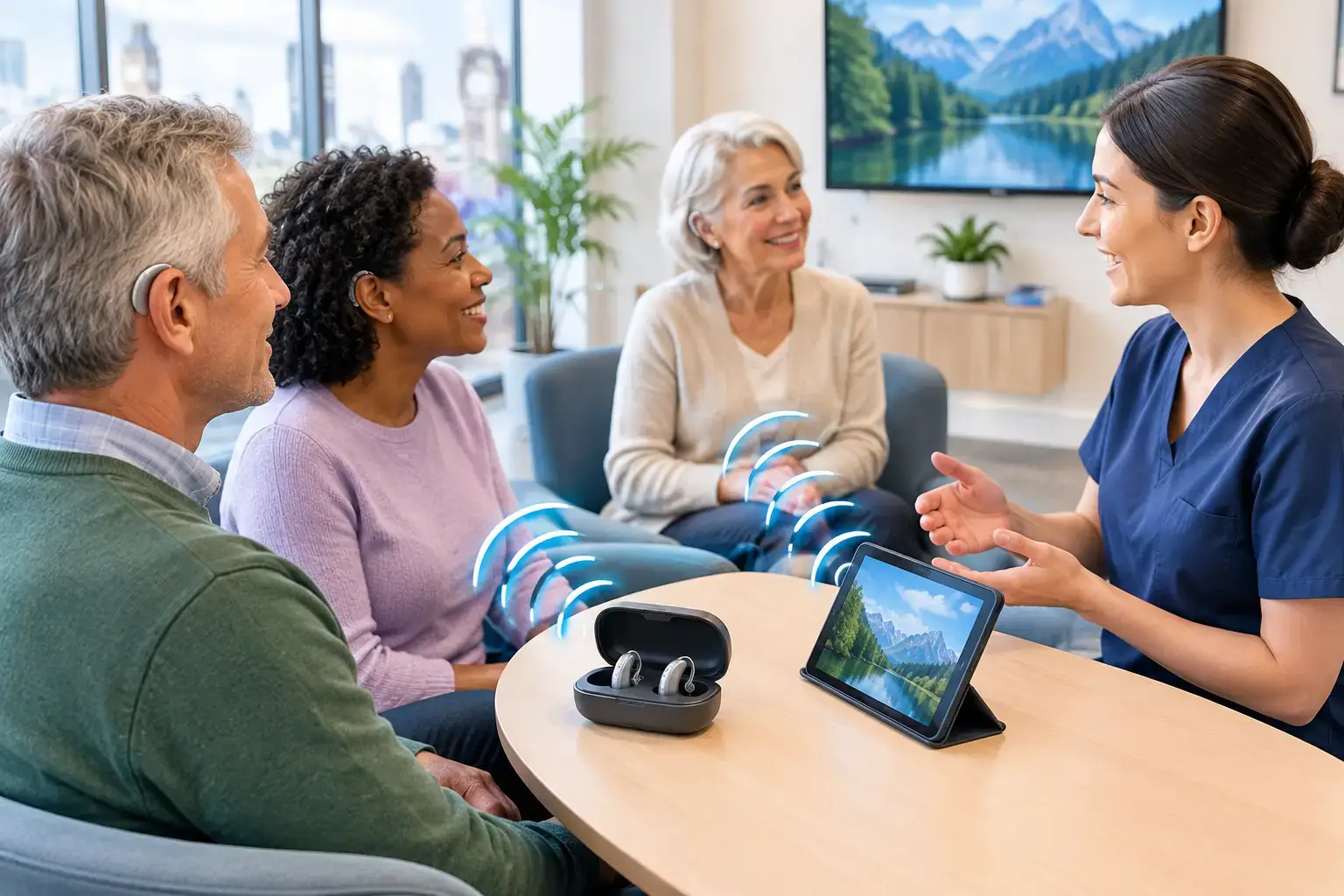
A restaurant table can be the hardest place to follow a conversation: glasses clink, music plays and several people speak at once. Auracast hearing aids are designed to offer a new way of managing sound in situations like these, allowing compatible hearing aids to receive selected audio broadcasts directly. The potential is significant, but the technology is not a substitute for a precise hearing assessment or a carefully fitted hearing solution.
What are Auracast hearing aids?
Auracast is a Bluetooth audio-broadcasting feature built on newer Bluetooth LE Audio technology. Rather than sending sound from one device to one pair of hearing aids, it can transmit audio from one source to many compatible listeners at the same time.
Think of a television in a waiting room, an airport announcement, a guided tour or a lecture. Where an Auracast transmitter is available, a listener may be able to select that broadcast through their compatible hearing aids or an associated app. The sound is then delivered directly to the aids, adjusted according to the listener’s programmed hearing settings.
This is different from ordinary Bluetooth streaming. Traditional streaming is usually a private connection between your mobile phone, television accessory or other personal device and your hearing aids. Auracast creates a shared broadcast that multiple people can join, much like choosing a channel. It may be public, such as a cinema soundtrack, or private, such as a household television broadcast shared only with family members.
Why shared audio matters for hearing care
For people with hearing loss, poor acoustics can turn everyday events into hard work. Distance, background noise and room echo all reduce speech clarity. Turning up the volume alone does not solve this problem. It can make unwanted sound louder too.
Direct audio transmission can reduce the effect of those barriers. If a speaker’s microphone feeds an Auracast broadcast, the voice reaches the hearing aids with less interference from the room. At a presentation, for example, this could make it easier to hear the person speaking without sitting in the front row or relying on subtitles.
There is also a social benefit. Audio systems in public venues have often required visitors to borrow dedicated receivers, wear headphones or ask a member of staff for assistance. Auracast could make access more discreet and more immediate for people whose devices are compatible. It gives the listener greater control over how they receive sound.
The key word is could. The technology is still being introduced, so availability will vary. A compatible hearing aid alone does not create an Auracast broadcast. The venue, television or audio source also needs suitable transmitting equipment, and public installations are not yet universal.
How Auracast hearing aids work in practice
A compatible audio source captures sound, such as a microphone at a conference or audio from a television. An Auracast transmitter then broadcasts it over Bluetooth LE Audio. Your hearing aids identify available broadcasts, usually through a hearing aid app, phone settings or a dedicated control, and you choose the one you want to hear.
Some broadcasts may be open to anyone nearby. Others may require a QR code, password or on-screen instruction to join. This can be useful when privacy matters, for instance in a meeting room or at home.
Once connected, the hearing aids receive the audio as a stream. Depending on the device and fitting, you may hear the broadcast by itself or alongside sounds from the room. Being able to retain awareness of your surroundings matters. Someone watching television may still want to hear their partner speak; someone receiving an announcement in an airport must remain alert to nearby activity.
Your audiologist can help establish the most comfortable balance. A well-programmed hearing aid should account for your hearing profile, listening priorities and tolerance of sound. New technology performs best when it is part of good rehabilitation, not simply switched on and left unexplained.
Possible everyday uses
The most obvious home use is television. Instead of increasing the volume for everyone in the room, a compatible television transmitter may send the programme directly to one or several pairs of hearing aids. Each person can hear at a level suited to them while still sharing the same programme.
Outside the home, future uses may include transport hubs, museums, theatres, places of worship, fitness classes and workplaces. In education, a teacher’s voice could potentially be broadcast to compatible devices, although a child’s hearing needs, safeguarding requirements and classroom support should always be considered individually.
Auracast may also help families. A grandparent and adult child with compatible hearing aids could listen to the same television broadcast, each with their own hearing settings. That is a practical improvement, but it should not be mistaken for a solution to every communication difficulty. Face-to-face conversation in noise still depends on hearing aid microphones, room acoustics and the strategies used by everyone involved.
Is Auracast right for you?
Auracast is worth considering if you frequently struggle with television dialogue, meetings, presentations or public announcements, and you want a hearing solution with strong future connectivity. It may be especially appealing if you already use audio streaming and value controlling sound from your own device.
However, connectivity should not be the only reason for choosing hearing aids. The priority remains hearing performance that is appropriate for you. This includes speech understanding, listening comfort, feedback management, physical fit, dexterity, visual needs and the environments that matter most in your life.
For some people, a small rechargeable model with app control will be ideal. For others, battery choice, simple physical controls or compatibility with existing accessories may be more important. If tinnitus or sound sensitivity is part of your experience, careful discussion of sound settings and listening comfort is particularly valuable.
It is also sensible to ask what is available now rather than buying solely for a future possibility. Features, software updates and transmitter availability differ between models. Your mobile phone or other devices may affect how you access broadcasts. A qualified audiologist can explain the practical position clearly, without overstating what the technology can do.
Questions to ask at a hearing aid appointment
An expert hearing assessment provides the foundation for this conversation. It identifies how you hear across different pitches and how hearing difficulties may affect speech understanding. From there, your clinician can recommend technology based on your needs rather than a feature list.
Ask whether the hearing aids are Auracast compatible, whether compatibility is already active or depends on a future update, and how you would access broadcasts in everyday use. It is equally useful to ask how television streaming works at home, whether you need an additional transmitter, and what controls are available if you do not want to rely on a smartphone.
You should also discuss follow-up care. Hearing aids need adjustment as you adapt to amplified sound and notice where communication remains difficult. A premium hearing care service includes verification, fine-tuning and practical guidance, so that technology supports real life rather than becoming another device in a drawer.
A considered route to better connected hearing
Auracast represents an encouraging shift towards more accessible shared audio. For the right listener, it may make a presentation, family television viewing or a public announcement clearer and less tiring. Yet its value depends on compatibility, local availability and, above all, the quality of the hearing care around it.
At Tragus-The Ear Specialists, qualified audiologists can assess your hearing, discuss your listening goals and advise on hearing technology with clinical care. If clearer connection to the people and places that matter is your aim, an expert assessment is the right place to begin.