
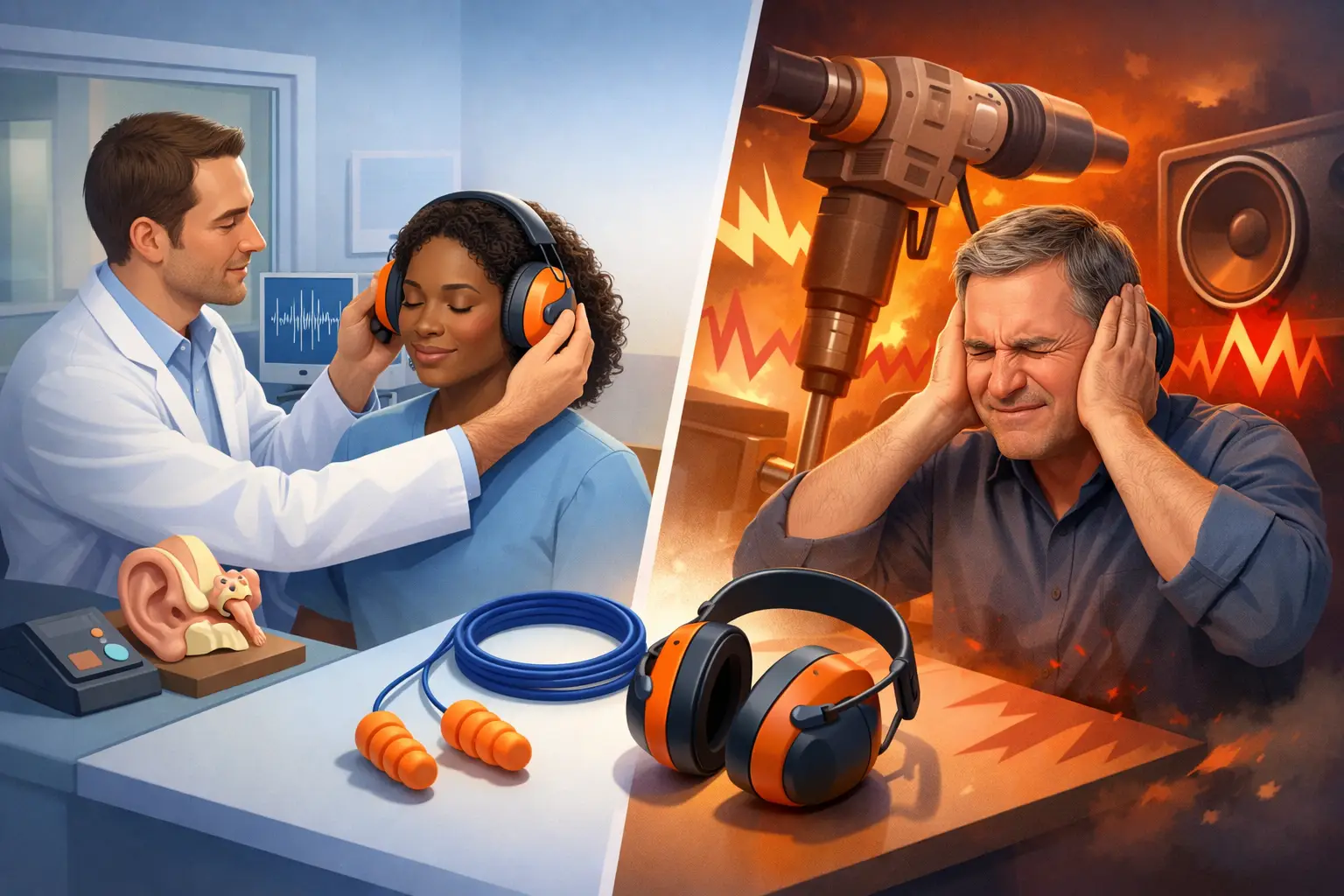
A ringing sensation after a concert, muffled hearing after using power tools, or the need to raise your voice at work are not signs that your ears are simply “getting used to it”. They can indicate that sound exposure has exceeded what your hearing can comfortably tolerate. Effective hearing protection reduces this risk, helping to preserve the clarity, comfort and confidence that good hearing brings to everyday life.
Noise-related hearing damage is often gradual. Unlike an injury that demands immediate attention, changes in hearing may build over months or years, particularly where loud sound is part of work, leisure or regular travel. The right protection is not about blocking out the world. It is about reducing harmful sound to a safer level while allowing you to communicate, perform and enjoy the activity in front of you.
Why loud noise can damage hearing
Inside the cochlea, the hearing organ in the inner ear, are tiny sensory cells that translate sound vibrations into electrical signals for the brain. These cells are delicate. A single very loud event can cause damage, but more commonly the problem comes from repeated exposure over time.
The risk depends on both volume and duration. A louder sound can be tolerated for less time than a moderate one. This is why a brief visit to a quiet café presents little concern, while a shift around machinery, a long rehearsal beside drums, or an evening close to loudspeakers may require a considered approach.
Sound is measured in decibels, and the scale is not linear. A small increase in decibels represents a meaningful rise in sound energy. As a practical guide, regular exposure around 85 dB and above deserves attention. Busy traffic, some gym classes, lawnmowers, live music venues and workshop equipment can all reach or exceed this level. If you need to shout to be heard by someone standing an arm’s length away, the environment is probably too loud for prolonged unprotected exposure.
Noise exposure can lead to temporary muffling or ringing, sometimes called a temporary threshold shift. Hearing may seem to recover after rest, but repeated episodes should not be dismissed. They can be a warning that the auditory system is under strain. Long-term damage can affect the ability to hear speech clearly in background noise, often before a person notices an obvious reduction in overall volume.
Hearing protection should fit the situation
There is no single best option for every person or setting. The most suitable hearing protection depends on the noise level, how long you are exposed, whether you need to communicate, and whether your ears are comfortable and healthy enough to wear it. Protection that is technically excellent but left in a pocket offers no benefit.
Disposable foam earplugs can provide strong attenuation when they are inserted properly. They are useful for occasional noisy tasks, but their effectiveness falls sharply if they are not rolled, inserted and allowed to expand correctly. Many people place them only at the entrance of the ear canal, leaving too much of the plug exposed and too little protection in place.
Reusable filtered earplugs are often preferred by musicians, concert-goers and hospitality staff. Rather than making sound dull or heavily distorted, quality filters reduce sound more evenly across frequencies. Speech and music can remain clearer, while the overall level is lowered. The amount of reduction still needs to suit the venue and exposure time.
Earmuffs are quick to put on and easy to check for a good seal, making them a sensible choice for DIY, gardening, construction tasks and some industrial environments. Their limitations are practical: they can feel warm, may interfere with helmets or eyewear, and can lose effectiveness when hair, glasses arms or poor adjustment break the seal around the ear.
Custom-moulded earplugs are made from impressions of your ears and are particularly valuable for regular or specialist use. Musicians, shooters, motorcyclists, swimmers and people working in demanding noise environments may benefit from a tailored fit and purpose-specific filters. They cost more than off-the-shelf products, but comfort, consistency and durability can make them the better long-term choice.
For shooting sports, protection should account for very high peak sound levels. Many people use both correctly fitted earplugs and earmuffs, particularly at indoor ranges. Electronic earmuffs can be helpful because they reduce harmful impulse noise while allowing lower-level conversation and range instructions to remain audible.
Getting the fit right matters as much as the product
An earplug’s quoted noise reduction rating is measured under controlled conditions. Daily life is less forgiving. Poor insertion, a loose custom mould, or an earmuff seal disrupted by spectacles can substantially reduce real-world protection.
Foam plugs should be rolled into a narrow cylinder with clean fingers, inserted gently while pulling the outer ear upwards and backwards, then held in place while the foam expands. They should sit securely without causing pain. If you can still see most of the plug from the front, it may not be inserted deeply enough.
Do not force any earplug into an ear that is painful, infected, discharging, or heavily blocked with wax. A blocked ear can alter how sound is perceived and make ear protection uncomfortable. Attempting to push a plug past wax may compact it further. In these circumstances, an expert ear examination and appropriate wax removal may be the safest first step.
Custom protection also needs periodic review. Ears can change shape, especially after weight changes, surgery or with normal ageing. A plug that once sealed well may become loose, and filters may require cleaning or replacement. Children should be reassessed as they grow, rather than expected to use the same moulds indefinitely.
Protect your hearing without isolating yourself
Some people avoid ear protection because they worry it will make them unable to communicate, hear hazards or enjoy music. This is a reasonable concern, and it is why matching the device to the task matters.
For a music performance, heavily attenuating foam may be appropriate near loud amplification, but filtered musician’s plugs may better preserve the balance of the sound. In a workplace, the required protection level should be guided by a noise assessment and employer policy. In social settings, moving away from speakers, taking short breaks in quieter spaces and limiting exposure time can reduce the need for maximum attenuation throughout the event.
Volume controls matter too. Headphones can be a hidden source of cumulative noise, especially on trains, buses and busy streets where listeners turn the volume up to overcome background sound. Noise-cancelling headphones may help by reducing the urge to increase volume, but they are not a substitute for sensible listening habits. Aim for a level that allows you to remain aware of your surroundings where safety requires it, and give your ears regular quiet periods.
When to arrange a hearing assessment
Hearing protection is preventative care, but it should not replace assessment when symptoms are already present. Arrange a professional hearing test if you notice persistent tinnitus, difficulty following conversation in restaurants or meetings, sound sensitivity, recurrent muffling after noise exposure, or a change in one ear that is different from the other.
Sudden hearing loss, a sudden increase in tinnitus alongside hearing change, severe dizziness, ear pain or ear discharge requires urgent medical advice. These symptoms should not be managed by simply buying earplugs or waiting to see if they settle.
For children, listening difficulties can be mistaken for inattention, behaviour concerns or delayed language development. If a child frequently asks for repetition, turns the television up, struggles in noisy classrooms or has recurring ear infections, a specialist paediatric hearing assessment can provide clarity. Where children are exposed to loud events, motorsport or music practice, protection should be correctly sized and consistently supervised.
At Tragus-The Ear Specialists, qualified audiologists can assess hearing concerns, advise on tinnitus and sound sensitivity, and provide custom ear protection for appropriate activities. The aim is not merely to reduce noise, but to help you continue working, performing, swimming, travelling and socialising with greater confidence.
Your ears do not need a dramatic incident to deserve care. If noise is a regular part of your life, choose protection you will genuinely wear, use it correctly, and seek expert advice before small changes become a lasting limitation.