
A child who repeatedly asks for words to be repeated, turns the television up, struggles to follow classroom instructions or seems unsettled around loud sounds deserves a careful clinical assessment. Choosing to access paediatric audiology privately can give families a direct route to a specialist assessment, without waiting for uncertainty to affect communication, confidence or learning.
Private care is not about assuming there is a hearing problem. It is about understanding what your child hears, how their ears are functioning and whether further support is needed. A high-quality assessment gives parents clear findings, practical next steps and, where appropriate, a report that can be shared with a GP, school or other healthcare professional.
When should you seek a paediatric hearing assessment?
Hearing difficulties in children are not always obvious. Some children compensate well at home, particularly in quiet rooms where they can see a parent’s face. The signs may become more noticeable in the classroom, at nursery, during group activities or when there is background noise.
A private paediatric audiology appointment may be appropriate if your child has delayed or unclear speech, frequent ear infections, a recent change in responsiveness, concerns raised by school, tinnitus, sound sensitivity or a family history of hearing loss. It can also be valuable after a failed screening result, or simply where a parent’s instincts suggest that something has changed.
Not every concern indicates permanent hearing loss. Temporary middle-ear problems, such as fluid behind the eardrum, can affect hearing and fluctuate over time. Attention, language development and sensory processing can also influence how a child responds to sound. This is exactly why specialist testing matters: it helps separate assumption from evidence.
How to access paediatric audiology privately
Most families can self-refer to a private audiology clinic. You do not usually need to wait for a GP referral before arranging an appointment, although a referral may still be useful if your child is already under the care of an ENT specialist, paediatrician or speech and language therapist.
When booking, explain your child’s age, the concerns you have noticed and whether they have had ear infections, ear surgery, hearing screenings or previous hearing tests. This helps the clinic plan the right appointment length and testing approach. A qualified audiologist should be able to explain whether the service is suitable for your child and what the assessment will involve.
For families in Kent, choosing a specialist ear clinic can make it easier to obtain timely, child-focused assessment close to home. The most important consideration, however, is clinical expertise. Children are not simply smaller adults: their hearing assessments require age-appropriate methods, patience and the ability to interpret results in the context of development.
Check the clinician’s paediatric experience
Look for an audiologist with demonstrable experience in paediatric assessment and appropriate professional registration. Ask whether the clinic routinely tests children of your child’s age, whether it provides ear examination and middle-ear testing where indicated, and how results are explained to parents.
A premium clinical service should not feel rushed or transactional. The clinician should take a proper history, observe your child’s responses, adapt the test where needed and tell you clearly if the results are reliable enough to act upon. If a child is tired, unwell or unable to engage with a particular method, a repeat test or different approach may be the safest recommendation.
Ask what is included before you book
Private appointment structures differ. Before attending, establish the assessment fee, expected duration, whether a written report is included and whether follow-up is charged separately. It is also sensible to ask how the clinic handles onward referral if it identifies a medical ear condition or a result needing consultant ENT input.
Clear information before the appointment allows families to make an informed decision. It also avoids comparing services on price alone, when the quality of testing, clinician expertise and follow-up support may be substantially different.
What happens during a private paediatric audiology appointment?
A good assessment begins with listening to the parent and, where appropriate, the child. The audiologist will ask about pregnancy and birth history, speech and language milestones, ear infections, exposure to loud noise, family hearing history and the situations in which hearing seems difficult.
They may then examine the outer ear and ear canal. If wax, infection, discharge or another visible concern is present, this can affect both hearing and the choice of test. Earwax should not be removed from a child without a suitable clinical assessment and an age-appropriate treatment plan.
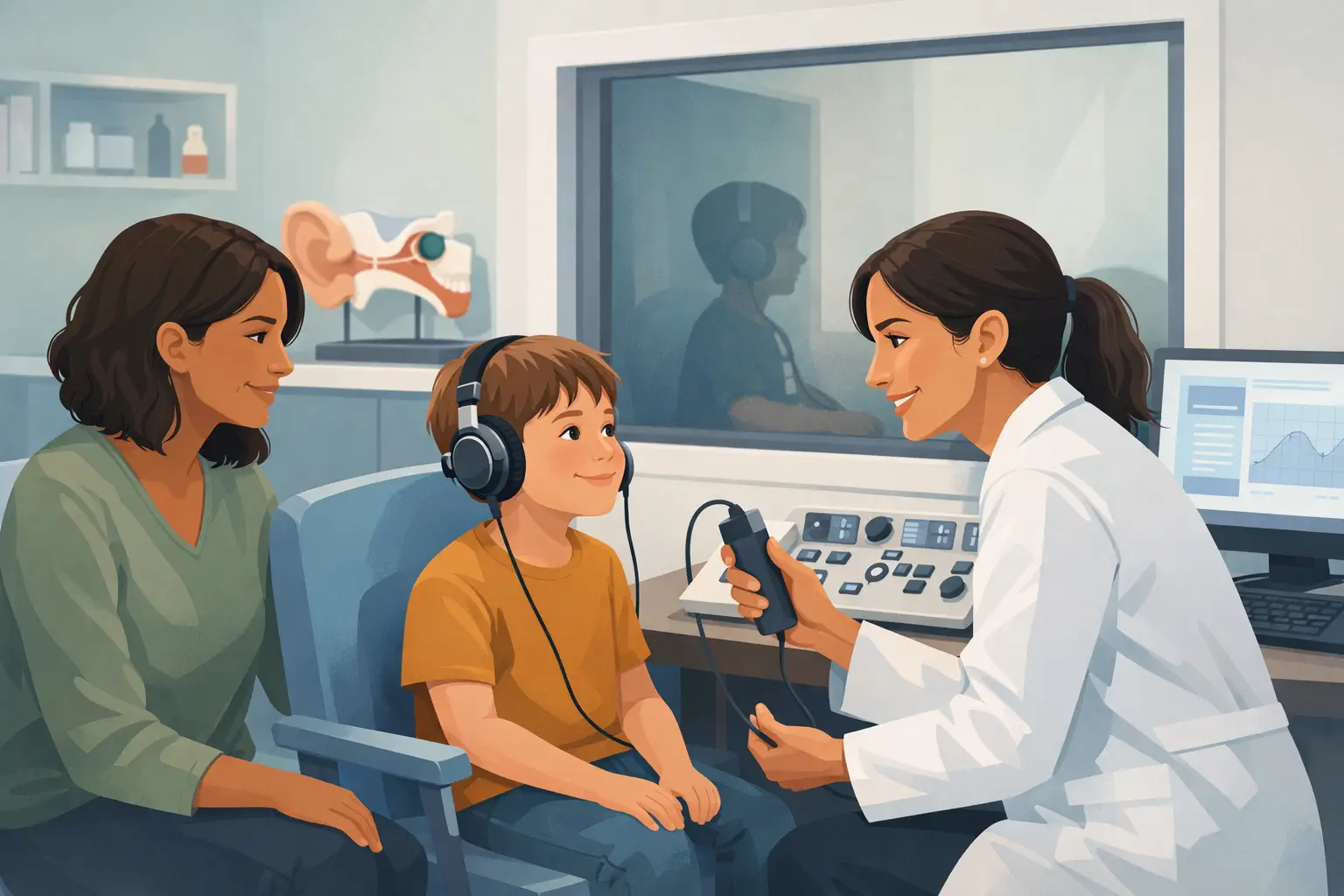
The hearing test itself depends on developmental stage. Babies and very young children may be assessed using behavioural observation techniques or objective measures that assess how the ear is responding. Toddlers and preschool children often respond to sounds through play-based methods, such as placing a toy in a box when they hear a sound. Older children can usually complete more conventional headphone testing, responding when tones or speech are heard.
The appointment may also include tympanometry, a quick test that checks how the eardrum and middle ear are moving. This is particularly useful where glue ear or pressure changes are suspected. Speech testing can show how well a child understands spoken words, sometimes in quiet and sometimes with background noise, depending on their age and the clinical question.
A child does not need to perform perfectly for an assessment to be useful. Skilled paediatric audiologists build rapport, use clear encouragement and adjust the session to the child. Bringing a favourite small toy, scheduling around naps or meals, and explaining the visit positively can all help. Avoid telling your child that there are “right answers” – the aim is simply to show the clinician what they can hear.
Understanding the results and next steps
At the end of the assessment, the audiologist should explain the findings in plain language. You should understand whether hearing appears within expected limits, whether there is evidence of a conductive issue in the middle ear, whether one ear differs from the other and how confident the clinician is in the test results.
If results are normal but concerns remain, the next step may involve monitoring, discussing listening strategies at home and school, or considering another professional assessment. Normal hearing thresholds do not answer every question about communication, concentration or language, but they provide an essential part of the clinical picture.
If hearing loss or middle-ear dysfunction is identified, the plan will depend on its type, severity, duration and likely cause. A short-term middle-ear issue may need review after a defined period. Persistent, asymmetric or medically concerning findings may require GP or ENT referral. Where a child needs hearing technology or rehabilitation, this should be discussed carefully, with realistic expectations and ongoing review.
Private audiology can complement NHS care, particularly when a family needs timely diagnostic clarity or a detailed opinion. For some children, NHS audiology and ENT services will remain central to medical treatment and long-term provision. A responsible private clinic should be clear about when shared care or onward referral is in your child’s best interests.
Helping your child get the most from the appointment
Children often take their cue from the adults with them. Describe the visit as a chance to listen to some sounds and play a few hearing games. Keep explanations simple, arrive with enough time to settle, and bring glasses or hearing devices if your child already uses them.
It is helpful to write down specific examples beforehand: words your child mishears, noisy environments they avoid, teacher observations, recent infections and any changes you have noticed. These details can be more informative than a general sense that they are “not listening”. If school has raised concerns, ask for a short written account of what staff have observed.
For parents, the value of a private assessment lies in more than speed. It is the reassurance of knowing that your child has been assessed by a qualified clinician, using methods designed for their age and needs. Whether the outcome is a normal result, a need for monitoring or a route to further treatment, clear answers allow you to respond with confidence. Do not wait in silence when your child’s hearing, comfort or communication is causing concern.