
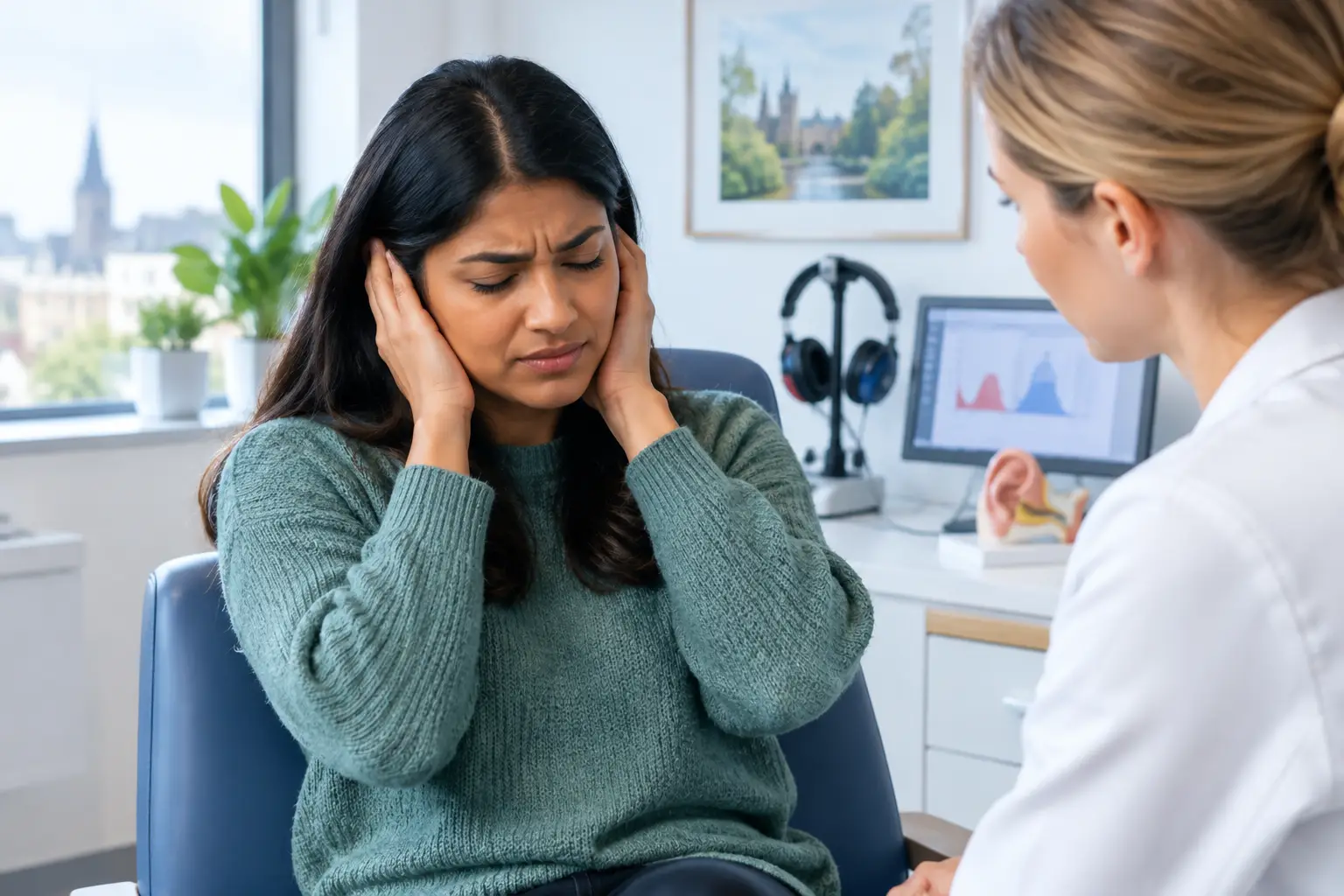
A kettle boiling, cutlery touching a plate or a colleague speaking across the room should not feel physically unbearable. Yet for people with hyperacusis, everyday sound can become painful, alarming or exhausting. Recognising the top signs of hyperacusis is the first step towards an expert assessment and a plan that helps make daily life more comfortable.
Hyperacusis is more than a dislike of loud noise. It is an altered tolerance to sound, where noises that most people would consider ordinary may feel excessively loud, intrusive or painful. It can affect adults and children, and it often occurs alongside tinnitus, hearing loss, migraine, stress or following a period of noise exposure. The experience varies significantly from person to person, which is why a careful clinical assessment matters.
The top signs of hyperacusis
Everyday sounds feel uncomfortably loud
The most recognisable sign is a marked reaction to sounds at normal levels. A family conversation, running water, a television at a modest volume or traffic outside may feel far louder than it should. This is not simply a preference for peace and quiet. The sound can feel overwhelming even when others in the same environment are comfortable.
Some people notice the problem gradually, while others can identify a clear point at which their sound tolerance changed. For example, symptoms may begin after attending a loud event, following an ear infection, during a period of severe stress or alongside the onset of tinnitus. The timing is useful information for an audiologist, but it does not by itself establish the cause.
Sound causes pain, pressure or a physical reaction
For some people, certain sounds do not just feel too loud. They cause sharp discomfort, aching, pressure, a fluttering sensation in the ear, headache or a sudden urge to get away. This is sometimes called pain hyperacusis, although the precise nature of symptoms needs professional assessment.
High-pitched or sudden sounds are often particularly difficult. A child crying, a hand dryer, dishes clattering or a motorbike passing close by can provoke an immediate physical response. Repeated exposure may leave someone feeling drained or on edge for hours afterwards.
You begin avoiding ordinary places and activities
Behaviour changes can be as revealing as the sound sensitivity itself. You may stop going to cafés, restaurants, supermarkets, family gatherings, the cinema or busy workplaces because the noise feels unpredictable. Parents may notice that a child becomes distressed in the school hall, avoids assemblies or struggles with busy classrooms.
Avoidance can bring short-term relief, but withdrawing from everyday sound altogether may make life smaller and, in some cases, increase sensitivity over time. This does not mean someone should force themselves through painful environments. It means the balance between sensible protection and gradual rehabilitation should be guided by a qualified clinician.
You feel anxious before noise happens
Hyperacusis can create anticipatory anxiety. Rather than reacting only when a sound occurs, you may find yourself scanning an environment for possible triggers, worrying about the next train announcement or feeling tense before a social event. The nervous system can become highly alert to sound, making the experience more distressing.
This reaction is real and it is not a sign that symptoms are imagined. Hearing and emotional responses are closely connected. A specialist tinnitus and hyperacusis assessment considers both the sound sensitivity itself and the effect it is having on sleep, confidence, work, education and relationships.
Earplugs become a daily necessity
Using hearing protection is appropriate in genuinely loud settings, such as live music venues, shooting ranges, construction areas or when using loud machinery. Custom earplugs can provide valuable protection in these situations. However, routinely wearing earplugs in quiet or normally noisy places – such as at home, in a shop or during a normal conversation – can indicate that sound tolerance has become a significant problem.
The answer is not simply to stop using earplugs. It depends on the environment, the severity of symptoms and whether there is a separate reason to protect your hearing. An audiologist can help you understand when protection is helpful and when it may be maintaining fear of ordinary sound.
Tinnitus is present alongside sound sensitivity
Tinnitus and hyperacusis frequently overlap. You may hear ringing, buzzing, humming or hissing in the ears, while also finding external sounds difficult to tolerate. In some cases, a sound that once masked tinnitus can become uncomfortable, leaving people unsure how to manage either symptom.
The two conditions are related but not identical. Tinnitus is the perception of sound without an external source, while hyperacusis concerns the way external sounds are processed and tolerated. A full hearing assessment can help identify hearing changes and provide a clearer basis for personalised support.
Concentration, sleep or mood are affected
When ordinary noise feels threatening or painful, the effect reaches far beyond the ears. You may struggle to concentrate in an open-plan office, become irritable in busy family settings or need long periods of quiet after routine errands. Sleep may be affected if you are constantly alert to noises in the home or outside.
Children may not always explain sound sensitivity clearly. Instead, they may cover their ears, cry or become angry in noisy places, refuse activities they previously enjoyed, or appear exhausted after school. These signs should be approached with reassurance rather than criticism. Children need an assessment tailored to their hearing, development and daily environments.
You have begun controlling everyone else’s noise
As sensitivity increases, people often try to control sound around them: asking others to lower their voices, turning off household appliances, closing windows, avoiding public transport or leaving rooms when music starts. These actions may be understandable attempts to cope, but they can place strain on family life and limit independence.
A useful question is whether sound is determining your choices more often than you are. If it is affecting where you go, who you see or what you can manage at work, it is time to seek specialist advice rather than continuing to cope alone.
Hyperacusis, hearing loss and other possible causes
Sound sensitivity is not always hyperacusis. Some people are especially sensitive to a specific sound, such as chewing or breathing, which may point towards misophonia. Others find sound distorted, harsh or unclear because of hearing loss, middle-ear problems or earwax blockage. Migraine, medication changes, neurological conditions, anxiety and noise exposure may also play a role.
This is why self-diagnosis has limits. An online checklist can help you recognise a pattern, but it cannot examine the ear, assess hearing levels or determine the safest next step. A clinical assessment may include a discussion of your symptoms and history, an ear examination, hearing tests and carefully selected measures of sound tolerance. The process should be paced appropriately. Nobody should be exposed to sounds that feel intolerable simply to prove that a problem exists.
When to arrange an expert hearing assessment
Arrange an assessment if sound sensitivity persists, is worsening, causes pain, affects your work or family life, or occurs with tinnitus or a noticeable change in hearing. Early support can prevent symptoms becoming more entrenched and can give you practical strategies for managing difficult environments.
Seek prompt medical advice for sudden hearing loss, new weakness or numbness in the face, severe dizziness, ear discharge, significant ear pain, or symptoms following a head injury. These symptoms need medical evaluation and should not be assumed to be hyperacusis.
At Tragus-The Ear Specialists, qualified audiologists can assess hearing and sound tolerance in a calm, clinically focused setting. Where hyperacusis is suspected, the goal is not to tell you to simply endure noise. It is to understand your symptoms, identify contributing factors and create a realistic route back towards greater comfort and confidence.
You do not need to wait until sound sensitivity has taken over your routine. If ordinary sounds are changing how you live, a specialist assessment can replace uncertainty with clear, compassionate guidance and help you begin hearing the world more comfortably again.