
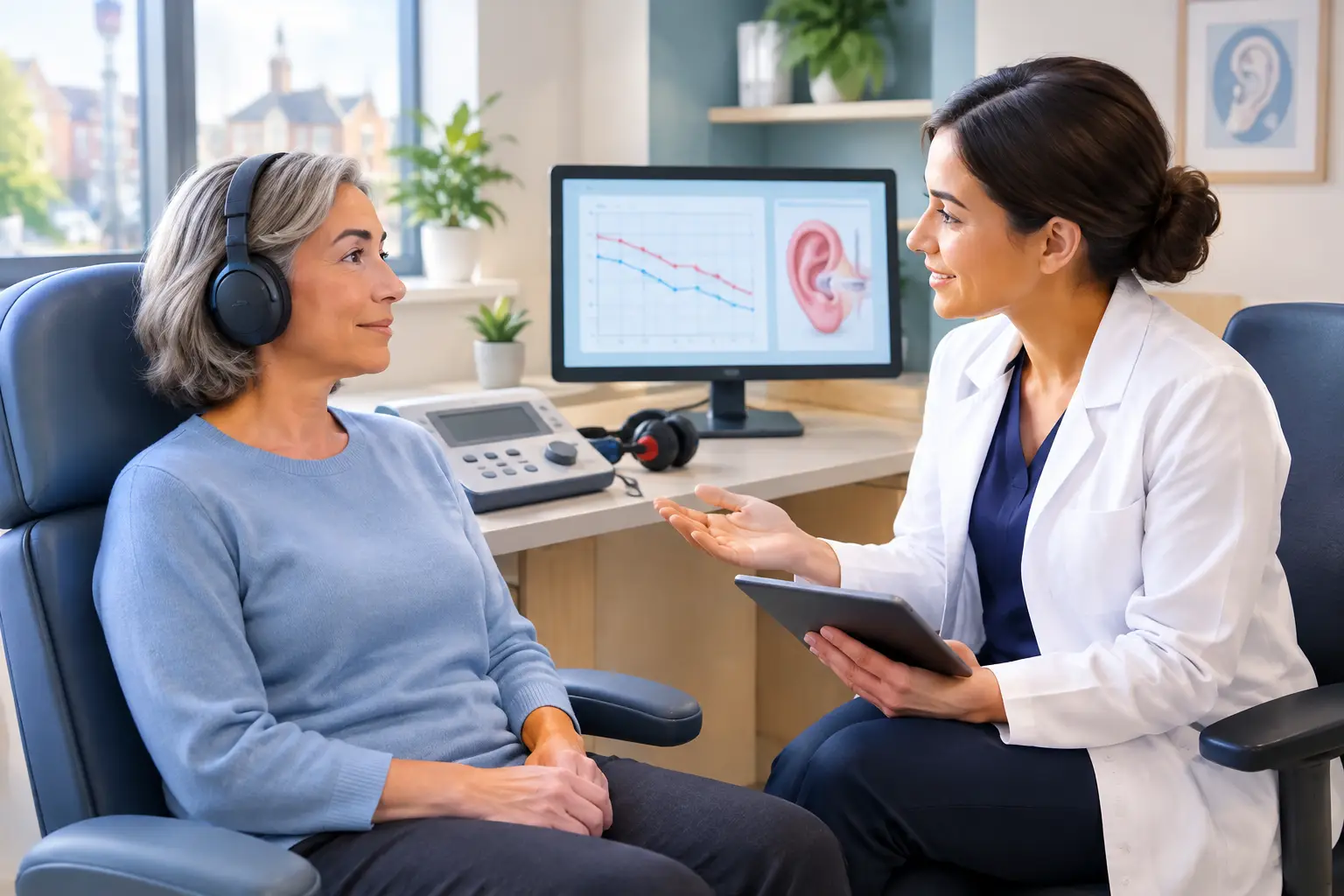
A hearing change is rarely just about turning the television up. It can affect conversations at work, confidence in busy restaurants, a child’s progress at school, or the comfort of everyday sounds. Expert hearing diagnostics provide a clear starting point: they establish how you hear, identify meaningful patterns in your results, and guide the most appropriate next step.
At Tragus-The Ear Specialists, assessments are carried out by qualified audiologists with clinical experience across NHS and specialist settings. The aim is not simply to produce a graph. It is to understand how your ears and hearing are affecting your day-to-day life, then provide advice and care that are tailored to you.
What hearing diagnostics involve
Hearing diagnostics are a structured series of assessments used to investigate hearing concerns. The exact tests depend on your age, symptoms, hearing history and the reason for your appointment. A thorough assessment normally begins with a discussion about what you have noticed – perhaps speech has become less clear, one ear feels different, tinnitus is intrusive, or certain sounds feel uncomfortably loud.
Your audiologist will ask when the issue began, whether it is constant or intermittent, and how it affects communication, sleep, concentration and wellbeing. For children, parents may be asked about responses to sound, speech and language development, school feedback, ear infections and family hearing history.
This conversation matters. Two people can have similar hearing test results but experience very different practical difficulties. Someone who works in meetings may struggle most with speech in background noise, while another person may be distressed by sound sensitivity or a persistent internal noise. The assessment should account for the person, not only the test result.
Looking in the ears first
An ear examination is an essential part of high-quality hearing care. Your clinician will inspect the ear canal and eardrum using specialist equipment to check whether wax, debris, irritation or another visible issue could be affecting the result.
Earwax can cause a blocked sensation and temporary reduction in hearing. If it is present in a way that prevents an accurate assessment, microsuction earwax removal may be advised before testing. Testing through a blocked ear canal can produce misleading results, so dealing with this first is often the sensible approach.
Measuring hearing accurately
Pure tone audiometry is the familiar part of many hearing assessments. You wear headphones and respond when you hear a series of tones at different pitches and volumes. This allows the audiologist to map the quietest sounds you can hear across frequencies that are important for everyday listening.
Speech testing may also be used to assess how clearly you understand words, sometimes in quiet and sometimes with background noise. This can be particularly helpful when your main complaint is, “I can hear people talking, but I cannot make out what they are saying.” Hearing sounds and understanding speech are related, but they are not identical experiences.
Where appropriate, tympanometry may be performed. This quick test measures how the eardrum moves and can provide useful information about middle-ear function. It does not hurt, although some people notice a brief feeling of pressure.
Why a full assessment is more useful than a quick screen
A hearing screen can indicate that further investigation may be helpful, but it is not the same as a diagnostic assessment. A comprehensive appointment combines clinical history, ear examination, carefully selected tests and professional interpretation.
That difference is particularly valuable when symptoms are uneven, recent, fluctuating or difficult to describe. It also matters for people with tinnitus, hyperacusis or listening difficulties that do not fit neatly into a simple “hearing loss” description.
A specialist audiologist considers the whole picture. They can explain whether the findings match the challenges you describe, whether further medical advice is appropriate, and what form of support may improve your listening comfort and confidence.
Understanding your results
Hearing test results are often shown on an audiogram. This is a chart that records responses at different pitches and levels. It can appear technical at first glance, but your audiologist should translate it into plain language: which sounds are easier or harder to hear, whether both ears are similar, and what this means in real situations.
For example, difficulty hearing higher-pitched sounds can make consonants such as “s”, “f” and “th” less distinct. Speech may seem audible but blurred, particularly when there is competing noise. If lower-pitched sounds are affected, voices and environmental sounds may be perceived differently. The functional impact varies considerably between individuals.
It is also useful to remember that an audiogram is a snapshot of hearing on the day of testing. Your reported experience remains important. If your results appear within expected limits but you are still struggling with sound tolerance, tinnitus or communication in complex environments, that deserves a proper conversation rather than dismissal.
Hearing diagnostics for tinnitus and sound sensitivity
Tinnitus is commonly described as hearing a sound without an external source, such as ringing, buzzing, humming or hissing. Its impact can range from an occasional background noise to something that affects sleep, mood and concentration. A tinnitus assessment considers your hearing alongside the nature of the sound, when you notice it most, and the level of distress it creates.
Hyperacusis and other sound sensitivity concerns require equally careful assessment. Everyday sounds may feel disproportionately sharp, intrusive or physically uncomfortable. The right approach is not simply to avoid every sound or to assume that amplification is the answer. Recommendations should be individual, measured and based on your symptoms, lifestyle and test findings.
Specialist tinnitus and hyperacusis therapy can form part of a personalised management plan. The focus is on reducing the impact these symptoms have on your life and helping you regain a more comfortable relationship with sound.
When hearing aids may be discussed
If your assessment identifies hearing difficulty that could benefit from amplification, your audiologist may discuss hearing aids. This should be a clinical recommendation, not a product-led conversation.
Modern hearing aids can be programmed to your hearing profile and listening needs, with features that may support speech understanding in more challenging environments. However, the best choice depends on several factors: the nature of your hearing results, dexterity, lifestyle, cosmetic preferences, connectivity needs and budget.
A fitting is only the beginning. Adjustment, verification and follow-up are central to successful hearing rehabilitation. Your brain needs time to adapt to sounds that may have become less noticeable, and settings often need refining once you have used the devices in your own environments.
Paediatric hearing assessments need a different approach
Children are not simply smaller adult patients. Their hearing assessment must be age-appropriate, engaging and interpreted in the context of development. A child may not say that they are struggling to hear. Instead, parents or teachers may notice delayed responses, frequent requests for repetition, difficulty following instructions, tiredness after school or challenges in noisy classrooms.
Depending on the child’s age and ability, testing may involve play-based methods, visual responses or conventional headphones. The clinician’s skill in creating a calm, supportive environment is as important as the equipment used. Families should leave with clear explanations and practical next steps, not uncertainty.
When to arrange an assessment
It is sensible to book an expert hearing assessment if you have noticed a gradual change in hearing, persistent tinnitus, increased sensitivity to sound, trouble following speech in noise, or a feeling of blockage that does not resolve. Parents may wish to seek assessment if they have concerns about a child’s responses to sound, communication or school listening.
If a hearing change is sudden, marked, or accompanied by other concerning symptoms, seek urgent medical advice rather than waiting for a routine appointment.
Good hearing care starts with being heard properly. A detailed assessment can replace guesswork with evidence, explain what your ears need, and help you move forward with greater clarity and reassurance.