
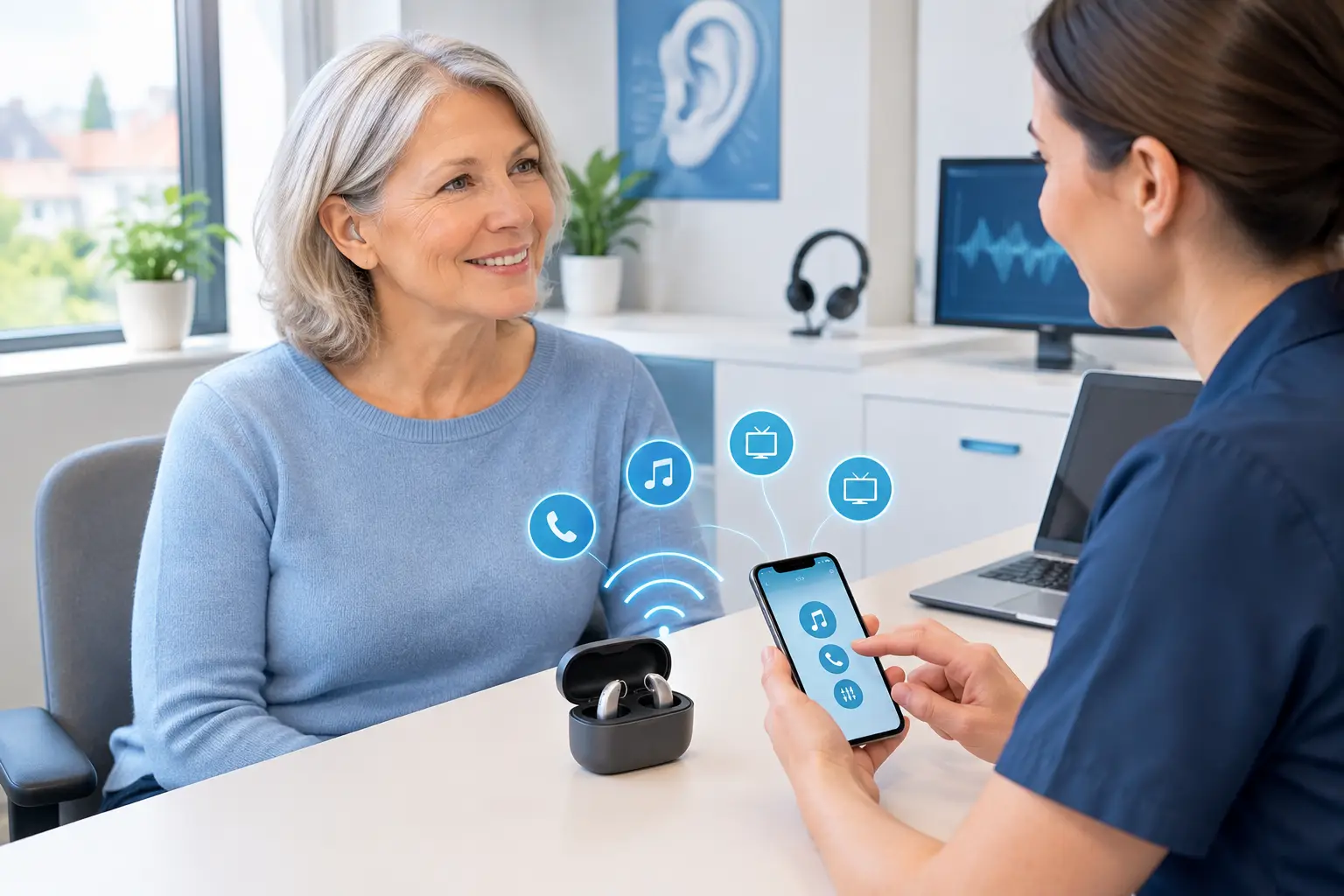
A phone call should not mean choosing between hearing the caller and holding a device awkwardly against your ear. For many people, hearing aid connectivity makes conversations, television and everyday listening easier to manage by sending sound directly to their hearing aids. Yet the most suitable technology depends on your hearing needs, the devices you use and what you want to hear more clearly in daily life.
At Tragus – The Ear Specialists, our qualified audiologists look beyond a list of features. We assess how you hear, where communication is difficult and whether connected hearing technology would add genuine value to your rehabilitation.
Hearing aid connectivity: more than a convenience
Connected hearing aids use wireless technology to communicate with compatible phones, tablets, televisions and other accessories. In practical terms, this can allow sound from a call, video or music to play through both hearing aids rather than through a phone speaker alone.
This matters because the signal is delivered close to the ear and can be adjusted to your individual hearing prescription. It may reduce the need to turn the volume up excessively, repeatedly ask people to repeat themselves, or struggle to follow speech while holding a phone in one fixed position.
Connectivity is not only about entertainment. It can support clearer communication with family, friends and colleagues, particularly when calls and online meetings are a regular part of work or daily life. It may also offer more discreet control of hearing aid settings without needing to touch the aids themselves.
How connected hearing aids work
Most modern systems use Bluetooth or related low-energy wireless technology. The hearing aids pair with a compatible device, often through a manufacturer app, much like wireless headphones. Once paired, you can usually stream phone calls, audio and video sound directly to your hearing aids.
Some hearing aids connect directly to certain smartphones, while others use an intermediary accessory. Television streamers are also available for many systems. These small units connect to the television and send its sound to the hearing aids, so you can listen at a comfortable level without making the room uncomfortably loud for someone else.
Newer Bluetooth standards may also support broadcast audio in public places. This is an emerging area, so availability remains variable. A compatible hearing aid, a compatible receiving device and an enabled venue are all required. It could become useful in settings such as theatres, transport hubs or lecture spaces, but it should not be the sole reason for choosing a hearing aid today.
Where connectivity can make the biggest difference
The benefit is often most obvious in situations where speech competes with distance, room acoustics or background sound. A phone call is a common example. Streaming the caller’s voice to both ears can make the voice feel more balanced and easier to follow than listening through one handset speaker.
Television is another frequent concern. If family members say the television volume is too high, direct streaming can give you greater personal control. You may be able to adjust the streamed volume independently, while others listen at a level that suits them. The result is often a more relaxed evening, rather than a disagreement over the remote control.
For people who work remotely or attend frequent video calls, connected hearing aids can be particularly helpful. Voices from a laptop or tablet can be sent to the hearing aids, allowing you to focus on the meeting without relying entirely on built-in speakers. However, microphone behaviour differs between devices and settings, so it is worth discussing your typical work set-up during a hearing aid consultation.
Apps can also offer useful day-to-day controls. Depending on the system, you may be able to alter volume, switch listening programmes, adjust the balance of speech and background sound, check battery status or locate a misplaced hearing aid nearby. These controls are helpful for some people, but they are not a substitute for carefully programmed hearing aids and professional follow-up care.
Choosing the right features for your routine
More connectivity does not automatically mean a better hearing solution. The best choice begins with an expert hearing assessment and a clear understanding of your listening priorities. Someone who mainly wants to hear grandchildren on video calls may need something different from a person who spends much of the week in meetings, travels frequently or enjoys television in the evening.
Your mobile phone and operating system matter. Not every hearing aid offers the same direct-streaming experience with every handset, tablet or computer. Compatibility can also change after software updates. Before selecting a device, it is sensible to check the exact phone model, operating system and accessories you plan to use most often.
Battery preference is another genuine trade-off. Rechargeable hearing aids are convenient for many users and can be straightforward to place in a charging case overnight. Disposable-battery models may appeal to people who are away from a charging point for long periods or prefer to carry spare batteries. Streaming can use more power, so your typical daily listening time should form part of the discussion.
Physical comfort and dexterity deserve equal attention. If an app feels confusing or a small control is difficult to manage, the technology may become frustrating rather than helpful. A good fitting process includes practical guidance, not simply pairing devices and sending you away. You should feel confident making a call, adjusting a setting and knowing what to do if a connection drops.
Connectivity in noisy places
It is understandable to expect streamed sound to solve every difficult listening situation. In reality, hearing aids work best when their settings, microphones and noise-management features are tailored to your hearing profile and listening environments. Connectivity can add another useful route for sound, but it does not remove all background noise or make every voice equally easy to understand.
For example, streaming a person’s voice during a video call may improve clarity, but a poor internet connection, poor microphone quality or several people speaking at once can still make the conversation demanding. In a busy restaurant, a remote microphone accessory placed close to the speaker may be more useful than phone streaming. The right option depends on the situation.
People with tinnitus or sound sensitivity may also need careful adjustments. Connected sound should be introduced at a comfortable level, with an approach that respects your wider auditory needs. This is where specialist audiology input is valuable: the aim is not simply more sound, but sound that is appropriate, tolerable and useful.
Why professional fitting and follow-up matter
Hearing aid connectivity works best when it is part of personalised hearing care. During a fitting, an audiologist can programme the hearing aids to your hearing test results, verify their performance and discuss the environments where you need support. They can also help pair relevant devices, explain app controls and troubleshoot common problems.
Follow-up appointments provide an opportunity to refine settings after you have used the hearing aids at home, at work and with family. A feature that sounds appealing in a demonstration may prove unnecessary, while a small adjustment to streamed volume or microphone behaviour can have a meaningful effect on comfort and confidence.
For parents considering hearing technology for a child, the process requires particular care. Paediatric hearing needs, communication development, school routines and safe, age-appropriate use should all be considered. Specialist assessment helps families make decisions based on the child’s individual needs rather than relying on generic technology claims.
A better connection starts with understanding your hearing
The most useful connected hearing aid is the one that fits your hearing, your hands, your devices and your real routine. If calls, television or conversations are becoming hard work, an expert assessment can clarify whether hearing aid connectivity could help you hear with greater ease and confidence. Don’t wait in silence when practical, personalised support is available.