
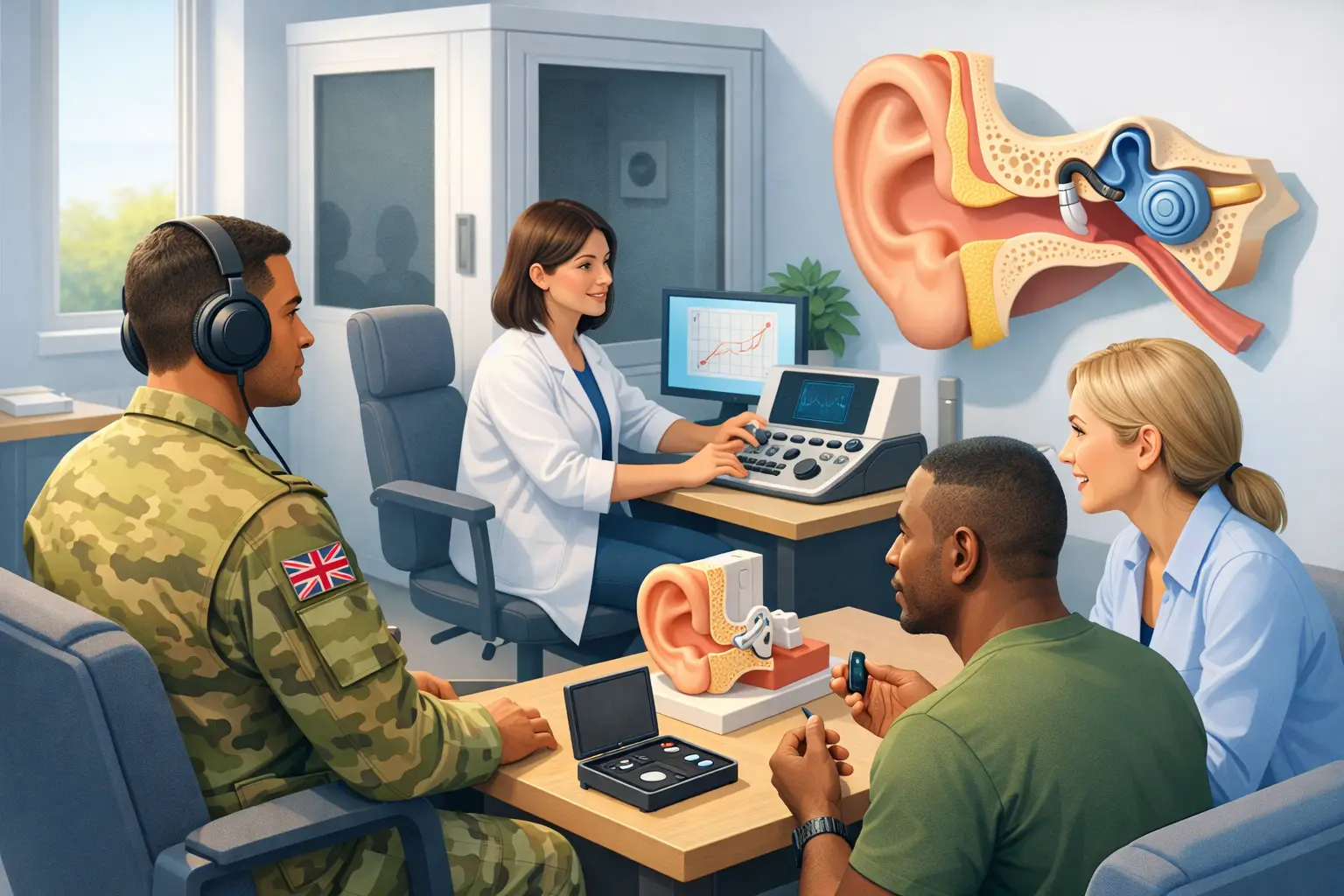
Gunfire, aircraft, armoured vehicles, explosions and repeated training noise can all place exceptional strain on the ears. For serving personnel, veterans and their families, a guide to military hearing loss needs to start with one clear point: hearing changes are not something to simply put up with. Early, specialist assessment can clarify what has happened and provide practical support for communication, sleep, concentration and confidence.
Military noise exposure is rarely a single, simple event. Some people notice an immediate muffling of sound or ringing after a blast. Others develop a gradual difficulty hearing speech in busy places years after regular exposure to weapons, machinery or engines. Both patterns deserve careful attention.
What makes military hearing loss different?
The inner ear contains delicate sensory cells that convert sound into signals for the brain. Intense sound can damage these cells, and unlike many other tissues in the body, they do not reliably repair themselves. A sudden explosive event may cause acoustic trauma, while years of repeated noise exposure can lead to cumulative noise-induced hearing loss.
The effects are not always limited to volume. A person may hear that someone is speaking but struggle to separate their words from background noise in a pub, workplace meeting or family gathering. High-pitched sounds are often affected first, which can make consonants such as s, f, t and k less distinct. This is why people may feel that others are mumbling even when a routine conversation seems audible.
Hearing loss can also occur alongside physical injury to the ear. A blast can affect the eardrum or middle ear, while infection, wax blockage and age-related change may contribute to hearing difficulties too. It is unwise to assume every symptom has one cause. An expert assessment identifies the pattern and helps determine the most appropriate next step.
Common signs after military noise exposure
Symptoms can begin during service, shortly after a particular incident or become more noticeable later in life. Pay attention to persistent ringing, buzzing, hissing or whistling in the ears, known as tinnitus. Tinnitus may be intermittent or constant, and it can be particularly intrusive at night or in quiet rooms.
Other signs include asking people to repeat themselves, turning the television up, avoiding restaurants because conversation feels exhausting, or finding telephone calls difficult. Some people develop sound sensitivity, known as hyperacusis, where ordinary noises feel uncomfortably loud or even painful. Others experience a blocked sensation, reduced clarity in one ear, dizziness or imbalance.
Not every change is an emergency, but certain symptoms need prompt medical attention. Seek urgent advice for sudden hearing loss, a sudden major change in one ear, severe vertigo, facial weakness, ear discharge following an injury, or tinnitus that pulses in time with your heartbeat. These symptoms require timely assessment rather than a wait-and-see approach.
A guide to military hearing loss assessment
A comprehensive hearing assessment is more valuable than a quick screen on a busy high street. A qualified audiologist will take a detailed history of noise exposure, symptoms, health conditions, medication and the situations where hearing is most difficult. This context matters. The hearing needs of a former infantry soldier who struggles in a crowded workplace may differ from those of a musician with tinnitus after service.
The appointment normally includes an examination of the ears and a hearing test that measures the quietest sounds you can hear across a range of frequencies. Speech testing may also be used to understand how well you recognise words, particularly when listening is challenging. If wax is preventing a clear view of the eardrum or affecting the test, safe removal may be advised before final results are interpreted.
For tinnitus or sound sensitivity, the assessment should go beyond asking whether the sound is present. The clinician should explore its impact on sleep, stress, mood, work and daily routines. That allows care to be tailored properly, whether the priority is improving hearing clarity, reducing the distress associated with tinnitus or rebuilding tolerance to everyday sound.
Why a hearing test can be reassuring
Many people delay testing because they worry they will be told they need hearing aids immediately. A good assessment is not a sales exercise. It is a diagnostic process that gives you an accurate baseline, rules out treatable issues where possible and explains your choices.
Sometimes the right plan is monitoring and hearing protection. In other cases, hearing aids, tinnitus therapy or referral to another healthcare professional may be appropriate. The recommendation depends on the test results, your symptoms and the impact on your life.
Treatment and rehabilitation options
Noise-related inner-ear damage cannot usually be reversed, but that does not mean nothing can be done. Modern hearing care focuses on reducing the practical consequences of hearing loss and helping you stay engaged with the people and activities that matter.
Hearing aids can make speech clearer and reduce listening effort, particularly when they are selected and programmed around your hearing profile and lifestyle. Premium devices can offer sophisticated background-noise management, directional microphones and connectivity for calls or television. They are not a cure, and no device can remove every difficult listening situation. However, well-fitted hearing aids can make a substantial difference when supported by careful adjustment and follow-up care.
Tinnitus management is equally individual. For some people, understanding the condition and improving hearing is enough to reduce its prominence. Others benefit from sound enrichment, structured tinnitus therapy and strategies that address the stress and sleep disruption that can keep tinnitus at the centre of attention. If sound sensitivity is present, care needs to be measured. Overusing ear protection in ordinary safe environments can sometimes increase sensitivity, whereas protection remains essential around genuinely hazardous noise.
Communication strategies also have a place. Sitting where you can see faces clearly, choosing quieter tables in restaurants, asking colleagues to gain your attention before speaking and taking breaks from demanding listening environments can reduce fatigue. These are not signs of weakness. They are sensible adaptations to a real sensory difficulty.
Protecting the hearing you still have
Past exposure cannot be changed, but future exposure can be managed. Use suitable hearing protection for shooting, motorsport, power tools, loud music and other high-noise environments. Custom-moulded earplugs may provide a more secure and comfortable fit than generic plugs, especially for regular use. The best option depends on the activity: protection for shooting has different requirements from filtered plugs for musicians or plugs for swimming.
Fit and consistency matter as much as the stated protection level. Earmuffs or plugs worn incorrectly offer far less protection than expected. If you are unsure what is suitable for your hobby or work, ask an audiologist for practical guidance rather than relying on packaging alone.
It is also worth protecting your general ear health. Avoid inserting cotton buds or other objects into the ear canal, as this can push wax deeper or injure the skin. Arrange an assessment if you suspect wax blockage rather than attempting to remove it yourself.
When to seek specialist support
Book a hearing assessment if hearing difficulties, tinnitus or sound sensitivity are affecting your relationships, employment, sleep or enjoyment of everyday life. You do not need to wait until symptoms become severe, and you do not need a GP referral to seek private audiology care.
At Tragus-The Ear Specialists, qualified audiologists provide detailed hearing, tinnitus and hyperacusis assessments for adults and children, with personalised rehabilitation based on clinical findings rather than a one-size-fits-all approach. For families across Kent, having a clear explanation of the problem and a realistic plan can be the first meaningful step forward.
Military service asks a great deal of the senses. If sound no longer feels as clear, comfortable or reliable as it once did, do not wait in silence. A specialist assessment can help you understand your hearing and make everyday conversations feel less like hard work.