
A child who repeatedly says “what?”, turns the television up, or seems distracted in class may not be misbehaving or losing interest. They may simply not be hearing speech as clearly as they should. A children’s hearing test in Orpington offers a calm, expert way to understand what is happening and, where needed, put the right support in place before hearing difficulties affect confidence, communication or learning.
Hearing can change gradually, and children often adapt remarkably well. They may rely on watching faces, copying classmates or avoiding noisy situations rather than being able to explain that sound feels unclear. A specialist paediatric assessment looks beyond a single response to a beep. It considers your child’s hearing, ear health, development and the practical situations in which they may be struggling.
When should you arrange a children’s hearing test in Orpington?
A hearing assessment is worthwhile whenever you have a persistent concern, even if your child has previously passed a newborn hearing screen or routine school check. Those checks are valuable, but they are not designed to identify every later change in hearing or every difficulty with listening in noise.
Some signs are easy to spot. Your child may need instructions repeated, respond inconsistently when called from another room, sit very close to screens or speak more loudly than usual. Other signs are less obvious: tiredness after school, reluctance to join group activities, unclear speech, slower language progress or difficulty following conversation in a busy restaurant or classroom.
Frequent ear infections, a recent cold with lingering muffled hearing, ear pain, discharge, tinnitus or a feeling of blocked ears also justify prompt clinical advice. Glue ear, medically known as otitis media with effusion, is particularly common in younger children and can cause fluctuating hearing. A child may seem to hear well one day and struggle the next.
It is also sensible to arrange an assessment if a teacher, speech and language therapist or GP has raised concerns. Hearing affects far more than volume. It helps children distinguish similar speech sounds, follow fast-paced instructions and participate confidently with friends.
Why listening difficulties are not always obvious
Children do not experience hearing in the same way as adults. A mild hearing change may be most noticeable when there is competing sound, such as a classroom, sports hall or family gathering. They may hear a parent clearly in a quiet room, yet miss key words when several people are speaking.
This distinction matters because a normal response at home does not always rule out a listening or hearing difficulty. Equally, not every concern means permanent hearing loss. Earwax, congestion, middle-ear fluid and recurring infections can all affect hearing temporarily. The purpose of an expert assessment is to identify the likely cause rather than make assumptions.
There can also be a difference between hearing sounds and processing spoken information. If the ears appear to be working normally but concerns continue, your audiologist can explain whether further assessment or support from other healthcare or educational professionals may be appropriate.
What happens at a paediatric hearing assessment?
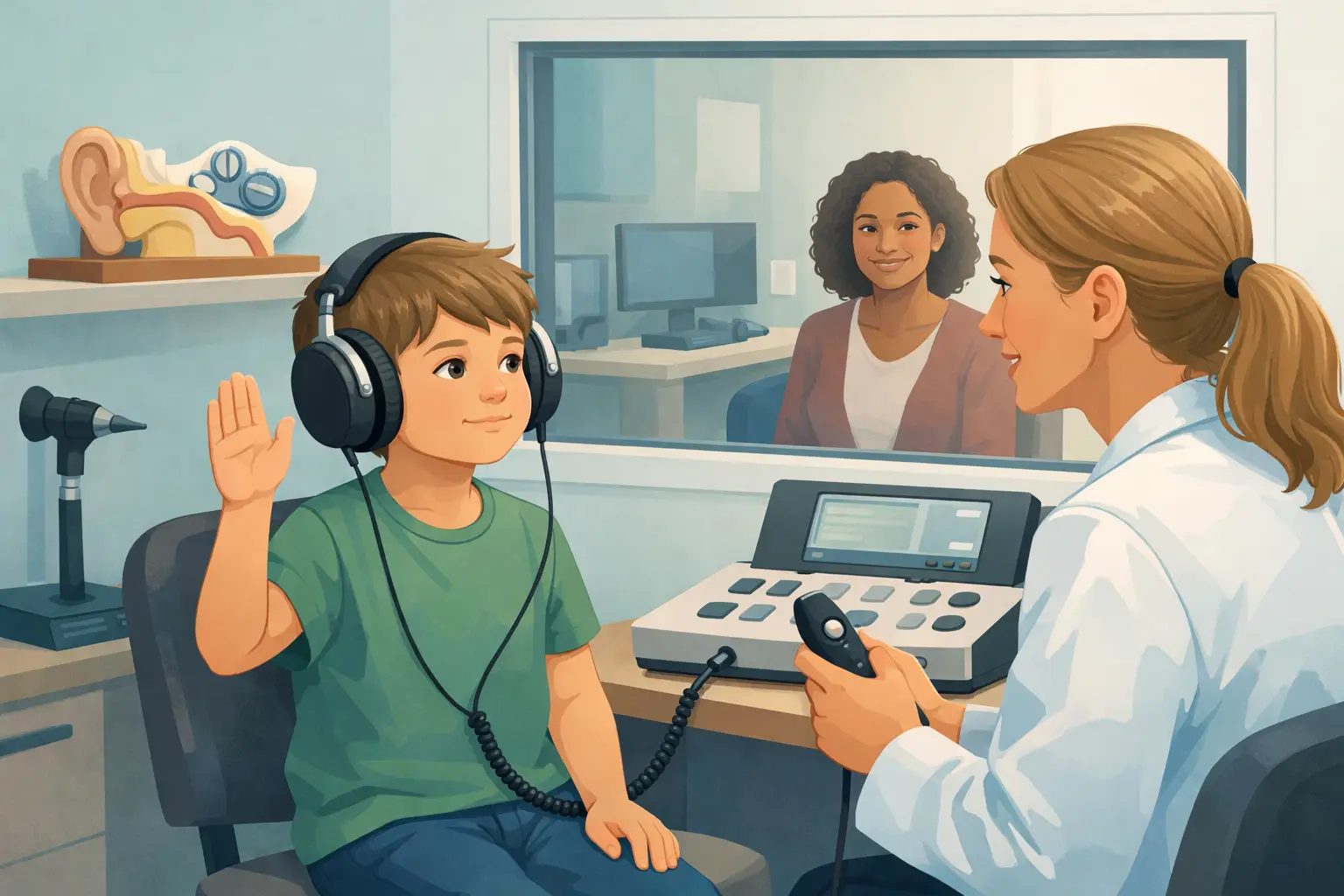
A good children’s hearing assessment is adapted to the child in front of the clinician. Age, confidence, communication style, developmental stage and the reason for referral all shape the appointment. There is no need for your child to “perform” perfectly, and assessments should not feel frightening or painful.
The appointment normally begins with a detailed discussion. You may be asked about pregnancy and birth history, newborn screening, ear infections, family history of hearing loss, speech and language development, school feedback and the specific situations that have concerned you. This context helps the clinician choose the most suitable tests and interpret the results accurately.
The audiologist will usually examine the outer ear and ear canal. This can identify visible wax, irritation, signs of infection or other factors that could affect sound reaching the eardrum. If earwax is present, the right next step depends on its amount, location and your child’s symptoms. Wax removal should never be treated as a one-size-fits-all solution, particularly in children.
Tests are chosen for your child’s age and ability
For babies and very young children, objective measures may be used. These can include tympanometry, which assesses how the eardrum and middle ear are moving, and otoacoustic emissions, which measure a response from the inner ear. These tests are quick and do not require the child to give verbal answers.
Older toddlers and preschool children may take part in play audiometry. Rather than raising a hand when they hear a sound, they might place a toy in a bucket or complete another simple game. School-age children can often complete pure tone audiometry using headphones, responding whenever they hear carefully controlled sounds at different pitches and levels.
Speech testing may also be useful, especially where listening in conversation is a concern. The precise test battery varies. A child with recurring glue ear may need a different assessment from a child who has difficulty hearing in class but no history of ear infections. This is why a paediatric-led approach is more valuable than a quick, generic screen.
Understanding the results and the next step
Results should be explained in plain language, not simply handed over as a graph. Your audiologist should clarify whether each ear is hearing within expected levels, whether there is evidence of middle-ear pressure or fluid, and whether the findings match the difficulties you have noticed.
Sometimes the answer is reassuring: hearing is within normal limits, and you have a clear baseline should concerns arise again. In other cases, monitoring may be recommended because middle-ear problems often improve as a cold resolves or fluid clears. Where further medical investigation is needed, an appropriate referral pathway can be discussed.
If hearing loss is identified, the next steps depend on its type, degree and likely cause. This may involve medical care, support at school, hearing technology or rehabilitation planning. There is no benefit in rushing to a solution without understanding the diagnosis, but there is also no reason to wait in silence when a child’s daily life is being affected.
At Tragus – The Ear Specialists, paediatric assessments are carried out with the same clinical care given to every ear-health concern. Qualified audiologists can provide a detailed assessment and practical guidance tailored to your child and family.
Preparing your child without causing worry
Keep the explanation simple. Tell your child they are visiting someone who checks how their ears hear sounds, and that they may wear headphones, listen for beeps or play a listening game. Avoid presenting the appointment as a test they can pass or fail. The aim is simply to learn more about their hearing.
Bring any relevant information, including school reports, details of recent infections, previous hearing-test results or a list of medicines. It can also help to note examples of when you see difficulties: perhaps your child misses their name in a crowded room, struggles with phonics or becomes upset by particular noises. Specific examples make the clinical conversation more useful.
If your child is tired, unwell or has severe ear pain on the day, call the clinic for advice. Some tests need a child to be settled and engaged, so a rearranged appointment may produce a more reliable result.
When to seek more urgent advice
Contact a GP or urgent healthcare service promptly if your child develops sudden hearing loss, severe ear pain, swelling around the ear, blood or pus-like discharge, dizziness, facial weakness, a high temperature with significant illness, or hearing change after a head injury. These symptoms need medical assessment rather than a routine hearing appointment.
For gradual concerns, recurring blocked ears or uncertainty about how well your child is hearing, arranging a specialist assessment can bring clarity. Children should not have to work harder than their peers simply to follow a conversation. A thoughtful hearing assessment can give families answers, reassurance and a clear route towards more comfortable, confident listening.