
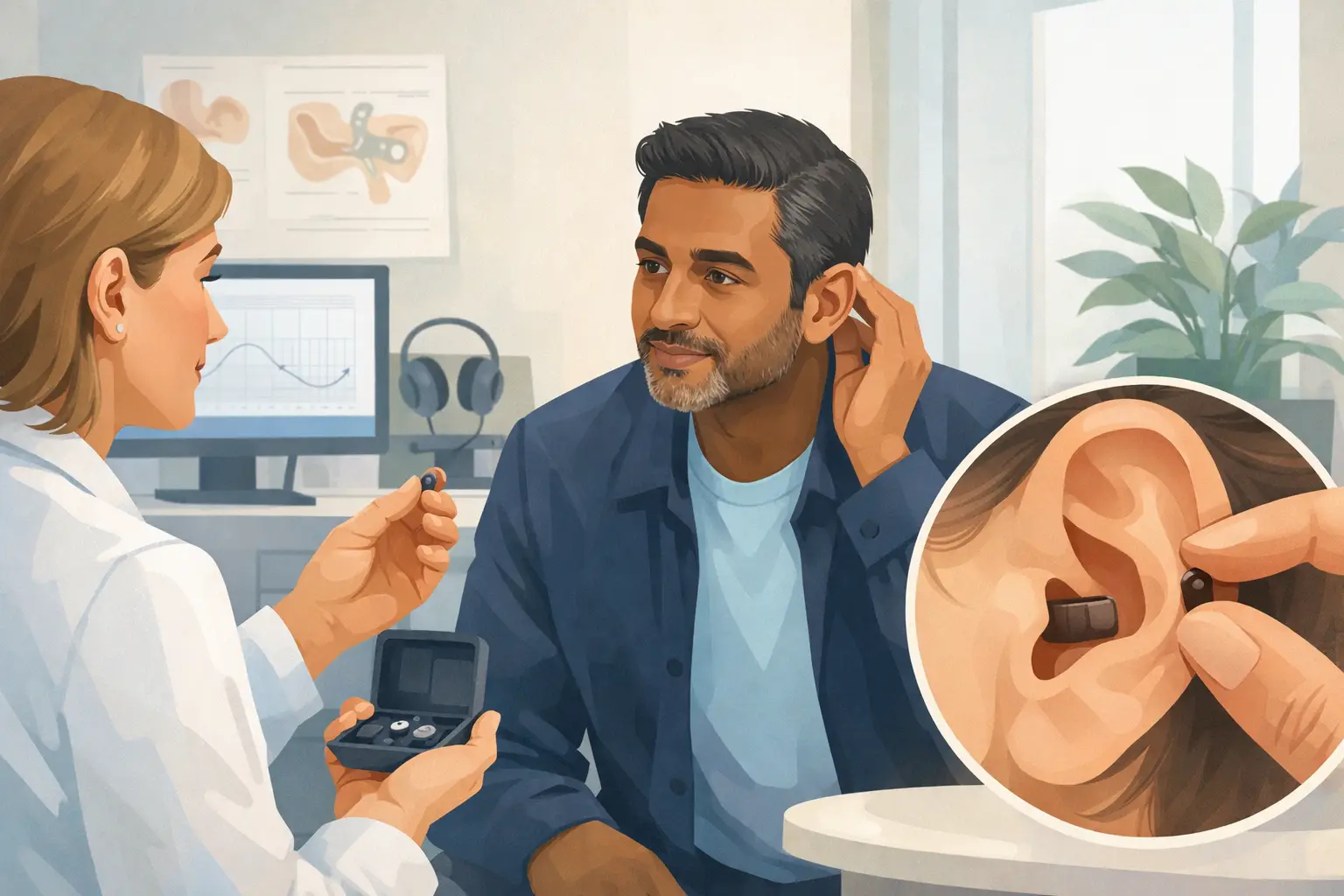
A hearing aid can be clinically sophisticated and almost impossible for others to notice. But are invisible hearing aids effective when it matters most: following conversation in a busy restaurant, hearing a colleague clearly, or enjoying family life without constantly asking people to repeat themselves? For the right person, they can be an excellent solution. Their effectiveness, however, depends on the type of hearing loss, the shape and health of the ear canal, and the quality of the assessment and fitting.
Invisible devices are not simply standard hearing aids made smaller. Their discreet design brings specific strengths and practical compromises. A qualified audiologist should help you decide whether those compromises are acceptable for your hearing needs and lifestyle, rather than allowing appearance alone to drive the choice.
What counts as an invisible hearing aid?
The term usually refers to hearing aids worn deep within the ear canal. The smallest are often called invisible-in-the-canal, or IIC, devices. They sit far enough into the canal that they are generally not visible when someone looks at you face-on. Completely-in-the-canal, or CIC, hearing aids sit slightly closer to the ear opening and may be visible at close range, although they remain very discreet.
Both styles are custom-made from an impression or digital scan of your ear. This is not a cosmetic detail. A precise fit affects comfort, sound quality, feedback control and how reliably the aid remains in place.
Because the microphones sit in or near the ear canal, these devices can make use of the ear’s natural shape to support a more natural sense of where sound is coming from. Some people also value the fact that they can wear glasses, masks, hats or protective headwear without a device sitting behind the ear.
Are invisible hearing aids effective for hearing loss?
Yes, invisible hearing aids can be highly effective for many people with mild to moderate hearing loss, particularly when the loss is suitable for the available level of amplification. Modern custom devices can be programmed carefully for your hearing profile, helping make speech clearer while managing sounds that might otherwise feel sharp or overwhelming.
Effectiveness should not be judged solely by whether speech seems louder. A successful fitting supports clearer communication, better listening comfort and a realistic adjustment to everyday sound. Your own voice may initially sound unfamiliar, and normal sounds such as running water, footsteps or rustling paper may appear more noticeable. This is often part of the brain readjusting to sounds it has not been hearing well.
The greatest test is often background noise. Small hearing aids have improved significantly, but their compact size limits the space available for microphones, battery capacity and certain advanced features. In a quiet one-to-one conversation, an invisible device may perform exceptionally well. In a crowded pub, open-plan workplace or large family gathering, a larger device may provide stronger directional microphone performance or more sophisticated noise management.
That does not mean invisible aids are ineffective in noise. It means the best option depends on where you spend your time and what you most need to hear. Someone who mainly wants discreet support for meetings, television and social conversation may be very well served. Someone who works daily in demanding, noisy environments may benefit from considering a broader range of styles.
Severity and type of hearing loss matter
An audiological assessment establishes not only how much hearing has changed, but also which frequencies are affected and how well speech is understood. Some invisible hearing aids can accommodate a useful range of losses, yet they do not offer the same power as larger receiver-in-ear or behind-the-ear models.
For more severe hearing loss, fitting an aid that is too small can mean insufficient amplification, reduced clarity and frustration. Choosing a larger device in this situation is not a failure of discretion. Many modern options are slim, subtle and capable of delivering substantially more support.
A hearing test can also identify signs that need medical investigation rather than immediate hearing aid fitting. Sudden hearing loss, one-sided changes, persistent ear pain, discharge, dizziness or a sudden increase in tinnitus should be assessed promptly by an appropriate healthcare professional.
The advantages of going discreet
For many patients, the appeal of an invisible hearing aid is not vanity. It is about feeling like themselves at work, in social situations or during a first step towards wearing hearing technology. If concern about visibility has delayed treatment, a nearly hidden device may remove a meaningful barrier and make consistent use more likely.
Custom in-the-ear devices can feel secure and comfortable once properly fitted. They are less likely to interfere with glasses, and they may be a practical choice for people who find behind-the-ear styles awkward with headwear. Their in-ear position may also reduce wind noise for some users compared with devices worn behind the ear.
There is a further practical advantage: because they are made for your ear, the fit is individual rather than generic. This can be particularly valuable for people who have tried standard amplification before and found it uncomfortable or unstable.
The trade-offs to consider honestly
The smallest hearing aid is not automatically the best hearing aid. Invisible models usually use very small batteries, which need replacing more often than rechargeable devices. Rechargeable custom options are available in some styles, but the tiniest deep-canal devices may still rely on disposable batteries due to their limited internal space.
They also require careful handling. Their size can make them harder to insert, remove and clean, especially for someone with reduced dexterity, poor vision or tremor. Most have a small removal thread, but this still needs to be managed confidently each day.
Earwax is another important consideration. All hearing aids need routine care, but devices placed deep in the canal are exposed to wax and moisture. Wax can block the sound outlet or microphone ports, making an otherwise well-programmed aid seem weak or silent. Regular checks and safe earwax management are part of effective long-term hearing care. Cotton buds should not be used inside the ear canal, as they can push wax deeper and cause irritation or blockage.
Not every ear canal is suitable for an IIC device. Very narrow, sharply curved or sensitive canals may make deep fitting uncomfortable or impractical. Recurrent outer-ear infections, active inflammation or significant wax build-up may need treatment before a custom hearing aid can be considered.
Why expert fitting makes the difference
A hearing aid is a clinical rehabilitation tool, not simply a sound amplifier. The process should begin with a detailed discussion of your symptoms, communication priorities, medical history and listening environments, followed by comprehensive hearing assessment.
At a specialist audiology appointment, the clinician can assess the ear canal, check for wax or signs of ear disease, measure hearing thresholds and evaluate speech understanding where appropriate. They can then explain whether an invisible hearing aid has enough power and the right features for your needs, or whether another style would offer a better outcome.
Programming is equally important. Hearing aids should be set according to measured hearing loss and verified where possible, then refined based on your real experience. A device can be technically advanced but disappointing if it is poorly fitted, uncomfortable or not adjusted after you have used it in daily life.
Follow-up support matters because adapting to hearing aids takes time. You may need settings adjusted for television, meetings, music or noise. You may also need practical coaching on insertion, cleaning, battery changes and recognising when wax is affecting performance. For people with tinnitus or sound sensitivity, careful programming and specialist advice can be particularly valuable.
How to decide whether they are right for you
Begin with your priorities. If you have mild to moderate hearing loss, want the least visible option and are comfortable with regular cleaning and battery changes, an invisible aid may be an excellent match. If your priority is rechargeable power, Bluetooth connectivity, easy controls or the strongest possible help in complex noise, a slightly larger hearing aid may be the more effective choice.
It is also worth considering your hands, eyesight and ear health, not just your audiogram. A hearing solution needs to work reliably on an ordinary Tuesday morning, not only look appealing in the clinic.
For patients in Kent who want an expert assessment rather than a one-size-fits-all recommendation, Tragus-The Ear Specialists can assess hearing, ear health and lifestyle needs before advising on appropriate technology. The aim is not to place the smallest device possible in the ear. It is to help you hear with greater clarity, confidence and comfort in the situations that matter to you.
If discreet hearing support would make you more likely to seek help, that is a worthwhile reason to explore invisible devices. Book a professional hearing assessment and let the evidence from your ears, your hearing and your daily life guide the decision.