
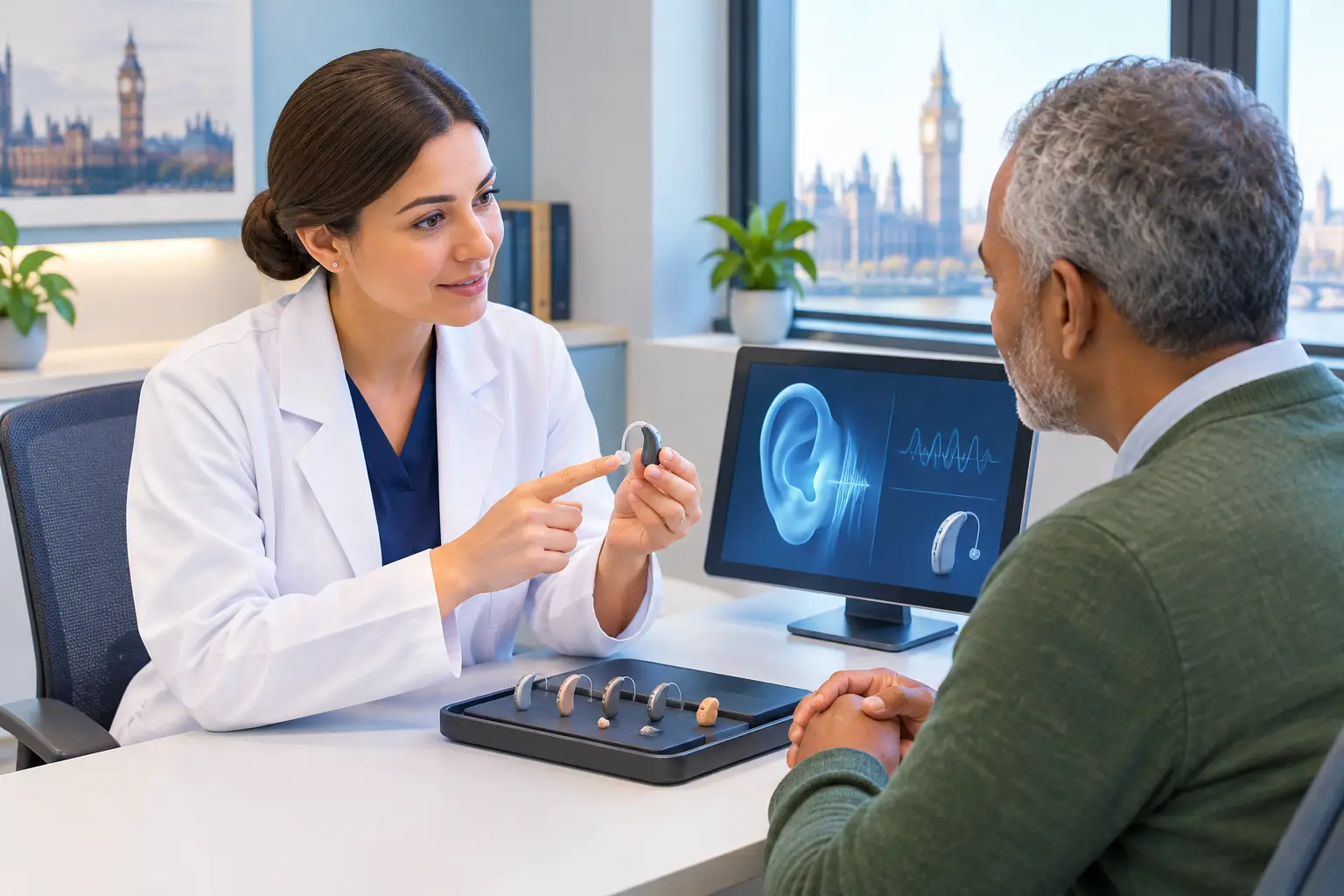
A busy family lunch can expose the real value of hearing technology. One moment you are following a conversation across the table; the next, cutlery, music and several voices make every word difficult to separate. AI hearing aids UK patients are hearing about are designed to respond more intelligently to these changing sound environments – but the technology is only as useful as the assessment, fitting and ongoing clinical support behind it.
What AI hearing aids are designed to do
The term “AI” can sound like a dramatic leap, but in hearing aids it usually refers to advanced algorithms that identify and respond to patterns in sound. Modern premium devices use microphones and sound-processing systems to analyse whether you are in a quiet room, a noisy restaurant, a car, outdoors or listening to speech from in front of you.
They can then adjust features such as directional microphones, noise reduction, feedback management and amplification automatically. Some systems are trained on large collections of real-world sounds, helping them distinguish speech from background noise more effectively than older, simpler programmes.
The aim is not to make every sound disappear. Background sound gives us useful information about where we are and what is happening around us. Instead, well-programmed technology should make speech more accessible and listening less effortful, while retaining a natural awareness of your surroundings.
For many people, the greatest potential benefit is in the situations that matter most: meetings, family gatherings, cafés, television viewing, travelling and conversation in the car. The result may be clearer speech, fewer manual adjustments and less fatigue at the end of a demanding day.
AI hearing aids in the UK are not all the same
“AI hearing aid” is not a single clinical category or a guarantee of performance. It is a marketing term used broadly across advanced hearing technology, and different devices use intelligence in different ways. One may focus on recognising acoustic environments, while another may prioritise speech enhancement, motion sensing, health-related tracking or personalised adjustments through an app.
This is why selecting a device from a feature list alone can be misleading. A person whose main difficulty is hearing a partner at home may need a different solution from someone working in open-plan offices, attending frequent social events or experiencing reduced hearing in both ears with troublesome background noise.
The physical design matters too. Some people prefer discreet devices that sit behind the ear or fit within it; others value rechargeable batteries, simple controls or a stronger connection to a mobile phone. Dexterity, vision, lifestyle and ear anatomy should all inform the recommendation. The most advanced technology is not automatically the most suitable technology.
What artificial intelligence cannot do
AI can support hearing, but it cannot restore normal hearing in every situation. When several people speak at once, even sophisticated devices must make decisions about which sounds to prioritise. Accents, distance, room echo and very low speech volume can still make communication challenging.
Nor can a hearing aid diagnose the reason for a change in hearing, tinnitus, ear discomfort or a blocked sensation. Sudden or concerning changes require timely clinical advice. Before recommending hearing technology, a qualified audiologist should establish a clear picture of your hearing, ear health and communication needs.
It is also worth being cautious about claims that a device can “remove” all background noise. If noise reduction is too aggressive, speech can sound unnatural or the listener may feel disconnected from their environment. Good audiological care balances clarity, comfort and awareness rather than pursuing silence at all costs.
Why expert assessment and fitting still matter
A hearing aid begins with the hearing assessment, not the device. At a specialist appointment, your audiologist should discuss when you struggle, the settings where you hear well, your medical and hearing history, and the impact on work, relationships and confidence. Testing should assess more than whether you can hear faint tones in a quiet room.
The prescription is then tailored to the pattern and degree of hearing loss in each ear. This matters because amplification that is too soft may not provide enough access to speech, while amplification that is too strong can be uncomfortable and may make sound feel harsh. Two people wearing the same model can need very different settings.
Verification is equally important. Real-ear measurement uses specialised equipment to assess how the hearing aid is performing in your own ear canal. It helps the audiologist confirm that amplification is meeting appropriate targets, rather than relying solely on manufacturer settings or a patient’s first impression.
Follow-up care gives your brain time to adapt and allows fine adjustments in response to real-life experience. Hearing through amplified sound is a process of rehabilitation. Voices, household sounds and your own voice may initially seem unfamiliar, particularly if hearing loss has been present for some time. A clinician can refine the programme and help you use the technology with confidence.
At Tragus – The Ear Specialists, hearing aid recommendations are made as part of a thorough, patient-centred assessment. The focus is on hearing clarity and everyday outcomes, supported by qualified audiologists with specialist clinical experience.
Questions to ask before choosing AI hearing aids
A useful discussion is not simply “Which is the newest model?” Ask which listening difficulties the recommended device is expected to address and where its limitations may remain. If hearing in noise is your priority, ask how speech and competing sound will be managed. If you use a mobile phone regularly, ask about call streaming, app controls and how straightforward they are in practice.
You should also ask what happens after the fitting. Hearing needs can change, and devices occasionally need adjustment, cleaning or troubleshooting. Ongoing aftercare is particularly valuable when technology has multiple automatic features, as a small programming change can make a meaningful difference to comfort and speech understanding.
For people with tinnitus or sound sensitivity, the conversation needs additional care. Some hearing aids may be used as part of a wider tinnitus management plan when hearing loss is also present, but settings should never be treated as a one-size-fits-all answer. The goal is to support comfortable hearing and reduce the strain that difficult listening can place on daily life.
Data, apps and practical confidence
Many AI-enabled hearing aids connect to smartphone apps. These can offer volume control, programme changes, remote fine-tuning in some cases and useful usage information. For some patients, this added control is reassuring. For others, it is unnecessary or feels like another piece of technology to manage.
Ask what information an app collects, whether it is optional and how easy it is to use. If you would rather not rely on a smartphone, that should not prevent you from receiving effective hearing care. Physical buttons, automatic programmes and simple rechargeable options may be the better fit.
Battery routine is another practical consideration. Rechargeable aids are convenient for many users, particularly those with reduced dexterity, but they need regular charging and a dependable routine. Disposable batteries may suit others, especially where charging access is limited. Neither choice is universally better.
Getting the best from your hearing technology
Even excellent devices work best alongside practical communication habits. In a noisy venue, choose a quieter table where possible, face the person speaking and reduce distance between you. Let friends, family and colleagues know that hearing in noise can still take concentration. These small changes are not a failure of technology; they are sensible ways to make conversation easier.
If you are considering AI hearing aids, look beyond the label. The right solution should reflect your hearing test results, ear health, daily environments and personal priorities, then be carefully verified and reviewed. With expert assessment and properly tailored rehabilitation, advanced technology can help you hear the conversations that make life feel connected again.