
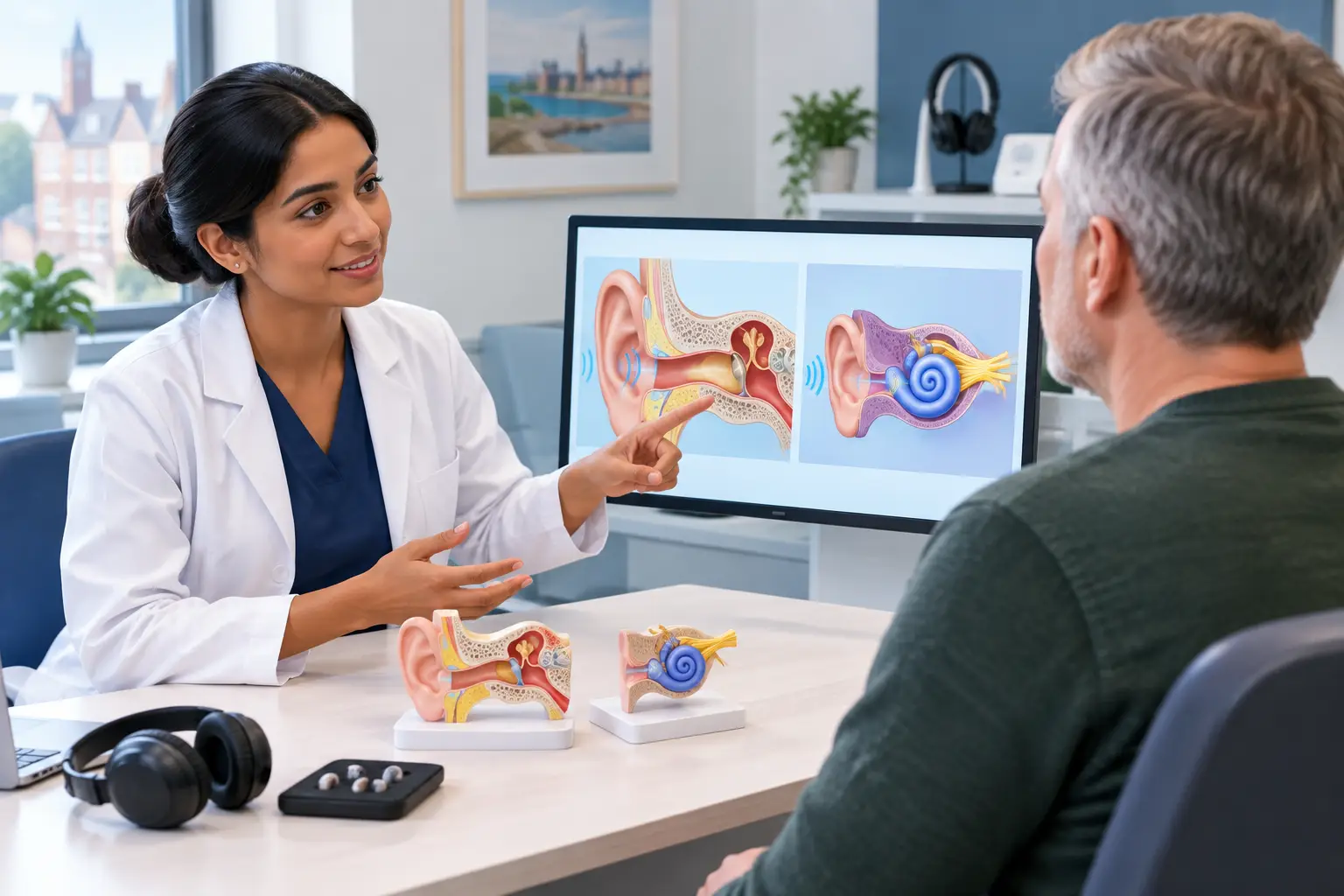
A blocked ear after a cold can make voices sound distant. A gradual difficulty following conversation in a busy restaurant can feel very different. Both may be described as hearing loss, but conductive versus sensorineural hearing loss refers to two distinct problems in the hearing system – and the difference shapes the right assessment, treatment and rehabilitation.
The first affects how sound travels through the outer or middle ear. The second affects the inner ear or hearing nerve. Symptoms can overlap, so it is not possible to diagnose the type reliably from sensation alone. An expert hearing assessment identifies where the difficulty is arising and, just as importantly, whether there is a treatable cause that should not be missed.
What is conductive hearing loss?
Conductive hearing loss occurs when sound cannot pass efficiently through the ear canal or middle ear to reach the inner ear. Think of it as a reduction in sound volume before sound reaches the part of the ear that converts it into nerve signals.
Common causes include earwax blockage, an ear canal infection, fluid behind the eardrum, a perforated eardrum and problems with the tiny middle-ear bones. Eustachian tube dysfunction – often associated with colds, allergies or pressure changes – can also create a feeling of fullness and temporarily affect hearing. Less commonly, conditions such as otosclerosis can restrict movement of the middle-ear bones.
Conductive loss is often associated with muffled hearing, pressure, popping, discomfort or a sense that one ear is blocked. Your own voice may sound unusually loud or hollow. However, pain is not always present, and a person can have a significant conductive loss without feeling unwell.
Many causes can be treated directly. Safe microsuction earwax removal may restore hearing quickly where wax is responsible. An infection, fluid or eardrum concern may require medical management, monitoring or referral to an appropriate ENT specialist. The treatment depends entirely on the cause, which is why looking into the ear is an essential part of assessment.
What is sensorineural hearing loss?
Sensorineural hearing loss arises in the inner ear, usually in the cochlea, or along the auditory nerve pathway. The cochlea contains delicate sensory hair cells that translate sound vibrations into electrical signals for the brain. These cells do not usually regenerate once damaged.
Age-related hearing loss is the most common cause. It often develops gradually and affects higher-pitched sounds first, making speech less clear rather than simply quieter. People may hear that someone is talking but struggle to distinguish words, particularly when there is background noise. Tinnitus can occur alongside sensorineural hearing loss, although it has several possible causes.
Other causes include prolonged or sudden exposure to loud noise, certain medications, viral illness, inherited factors, head injury and disorders affecting the inner ear. Sensorineural loss may affect one ear or both, and its pattern can offer valuable clinical clues.
While inner-ear damage is not generally reversible, that does not mean nothing can be done. Modern hearing aids are prescribed and programmed according to an individual’s hearing profile, listening needs and comfort. For some patients, tinnitus therapy, communication strategies and follow-up rehabilitation are equally important parts of care. The goal is not simply to make sound louder. It is to improve clarity, confidence and participation in daily life.
Conductive versus sensorineural hearing loss: key differences
The central difference is location. Conductive loss involves the outer or middle ear; sensorineural loss involves the inner ear or auditory nerve. Conductive loss can frequently be temporary or medically treatable, whereas sensorineural loss is more often permanent and managed through hearing rehabilitation.
In real life, the distinction is not always neat. A person with age-related sensorineural hearing loss may also develop wax blockage, making their hearing suddenly worse. Others have mixed hearing loss, meaning there is both a conductive and sensorineural component. This is one reason an off-the-shelf solution or an assumption that symptoms are “just wax” can delay the most appropriate care.
An audiogram helps differentiate the types. During a comprehensive hearing test, sounds are presented through headphones and through a small device placed behind the ear that bypasses the outer and middle ear. Comparing these responses helps establish whether sound transmission, inner-ear function or both are affected. Otoscopy, which examines the ear canal and eardrum, and middle-ear pressure testing may also be used.
When hearing loss needs prompt attention
Sudden hearing loss in one or both ears should be treated as urgent, especially if it develops over hours or a few days. Sudden sensorineural hearing loss can require prompt medical assessment, and early treatment may affect the outcome. Do not assume it is wax or wait for it to settle without seeking advice.
A rapid assessment is also advisable where hearing loss is accompanied by severe dizziness, facial weakness, ear discharge, significant pain, a head injury or new one-sided tinnitus. These symptoms do not automatically indicate a serious condition, but they need appropriate clinical judgement.
For gradual changes, it is still worth arranging an assessment rather than adapting around the problem. Turning up the television, avoiding group conversations or repeatedly asking family members to speak up can become normal long before someone recognises how much hearing is affecting work, relationships and wellbeing.
Why children need specialist assessment
In children, conductive hearing loss is commonly linked with middle-ear fluid, sometimes called glue ear. It may fluctuate, so a child can seem to hear well on some days and miss speech on others. They may become tired at school, appear inattentive, ask for repetition or turn the volume up.
Sensorineural hearing loss in children requires equally careful investigation and support. Early identification matters because hearing supports speech, language, learning and social development. A paediatric hearing assessment should be adapted to the child’s age, communication stage and ability to engage with testing. It is not simply an adult hearing test performed more quickly.
Parents should consider assessment if they have concerns about speech development, listening, balance, recurrent ear infections or a family history of hearing loss. Reassurance is valuable, but so is a clear answer.
What happens at a specialist hearing assessment?
A qualified audiologist begins by discussing the change you have noticed, your medical history, noise exposure, medications and the situations in which hearing is most difficult. The ears are examined before testing, as this may reveal wax, infection, inflammation or an eardrum issue.
Pure-tone audiometry measures the quietest sounds you can hear across different pitches. Speech testing may assess how clearly you understand words, while tympanometry evaluates middle-ear function. Where needed, further assessment or medical referral is recommended. The result should be explained in plain language, including whether the findings suggest conductive, sensorineural or mixed hearing loss and what practical next step makes sense.
At Tragus-The Ear Specialists, assessments are led by qualified clinicians with experience in diagnostic audiology, ear care and hearing rehabilitation. For patients across Kent and nearby areas, this means care can be tailored to the cause of the problem rather than limited to a one-size-fits-all response.
Choosing the right treatment and support
Treatment should follow diagnosis, not precede it. If hearing is reduced because of wax, the priority is safe removal and a check that hearing has returned as expected. If fluid or an eardrum problem is identified, monitoring or medical treatment may be appropriate. If testing confirms sensorineural loss, hearing aids may be recommended after a discussion of listening goals, dexterity, lifestyle and budget.
A hearing aid is not the right answer for every conductive problem, nor is medical treatment always able to restore inner-ear hearing. Some people benefit most from a combination of treatment, hearing technology and listening strategies. Regular review also matters, because hearing needs and ear health can change over time.
If hearing has become less clear, more effortful or increasingly isolating, an expert assessment provides more than a hearing score. It gives you a clear explanation and a plan to help you hear the conversations, sounds and moments that matter to you.