
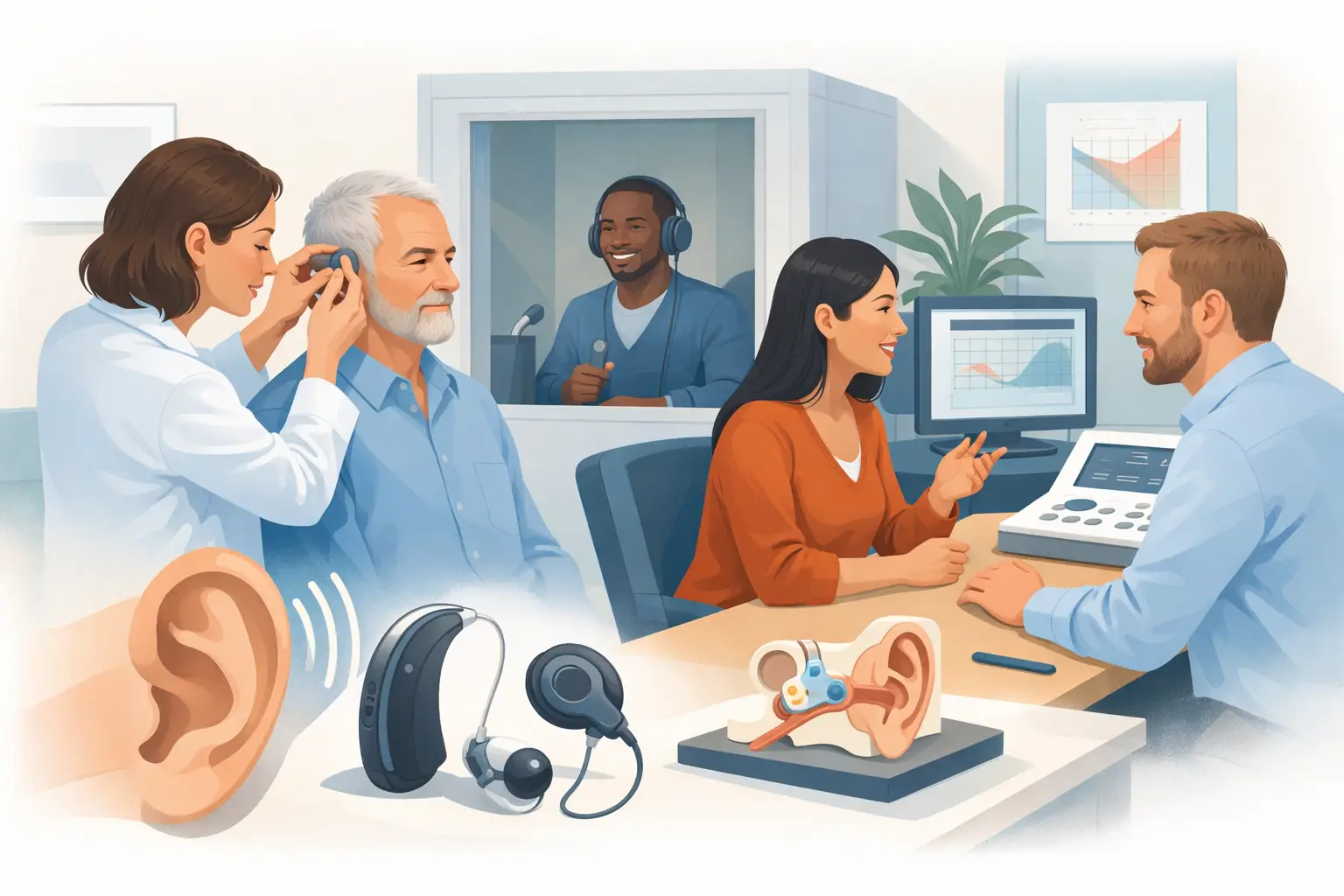
Hearing loss rarely affects only the ears. It can make family conversations tiring, meetings harder to follow and familiar social settings feel unexpectedly isolating. A guide to hearing rehabilitation should therefore begin with the wider picture: rehabilitation is not simply about making sound louder. It is a personalised clinical process designed to help you understand sound, communicate with greater confidence and return to the parts of life that hearing difficulties may have restricted.
For some people, that means carefully fitted hearing aids and structured follow-up. For others, it means treating earwax blockage, addressing tinnitus-related distress, developing listening strategies or arranging specialist assessment for a child. The right plan depends on the cause of the difficulty, your hearing test results and the situations that matter most to you.
What hearing rehabilitation actually involves
Hearing rehabilitation combines expert assessment, appropriate treatment and ongoing support. Its purpose is to reduce the practical and emotional impact of hearing difficulties, rather than focusing on an audiogram alone.
A hearing test provides essential information, but it is only the starting point. Two people with similar test results may have very different needs. One may struggle most in busy restaurants; another may be concerned about hearing grandchildren, participating in work calls or noticing alarms at home. A qualified audiologist should explore these real-world priorities before recommending a course of action.
Rehabilitation may include hearing aid fitting and fine-tuning, communication coaching, tinnitus therapy, advice for family members, hearing protection or medical referral where symptoms suggest an underlying ear condition. When care is joined up, each element supports the same goal: clearer, more comfortable and more confident hearing in daily life.
Start with an expert hearing assessment
A comprehensive assessment establishes whether there is hearing loss, its likely type and whether further investigation is needed. This is particularly important if hearing has changed suddenly, affects one ear more than the other, or occurs alongside pain, discharge, dizziness or a new persistent noise in the ear.
Your appointment should include a discussion of your symptoms, medical and noise-exposure history, and the situations where hearing is most difficult. The clinician will examine the ears, assess hearing thresholds and explain the findings in clear language. If wax is blocking the ear canal, this may need to be safely removed before an accurate test can be completed.
For children, assessment requires additional care. A child may not describe a hearing difficulty directly, and the signs can be subtle: delayed speech, frequent requests for repetition, difficulty following instructions or apparent inattention at school. Paediatric hearing assessment is tailored to the child’s age, developmental stage and ability to respond, giving parents a clearer basis for next steps.
When a hearing test leads to medical advice
Not every hearing difficulty is best managed with amplification. Conductive hearing loss, for example, can result from wax, middle-ear fluid or other conditions affecting sound transmission. Sensorineural hearing loss involves the inner ear or hearing nerve and is often permanent, although its impact can be managed very effectively.
A responsible rehabilitation plan recognises this distinction. Where findings indicate that ENT or GP input is appropriate, referral should form part of the care pathway. Hearing aids should not be used to bypass symptoms that require medical assessment.
Hearing aids: fitting is only the beginning
Modern hearing aids are small, sophisticated devices, but their value depends on clinical fitting and aftercare. The device must be selected for your hearing profile, ear shape, dexterity, lifestyle and listening goals. Someone who regularly attends professional meetings may need a different solution from someone whose main priority is relaxed conversation at home.
During fitting, settings are adjusted to provide appropriate audibility without making sound uncomfortably sharp or overwhelming. Your audiologist should explain insertion, charging or battery care, cleaning and the programme settings available to you. This practical guidance matters. A well-chosen device is less helpful if it stays in a drawer because it feels unfamiliar or difficult to manage.
It also takes time for the brain to adjust. Hearing loss can reduce access to certain sounds for months or years. When those sounds become audible again, everyday noises such as cutlery, traffic or rustling paper may initially seem prominent. This does not necessarily mean the hearing aids are wrong. It often reflects the adjustment period, although any persistent discomfort should be reviewed promptly.
Follow-up appointments make the difference
The most successful hearing aid users do not simply collect their devices and hope for the best. Follow-up allows the clinician to assess comfort, clarity and performance in the environments that matter to you. Adjustments may be needed for background noise, telephone use, television or a particular workplace setting.
Keep brief notes between appointments. Record situations that went well and those that remained difficult, including the type of noise present and whether you were close to the speaker. Specific examples help your audiologist make meaningful refinements rather than relying on general impressions.
Relearning how to listen
Hearing aids improve access to sound, but they cannot remove every communication challenge. Busy spaces remain demanding because the brain must separate speech from competing noise. Hearing rehabilitation includes practical strategies that make these situations easier.
Choose your position thoughtfully. Sit with your back to a wall where possible, face the person speaking and avoid placing yourself beside loud music or a coffee machine. Good lighting supports lip-reading and facial cues, which are a normal part of communication for everyone, not a sign of failure.
It is equally reasonable to tell others what helps. Ask people to gain your attention before speaking, face you rather than calling from another room, and rephrase rather than simply repeat a misunderstood sentence more loudly. Family members often want to help but may need clear guidance about how hearing loss affects conversation.
At work, small adjustments can have a significant effect. Request written agendas for complex meetings, use captions on video calls where available and choose quieter rooms for important discussions. Rehabilitation is most effective when the environment is adapted alongside the hearing technology.
Tinnitus and sound sensitivity need a tailored approach
Tinnitus is the perception of sound without an external source, often described as ringing, buzzing, humming or hissing. It may occur with hearing loss, but the level of distress it causes is not determined by volume alone. Sleep disruption, anxiety, concentration difficulties and fear of the sound can all make tinnitus feel more intrusive.
A tinnitus assessment explores the symptom in context. Hearing assessment may identify a hearing loss that contributes to reduced sound input, while therapeutic support can address the emotional and attentional response to tinnitus. Hearing aids may help some patients by improving access to external sound, but they are not the only approach and are not appropriate for every person.
Hyperacusis, or reduced tolerance to everyday sounds, also requires specialist care. Avoiding all sound or wearing earplugs constantly can sometimes increase sensitivity over time. The balance is individual: hearing protection is sensible for genuinely loud environments, such as live music, shooting or power tools, but routine overprotection may not be helpful. A qualified clinician can advise on safe sound exposure and a manageable rehabilitation plan.
How to make progress between appointments
Consistency is often more useful than perfection. If hearing aids have been prescribed, build wearing time steadily according to your clinician’s advice and use them in a variety of comfortable everyday settings. This gives your auditory system the opportunity to adapt while providing useful feedback for fine-tuning.
Protect your hearing from excessive noise without withdrawing from the activities you enjoy. Custom earplugs can be valuable for musicians, swimmers, motorcyclists and people exposed to loud recreational or occupational sound. The aim is protection that suits the task, not silence at all costs.
Review your goals as your confidence grows. You may begin with wanting to hear a partner more easily at home, then progress to enjoying a meal out or taking part in group conversations. These changes are meaningful clinical outcomes because hearing rehabilitation is about participation, independence and wellbeing.
Choosing specialist support
Look for care led by qualified audiologists who take time to assess both the hearing test and the person behind it. Ask how follow-up is managed, whether tinnitus and sound sensitivity are assessed where relevant, and what happens if the results suggest medical referral. Premium hearing care should be clinically accountable, transparent and tailored to your needs.
At Tragus-The Ear Specialists, hearing rehabilitation is approached as a continuing relationship rather than a one-off transaction. For adults and families across Kent, the priority is expert assessment, clear recommendations and support that helps hearing feel useful in the moments that matter.
You do not need to wait until communication has become exhausting to seek advice. An expert assessment can provide reassurance, identify treatable causes and give you a practical route towards hearing the world in high-definition once more.