
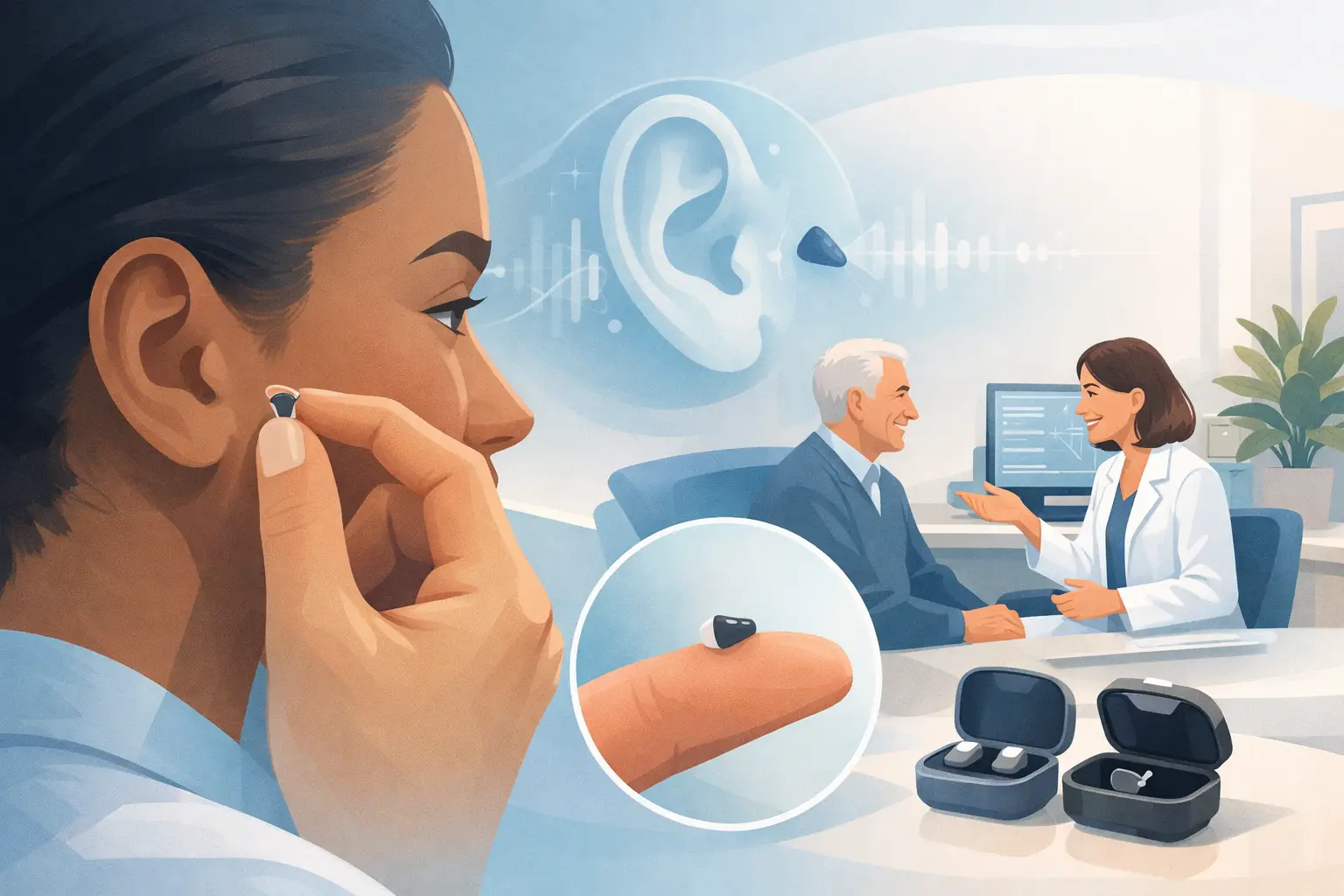
A hearing aid that sits entirely out of sight can sound like the ideal answer, particularly for people who have delayed seeking help because they worry about appearance. The future invisible hearing aids may be genuinely impressive: smaller devices, more personalised sound processing and better ways to hear speech in demanding places. Yet the most valuable development will not simply be making a device harder to see. It will be making hearing care more precise, comfortable and effective for the individual wearing it.
For many people, hearing loss first becomes obvious in ordinary moments: following a conversation in a busy restaurant, hearing grandchildren clearly, contributing confidently at work or no longer asking a partner to repeat themselves. A discreet device can support confidence, but it must also provide the right level of hearing rehabilitation. That starts with an expert assessment, not a product choice.
Why invisible hearing aids are changing
Invisible hearing aids are generally designed to sit deep within the ear canal, where they are less noticeable from the outside. Current styles vary from very small custom devices that sit close to the eardrum to slightly larger in-the-ear instruments that remain discreet while allowing more features or simpler handling.
The appeal is understandable. Some patients want to wear their hearing aid without drawing attention to it. Others find that a device positioned in the ear canal gives a more natural sense of sound, as the outer ear can continue to help direct sound into the ear. For suitable ears and hearing profiles, this can be an excellent option.
However, invisibility involves compromises. The smallest devices have limited physical space for batteries, microphones, controls and wireless components. They may be less appropriate for people with more significant hearing loss, narrow or curved ear canals, recurring earwax blockage, reduced dexterity or a need for extended daily battery life. A hearing aid should be chosen for its clinical suitability and benefit, not because it disappears from view.
Future invisible hearing aids will be more personalised
The next generation of discreet hearing technology is likely to focus on how well the aid adapts to the wearer, rather than only how small it can be. Hearing is not a single-volume problem. Many people hear some sounds adequately but struggle with speech in background noise, higher-pitched voices, television dialogue or conversations across a room.
More advanced processing can already identify aspects of a listening environment and adjust amplification accordingly. Future systems may become better at distinguishing speech from unwanted noise, prioritising the voice in front of the listener and adapting to the acoustic patterns of familiar settings such as home, work or a favourite café.
This has clear potential, but it needs a sensible expectation. No hearing aid can remove every background sound without also risking an unnatural listening experience. Noise reduction can make listening easier, but the brain still needs time to adjust to amplified sound and to relearn how to separate useful speech from competing noise. A carefully programmed device, supported by follow-up appointments, remains essential.
Better fitting through ear-shape data
Custom invisible aids depend on an accurate impression or scan of the ear canal. Improvements in digital scanning and manufacturing may allow an even closer, more comfortable fit, with better retention and more predictable acoustic performance.
A precise fit matters for more than discretion. It affects comfort, sound quality, feedback control and whether the aid can be worn consistently. If a device causes soreness, feels blocked or works its way out of the ear, it is unlikely to deliver its full benefit. The ear canal also changes over time, so comfort and fit should be reviewed rather than assumed.
Smarter health monitoring, with limits
There is growing interest in ear-worn technology that can monitor elements of health and activity. Future devices may be able to collect useful information about hearing aid use, listening environments or potentially wider wellbeing indicators. This could help audiologists understand when and where a patient is finding communication difficult.
That said, a hearing aid is not a substitute for medical assessment. New or sudden hearing changes, one-sided symptoms, persistent ear pain, discharge, dizziness or pulsatile tinnitus require timely clinical attention. Data from a device may be useful, but it cannot diagnose the cause of a hearing problem on its own.
The challenge of power and connectivity
A tiny hearing aid has very little room for a power source. Rechargeable technology is advancing quickly, but very small deep-canal devices may continue to rely on small disposable batteries for some time. This is not necessarily a disadvantage for every wearer. Some people prefer the convenience of replacing a battery, while others value the routine of charging overnight.
Connectivity creates another balancing act. Bluetooth streaming, app controls and remote fine-tuning can be helpful, especially for phone calls, television and day-to-day adjustments. But full wireless capability requires space and power. A larger discreet aid may therefore offer more practical features than the smallest invisible model.
The right question is not, “What is the smallest hearing aid available?” It is, “Which device will help me hear comfortably in the situations that matter most?” For one person, that may be an almost invisible custom aid. For another, a small receiver-in-the-ear device may provide greater speech clarity, longer wear time and easier control while still being very discreet.
Expert assessment remains central
Before considering future invisible hearing aids, a full hearing assessment is the right starting point. This should establish the type and degree of hearing loss, assess speech understanding and identify whether earwax, middle-ear concerns or other factors may be affecting hearing.
Ear health is particularly relevant for deep-canal devices. Wax can block sound from reaching the hearing aid microphone, reduce comfort and interfere with the fit. People who produce frequent wax may need periodic microsuction earwax removal and a device style that can be maintained safely. Attempting to clear wax with cotton buds or improvised tools can push it deeper and damage the ear canal.
A qualified audiologist will also discuss lifestyle, work demands, manual dexterity, vision, cosmetic preferences and previous experience with hearing aids. These details are not secondary. A technically advanced aid is of little use if the wearer cannot insert it confidently, change the battery, clean it properly or tolerate it for a full day.
At Tragus-The Ear Specialists, hearing aid recommendations are guided by clinical findings and real-world listening needs, with ongoing support to refine the fitting as hearing and circumstances change.
Hearing rehabilitation is more than the device
Even the most sophisticated hearing aid cannot immediately restore hearing to how it was years ago. When hearing loss has developed gradually, the brain has often adapted by paying less attention to sounds it no longer receives clearly. Reintroducing those sounds can initially feel sharp, busy or tiring.
This adjustment is normal. Consistent wear, gradual programme changes and follow-up fine-tuning give the brain time to adapt. Patients often notice that speech becomes easier to follow over several weeks, particularly when they use their hearing aids in a range of everyday settings rather than only on special occasions.
For people living with tinnitus or sound sensitivity, the approach should be even more individualised. Amplification can sometimes reduce the contrast between tinnitus and external sound, but the device settings must be comfortable and appropriate. Hyperacusis, tinnitus distress and hearing loss may need a combined rehabilitation plan rather than a simple amplification solution.
Choosing discreet hearing technology with confidence
The future is likely to bring hearing aids that are less visible, more intelligent and more tailored to the wearer’s ears. That is positive news, but smaller is not automatically better. The best device is one that matches the hearing test results, keeps the ear comfortable and delivers reliable benefit in the situations that shape daily life.
If you are considering a discreet hearing aid, begin with an expert hearing and ear-health assessment. A clear diagnosis and a carefully supported fitting can make the difference between owning a tiny device and genuinely hearing the world in high-definition once more.