
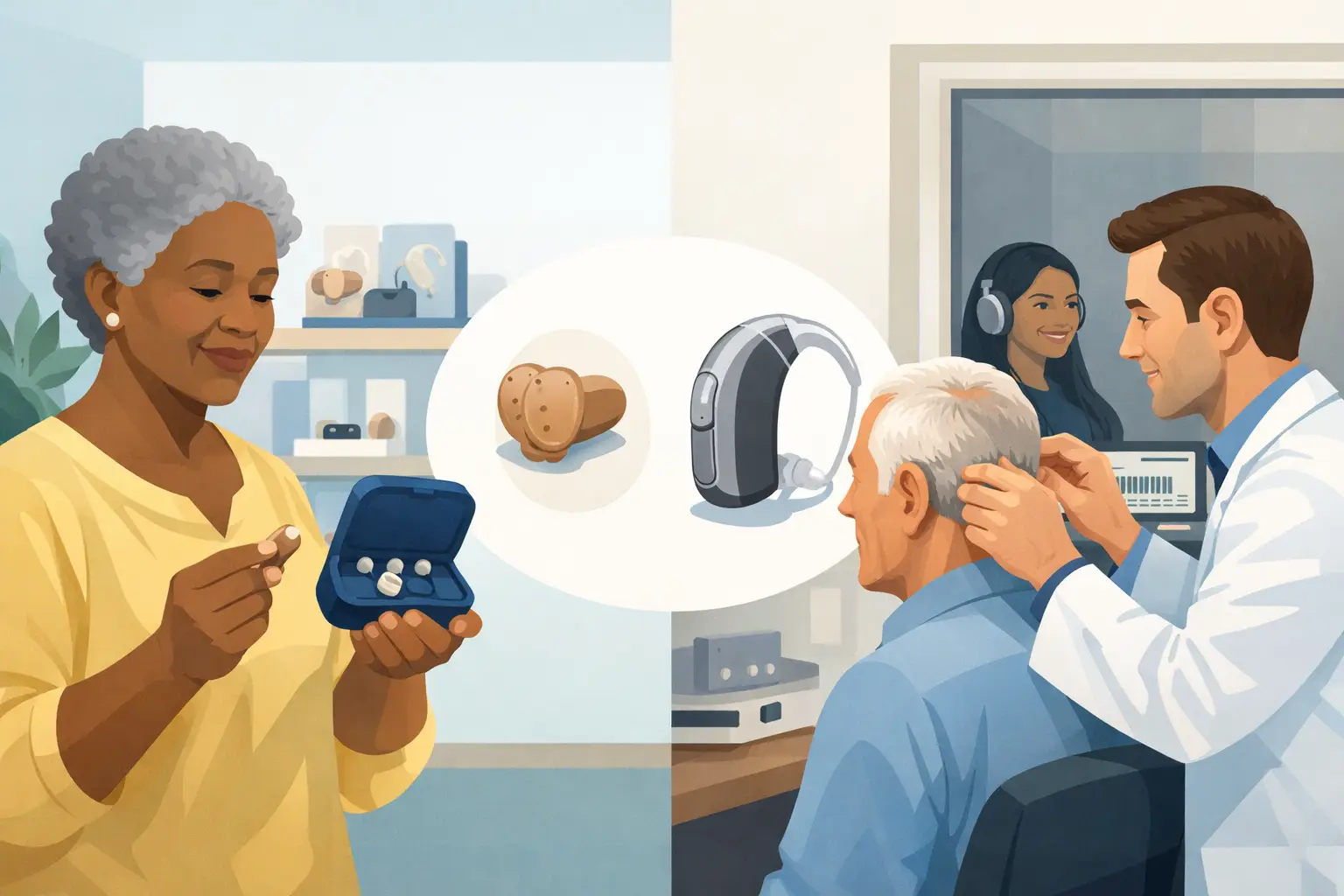
A hearing aid can make conversations, work meetings and family time feel accessible again. But when comparing over-the counter OTC versus prescription hearing aids, the lowest upfront price is only one part of the decision. The right choice depends on the nature of your hearing loss, the health of your ears and the level of clinical support you need to hear comfortably and confidently.
For many people, hearing loss develops gradually. You may turn up the television, struggle in restaurants or find yourself asking others to repeat themselves, yet still feel unsure whether a hearing aid is necessary. That uncertainty is precisely why expert assessment has value: it distinguishes a straightforward hearing loss from problems that require medical investigation, treatment or a more tailored rehabilitation plan.
Over-the-counter OTC versus prescription hearing aids: the UK position
The term “OTC hearing aid” is most commonly used in the United States, where there is a defined over-the-counter category for adults with perceived mild to moderate hearing loss. In the UK, the position is less clear-cut. Hearing aids are regulated medical devices, but some products can be bought directly online or from retail providers without a full in-person audiology appointment.
“Prescription hearing aid” is also not a formal UK prescription in the way antibiotics or spectacles may be prescribed. It is commonly used to describe a device selected, programmed and verified by a qualified audiologist after a comprehensive hearing assessment. This distinction matters. You are not simply buying amplification; you are receiving a hearing solution based on measured hearing thresholds, ear examination, lifestyle needs and ongoing care.
Some direct-to-consumer products are genuine hearing aids. Others are personal sound amplification products, which amplify sound but are not designed or regulated to address hearing loss in the same way. The language used in advertisements can be confusing, so it is worth checking exactly what is being sold and what support comes with it.
What an OTC-style device can offer
Direct-purchase hearing aids can be attractive for adults who have noticed mild difficulty hearing and want a lower-cost, immediate option. They are often small, rechargeable and adjusted through an app. Some include basic hearing checks, preset listening programmes and remote customer support.
For a person with stable, symmetrical mild hearing difficulty, good dexterity and confidence using a smartphone, this route may be reasonable. It can also help someone understand whether amplification feels beneficial before committing to a more comprehensive care plan.
The trade-off is that the user takes on more responsibility. You may need to complete self-tests, fit the device correctly, alter settings and judge whether the sound is appropriate. A product can be technically functional yet still fail to help in real life if speech remains unclear, background noise is overwhelming or the physical fit is uncomfortable.
Cost needs a wider view too. A lower purchase price may not include ear examination, personalised programming, real-ear measurement, follow-up appointments, repairs, wax management or help when your hearing changes. These services are often where the long-term value of professionally fitted hearing aids lies.
What professionally fitted hearing aids add
A clinical hearing aid journey starts with diagnosis, not a product catalogue. A qualified audiologist assesses your hearing across frequencies and considers how your results relate to the difficulties you experience at home, socially and at work. They should also examine the ear canal and eardrum, as wax, infection, middle-ear conditions and other concerns can affect hearing and require different care.
Once hearing loss is confirmed, the hearing aid is selected around your individual pattern of loss and practical needs. Someone who leads meetings, attends busy social events or has tinnitus may need different settings from someone whose main challenge is hearing a partner at home. Features such as directional microphones, noise management, connectivity and tinnitus programmes are only useful when configured carefully for the wearer.
Verification is more than turning the volume up
One of the clearest differences is real-ear measurement. This clinical test places a fine tube in the ear alongside the hearing aid to measure the sound actually reaching your eardrum. The audiologist can then check that amplification matches an evidence-based target for your hearing loss.
Without verification, a hearing aid can sound louder without delivering enough clear speech information. It may also be set too strongly in certain frequencies, making sound sharp, tiring or unpleasant. This is particularly relevant for people with tinnitus, sound sensitivity or a history of unsuccessful hearing aid use.
A professionally fitted device is then adjusted over time. Your brain needs time to adapt to sounds it has not heard clearly for months or years, including everyday sounds such as footsteps, running water and paper rustling. Follow-up care allows the settings to be refined as you use the aids in your own environments.
When a direct-purchase device may not be suitable
Do not rely on an OTC-style device as a substitute for assessment if your hearing loss is sudden, affects one ear more than the other, or has changed quickly. These symptoms need prompt medical attention. The same applies if you have ear pain, discharge, persistent dizziness, a blocked sensation that does not clear, or tinnitus that is new, one-sided or pulsating in time with your heartbeat.
Children should always have a specialist paediatric hearing assessment rather than using a direct-purchase amplifier. Hearing is closely linked to speech, language, learning and social development, and a child’s hearing needs must be assessed with age-appropriate methods.
Professional care is also strongly advisable if you have significant difficulty understanding speech in noise, a complex hearing history, regular wax blockage, reduced hand dexterity, poor vision, cognitive concerns or tinnitus and hyperacusis. In these situations, the challenge is rarely solved by simply making everything louder.
The practical question: what support do you need?
The better comparison is not simply cheap versus expensive. It is self-managed amplification versus clinician-led diagnosis, fitting and rehabilitation. A direct-purchase device may suit a confident adult with uncomplicated, mild difficulties who is comfortable troubleshooting technology and knows when to seek further help.
Professionally fitted hearing aids are usually the stronger option when hearing affects your relationships, confidence, work or wellbeing. They offer a clearer route from assessment to verified fitting, review and adjustment. They can also provide reassurance that an underlying ear-health issue has not been missed.
At Tragus-The Ear Specialists, hearing aid care begins with an expert assessment and a discussion about what you want to hear better. The aim is not to sell the most advanced device on a shelf. It is to find a comfortable, clinically appropriate solution that supports your daily life.
Questions to ask before you buy
Before choosing any hearing device, ask whether your ears have been examined, whether the product is a regulated hearing aid, and what happens if it does not feel right. Clarify whether the price includes fitting, real-ear verification, adjustment appointments, warranty support and repairs.
It is also sensible to ask how the device manages background noise and whether you can return it after a proper trial. Hearing aids are worn for many hours each day. Comfort, reliability and the ability to obtain help when circumstances change can matter as much as the initial specification.
If you are unsure which route suits you, begin with a hearing assessment rather than an online checkout. Understanding your ears first gives you the best chance of hearing the people and moments that matter with greater ease.