
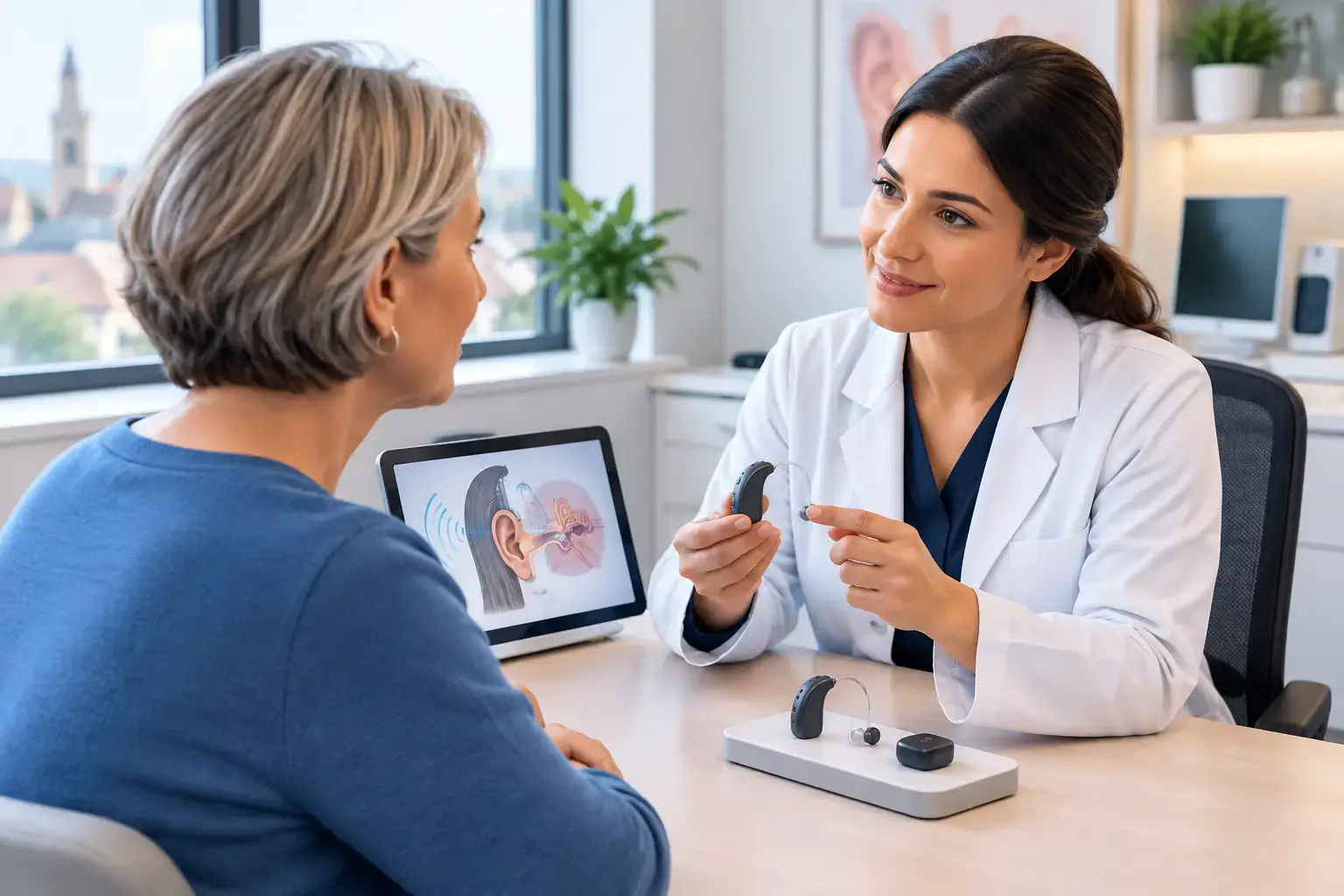
When sound regularly comes from the side you cannot hear, conversation can become tiring very quickly. An Oticon CROS Re system for single-sided deafness is designed to address that specific problem: it picks up sound on the poorer-hearing side and delivers it to the ear with better hearing. For many people, this can reduce the need to keep turning their head, asking others to repeat themselves or avoiding busy social situations.
The right technology is only part of the answer. A CROS system needs to be selected, programmed and verified around your hearing profile, listening priorities and everyday environments. An expert assessment helps establish whether this approach is appropriate and what realistic benefit you can expect.
What is an Oticon CROS Re system?
CROS stands for Contralateral Routing of Signal. The system uses two discreet devices. A transmitter worn on the ear with little or no usable hearing captures sound from that side. It sends the signal wirelessly to a receiver worn on the better-hearing ear, so that ear can hear sounds arriving from both directions.
The term Oticon CROS Re is often used when people are looking for an Oticon CROS solution with rechargeable technology. Exact product options and compatibility can vary, so a qualified audiologist should confirm which transmitter and receiving device are suitable for your needs.
Unlike a conventional hearing aid, the CROS transmitter does not attempt to amplify a very poor ear. Its role is to move sound around the head shadow effect. Your head naturally blocks and weakens higher-frequency sound travelling from one side to the other. This is why someone speaking on your poorer-hearing side may sound muffled or may be missed altogether, even when the other ear hears well.
Who may benefit from Oticon CROS Re for single-sided deafness?
A CROS arrangement may be considered for people who have very limited usable hearing in one ear and good hearing in the other. The practical difficulties are often familiar: a colleague speaks from the wrong side in a meeting, a companion walks beside you on your poorer-hearing side, or you struggle to follow a conversation from the passenger seat of a car.
It can also help when you want greater awareness of sound from the affected side. At home, that may mean noticing a family member speaking from another room. Outdoors, it may mean feeling less cut off from what is happening around you. The benefit is individual, and depends on the listening environment as much as the hearing results themselves.
If the better ear also has a hearing loss that would benefit from amplification, a BiCROS system may be more appropriate. In that arrangement, the receiving device functions as a hearing aid for the better ear while also receiving sound from the transmitter. This distinction is one reason a full hearing assessment is essential before choosing a device.
What a CROS system cannot replicate
A CROS device can improve access to sound from the poorer-hearing side, but it does not make two ears hear independently again. Natural two-ear hearing supports localisation – the ability to judge where a sound is coming from – and helps the brain separate speech from background noise. Routing sound to one ear cannot fully reproduce those binaural cues.
That does not mean a CROS system is ineffective. It means expectations should be grounded in the problem it is designed to solve. The aim is usually easier access to speech and sound from your less-hearing side, rather than perfect hearing in every environment.
Background noise also requires a measured discussion. When speech is on the poorer-hearing side and noise is elsewhere, CROS routing can be particularly useful. In some noisy settings, however, sending additional sound to the better ear may feel less helpful. Modern programme settings and directional microphone strategies can be adjusted to suit common listening situations, but they cannot remove all the challenges of a crowded restaurant or large family gathering.
Why assessment and fitting make the difference
Choosing a CROS system begins with more than identifying a difference between the ears. Your audiologist should assess hearing in both ears and discuss your listening history, communication demands and any symptoms that need further attention. The condition of the ear canal also matters, as wax build-up can affect test accuracy, comfort and device performance.
The consultation should explore how the hearing difficulty affects your day. Someone working in face-to-face meetings may have different priorities from a parent listening for a child at home, or from a person who spends much of the day travelling. Your preferred wearing style, dexterity, glasses use, phone calls and charging routine all influence whether a particular solution will work well in practice.
Once suitable technology has been identified, careful programming is needed. The balance between the transmitter and receiver must feel comfortable, clear and natural enough for regular wear. A professionally fitted system should be assessed with appropriate verification measures and real-world discussion, rather than simply set up and handed over.
Follow-up appointments are equally valuable. Many people need a period of adjustment while their brain becomes accustomed to receiving sound from the poorer-hearing side through the better ear. Fine-tuning may be needed after you have used the system at work, in the car, at home and in social settings.
Living well with a CROS device
A CROS system is most successful when it becomes part of a wider communication strategy. Positioning still matters. In difficult noise, sitting with your better ear closer to the person you most need to hear can help. Choosing a quieter table in a restaurant, reducing competing noise at home and asking others to face you when speaking can make conversation less effortful.
It is also sensible to protect the hearing in your better ear. If you are exposed to loud music, power tools, shooting noise or other high-noise environments, appropriately selected hearing protection is particularly important. Your audiologist can advise on suitable custom options without compromising necessary awareness or comfort.
Rechargeable devices may be convenient for people who prefer not to manage disposable batteries. The practical question is whether the charge duration fits your typical day, including commuting, streaming and longer social events. A discussion about charging habits is not a minor detail – a device that is easy to maintain is far more likely to be worn consistently.
When to seek specialist advice
If you have noticed a recent or changing difference in hearing between your ears, seek prompt clinical advice rather than assuming a hearing device is the next step. Sudden changes, ear pain, discharge, persistent dizziness or new one-sided tinnitus should also be assessed appropriately.
For established single-sided hearing difficulties, a specialist audiology appointment can clarify whether an Oticon CROS Re arrangement, a BiCROS solution or another hearing rehabilitation approach is the best match. At Tragus-The Ear Specialists, qualified audiologists take time to assess the whole listening picture, not just an audiogram.
You should not have to organise your life around the side you hear best. With informed assessment, realistic expectations and careful fitting, the right CROS solution can make everyday conversations feel less like hard work and more like participation.