
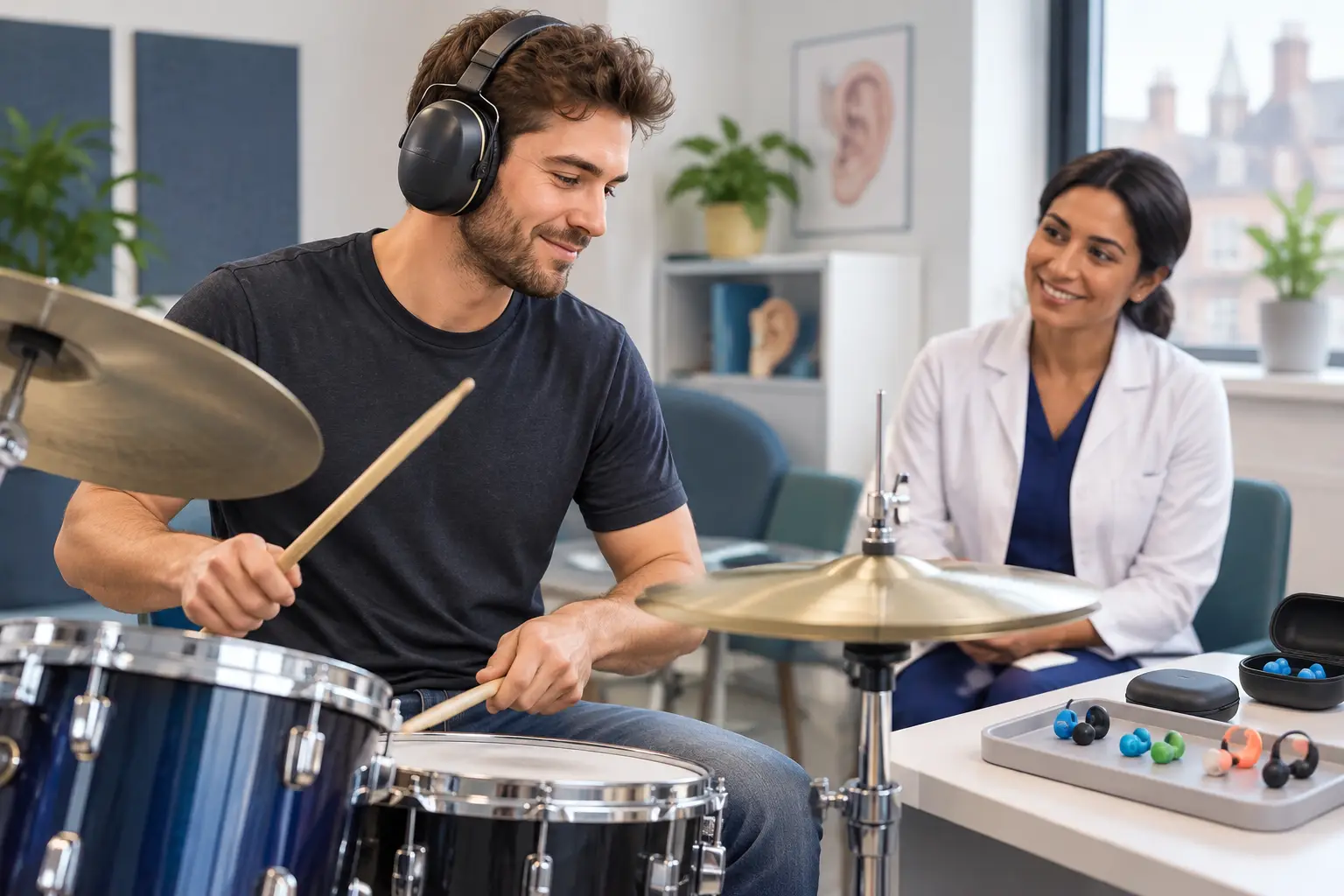
A drum kit can produce peak sound levels that are unsafe within moments, particularly in a small rehearsal room where cymbals and snare drum reflections have nowhere to go. Hearing protection for drummers is not about making music feel distant or dull. It is about protecting the hearing you rely on to keep time, judge dynamics and enjoy playing for years to come.
The risk is easy to underestimate because hearing damage is often gradual. You may leave a rehearsal with muffled hearing, a ringing tone or a sense that sounds are unusually sharp the following morning. These are not signs that your ears are becoming accustomed to the volume. They can be signs that your auditory system has been overloaded.
Why drummers face a higher hearing risk
Drummers are positioned at the source of several loud, impulsive sounds. A snare hit, crash cymbal or rimshot creates a brief but intense sound peak, while regular rehearsals and performances add up to substantial noise exposure over time. The overall level depends on the kit, room, playing style, amplification and proximity to other instruments, but live music commonly exceeds levels considered safe for prolonged listening.
Damage from loud sound can affect the delicate sensory cells of the inner ear. Once these cells are damaged, they do not regenerate. The consequences can include permanent hearing loss, tinnitus – hearing ringing, buzzing or other sounds without an external source – and hyperacusis, where everyday sound becomes uncomfortable or painful.
This does not mean every drummer will develop a hearing condition. It does mean that relying on how loud something feels is not a dependable safety measure. The ears can temporarily adapt to loud sound, making you less aware of the risk while exposure continues.
What good hearing protection for drummers should do
The right protection reduces harmful volume while preserving enough clarity to play confidently. You still need to hear the click, your bandmates, changes in arrangement and the character of the kit. That is why foam earplugs, although useful in an emergency, are not always the best long-term option for musicians.
Standard foam plugs can reduce sound unevenly. Speech, cymbals and detail may become muffled, encouraging some players to remove them mid-session or play harder to compensate. If protection is uncomfortable or affects your monitoring too severely, it is unlikely to be used consistently.
Musician’s earplugs with acoustic filters are often a better choice. They are designed to lower volume more evenly across frequencies, so the mix remains more natural. Different filters offer different attenuation levels. A lower filter may suit a quieter acoustic set, while a higher level of protection may be appropriate for amplified rehearsals, regular gigs or close exposure to cymbals and stage monitors.
The correct level depends on the sound environment and how long you are exposed. More attenuation is not automatically better if it prevents you hearing cues and leads you to remove the plugs. The aim is effective, wearable protection that you will use every time.
Custom earplugs versus universal musician’s plugs
Universal filtered earplugs are a practical starting point. They are usually less expensive, available quickly and can work well for occasional rehearsals, concerts or practice. Their fit, however, depends on the shape of your ear canal. If they loosen while playing, seal poorly or cause discomfort, their real-world protection may be reduced.
Custom-moulded musician’s earplugs are made from impressions of your ears and fitted with interchangeable or selected acoustic filters. For regular drummers, this secure personalised fit is a significant advantage. Custom earplugs tend to be more comfortable for long sessions, give more consistent attenuation and are less likely to work loose with movement or perspiration.
They are an investment, and not every player needs them immediately. But for professional musicians, music teachers, frequent gigging drummers and anyone with tinnitus or known sound sensitivity, an expert fitting is usually the most dependable route.
Are in-ear monitors enough?
In-ear monitors can reduce the need for loud stage wedges and help a drummer hear a controlled mix. Used correctly, they can be part of a safer setup. They are not, however, inherently hearing protection.
A poor seal, excessive monitor volume or the temptation to turn up the mix to overcome live drums can still expose you to harmful levels. Choose well-fitting monitors, keep volume as low as practical and consider a limiter to control sudden peaks. If you are unsure how loud you are monitoring, a qualified audiologist can discuss safer listening habits alongside your hearing assessment.
Practical ways to reduce exposure at rehearsals and gigs
Earplugs work best as part of a wider approach to sound management. Positioning the kit thoughtfully, using cymbal choice and playing technique to manage volume, and reducing unnecessary amplification can all make a meaningful difference. In a rehearsal room, absorbent treatment and sensible spacing may reduce harsh reflections, although they cannot make a loud kit safe on their own.
Build protection into your set-up routine. Keep your earplugs in the same case as your drum key or sticks, and put them in before soundcheck rather than when your ears already feel fatigued. A spare pair of universal plugs in your gig bag is sensible backup if custom plugs are misplaced.
Give your ears recovery time after a particularly loud session. Quiet time is preferable to immediately listening through headphones, especially at high volume. Avoiding additional noise does not reverse damage, but it can reduce the total load on your hearing.
It is also worth discussing volume openly with bandmates. A tighter, more controlled stage sound usually improves the performance as well as reducing risk. Protection should never be framed as a lack of toughness or commitment. It is professional kit, just like a drum throne that supports good posture or cases that protect your instruments.
When ringing, muffled hearing or sound sensitivity needs assessment
Brief ringing after loud music can occur, but it should not be dismissed as normal. If tinnitus persists, your hearing remains muffled, one ear seems different from the other, or ordinary sounds feel painfully loud, arrange an expert hearing assessment. Sudden hearing loss, particularly in one ear, requires urgent medical attention.
A comprehensive assessment can establish whether your hearing has changed, identify patterns that may be linked with noise exposure and provide a baseline for the future. This is particularly valuable for working musicians, whose livelihoods and confidence can be affected even by subtle difficulty hearing speech in noise or judging high-frequency detail.
At Tragus-The Ear Specialists, qualified audiologists can assess hearing concerns, advise on tinnitus and hyperacusis, and provide custom earplugs designed around the demands of music. For drummers in Kent who rehearse or perform regularly, this offers a clinically informed way to protect hearing without losing connection to the music.
Choosing a protection level you will actually wear
Start by considering where and how you play. A drummer practising alone with low-volume pads has different needs from someone playing weekly in a loud rock venue. Think about session length, cymbal proximity, monitor levels and whether you already notice ringing or fatigue afterwards.
Try not to make your decision based only on price or advertised noise reduction. The consistency of fit, comfort over several hours and sound quality matter just as much. A useful pair of earplugs is the pair that stays in your ears from the first count-in to packing down.
Your hearing is part of your musicianship. Protect it early, have changes assessed promptly, and give yourself the best chance of hearing every nuance of the next performance.