
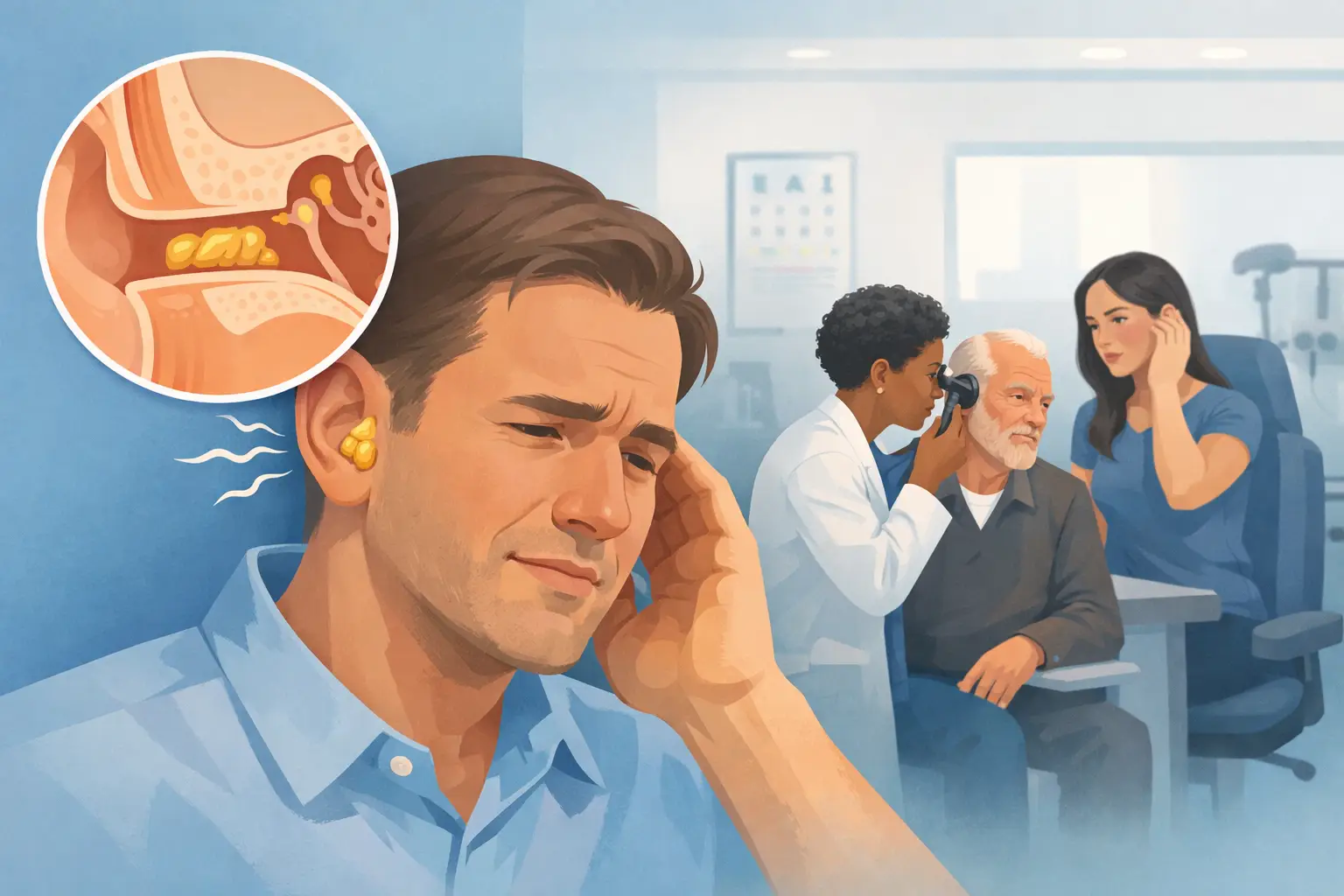
A familiar voice suddenly sounds muffled. Your own voice seems unusually loud inside your head. Or one ear feels as though it is under water after a shower. These are common earwax blockage symptoms in adults, and they can be disruptive even when there is no pain.
Earwax is not a sign of poor hygiene. It is a normal protective substance that helps trap dust and debris, lubricates the ear canal and supports its natural defences. Problems arise when wax builds up, becomes hard or is pushed deeper into the canal, preventing sound from reaching the eardrum properly. The right response depends on your symptoms, ear history and what a qualified clinician can see during an ear examination.
Earwax blockage symptoms in adults
A blocked ear can feel different from person to person. For many adults, the first change is reduced hearing in one ear. Conversations may become harder to follow, particularly in restaurants, meetings or family gatherings where there is background noise. Television volume may creep up, and callers may sound less clear when using the phone on the affected side.
A feeling of fullness or pressure is also typical. Some people describe a plugged sensation, while others notice mild discomfort, itching or the awareness that something is sitting in the ear canal. Wax itself does not always cause pain, so the absence of pain does not rule out a significant blockage.
Other possible symptoms include tinnitus, such as ringing, buzzing or humming, and a change in how your own voice sounds. This is known as an occlusion effect. It can make speaking feel oddly loud or echoing, especially if the ear canal is fully blocked.
When wax sits against or close to the eardrum, it may occasionally trigger coughing or a brief sensation of dizziness. This happens because the ear canal has nerve connections that can be sensitive to pressure. Persistent vertigo, however, should not automatically be attributed to wax and deserves proper assessment.
Why a blockage can appear suddenly
Earwax usually moves out of the ear naturally through normal jaw movement, including talking and chewing. A blockage often develops gradually, but it may only become noticeable after bathing, swimming or using ear drops. Water can cause dry wax to expand, making a previously mild build-up feel like an abrupt loss of hearing.
Some adults are more prone to recurrent wax build-up. This may be due to naturally narrow or curved ear canals, dry or sticky wax, skin conditions affecting the ear canal, or the use of hearing aids, earbuds and earplugs. These devices can interfere with the natural outward movement of wax and may compact it further if worn for long periods.
Cotton buds are another common cause. Although they may remove a small amount of wax from the outer ear, they often push wax deeper than it was before. The ear canal is delicate, and repeated probing can irritate the skin, create a compacted plug or, less commonly, cause injury.
Blocked ear or hearing loss?
Wax can cause a conductive hearing loss, meaning sound is physically obstructed on its way through the ear canal. This often produces muffled hearing that improves once the wax is removed safely. However, not every change in hearing is caused by wax.
Age-related hearing loss, middle-ear fluid, an ear infection, eardrum problems and sudden inner-ear hearing loss can all create symptoms that may be mistaken for blockage. Assuming that every muffled ear is simply wax can delay the assessment of a more significant condition. An otoscopic examination allows a clinician to establish whether wax is present, how much of the canal it occupies and whether the eardrum can be seen.
Symptoms that need prompt medical attention
A straightforward wax blockage is usually uncomfortable rather than dangerous. Yet certain symptoms call for urgent medical advice rather than home treatment or routine wax removal.
Seek prompt assessment if you have sudden hearing loss, particularly in one ear, or hearing loss that develops over hours or a few days. This is not something to wait on in the hope that it clears. The same applies to severe ear pain, discharge, bleeding, marked dizziness, facial weakness, fever or swelling around the ear.
You should also obtain clinical advice if ear symptoms follow a head injury, if you have had previous ear surgery, a known perforated eardrum, grommets, recurrent ear infections or mastoid surgery. These factors affect which wax-softening products and removal methods are appropriate.
For adults with diabetes, a weakened immune system or a history of difficult ear infections, new ear pain or discharge deserves particular caution. A qualified clinician can advise on the safest next step based on your history and examination.
What to avoid when you think wax is the problem
It is understandable to want immediate relief, especially before an important meeting, holiday or hearing test. However, attempting to remove wax with cotton buds, hair grips, tweezers, keys or ear candles can turn a manageable issue into an injured ear canal or impacted wax.
Ear candling is not an effective method of wax removal. It carries a risk of burns and wax residue entering the ear, without reliably removing the underlying blockage. Similarly, home irrigation kits may not be suitable for everyone. They should be avoided if you have a perforation, grommets, previous ear surgery, active infection, ear discharge or pain, unless a clinician has specifically advised otherwise.
Wax-softening drops can be helpful for some people, particularly where wax is dry and hard. But they are not a universal solution. Stop using them if they cause pain, a rash, significant irritation or worsening symptoms, and seek advice before using them if you are unsure about your eardrum health. Sometimes softening wax can temporarily make the ear feel more blocked before removal.
How specialist earwax assessment helps
Expert care begins with looking inside the ear, not simply assuming that wax is responsible. At a specialist ear clinic, a qualified audiologist examines the canal and eardrum and discusses your symptoms, medical history and any hearing devices you use. This helps distinguish uncomplicated wax from infection, inflammation or hearing concerns that require a different pathway.
Where removal is appropriate, microsuction is often used. This method uses magnification and a fine suction device to remove wax carefully under direct vision. It is generally dry, which can be particularly useful for people who should avoid water-based irrigation. The experience varies according to the amount and consistency of wax, but many people notice an immediate improvement in clarity once the canal is clear.
There are trade-offs. Very hard, longstanding wax may need softening before it can be removed comfortably, and an inflamed or sensitive ear canal may require a more cautious approach. If the wax cannot be removed safely in one appointment, a clinician should explain why and advise on the appropriate next step rather than forcing treatment.
At Tragus-The Ear Specialists, earwax removal is delivered as part of a wider ear and hearing assessment. That matters when a blockage has masked an underlying hearing difficulty, when tinnitus remains after wax is removed, or when repeat build-up is affecting hearing aid use and day-to-day communication.
After wax removal: when hearing still is not right
Many adults expect their hearing to return to normal immediately after wax removal, and often it does. If the ear canal was completely blocked, the difference can be striking. However, persistent muffling, tinnitus, discomfort or imbalance should be investigated rather than dismissed.
Wax can coexist with age-related hearing loss or noise-related hearing damage. Once the ear canal is clear, a hearing assessment can show whether there is an underlying loss and whether tailored support would improve conversations, work performance and confidence in social settings. For people who wear hearing aids, a clear canal is also essential for accurate fitting and effective amplification.
Recurrent wax does not mean you have failed to clean your ears. In most cases, the safest routine is to leave the ear canal alone, clean only the outer ear gently and arrange professional assessment when symptoms return. If blockages are frequent, your clinician can advise a sensible maintenance plan based on your ear anatomy, wax type and hearing needs.
A blocked ear can make the world feel distant, but it should not leave you guessing. A careful ear examination provides clarity, protects the health of your ear and helps you hear everyday life as it should sound.