
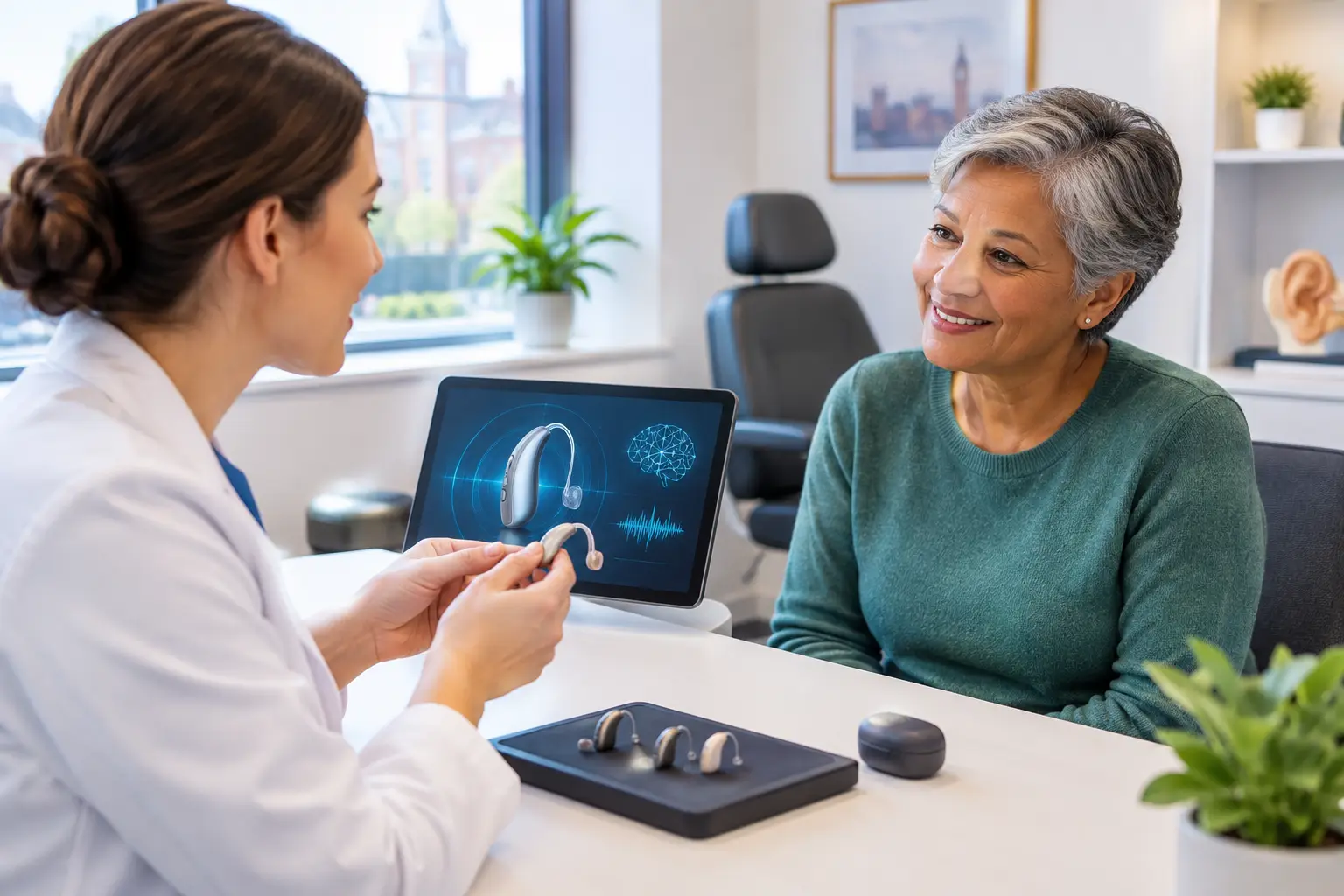
A busy café, a family dinner, a work meeting with several people speaking at once: these are the moments when hearing loss is most demanding. Hearing aid AI trends are increasingly focused on these real-life listening challenges, rather than simply making sounds louder. The aim is more useful support in changing, noisy environments – but the right technology still depends on an accurate hearing assessment and a carefully programmed device.
For patients considering hearing aids, artificial intelligence can sound either exciting or confusing. It is not a replacement for an audiologist, nor does it make every hearing aid equally effective. It is a set of tools that can help modern devices recognise listening situations, reduce unwanted noise and adjust settings more intelligently. Used well, it can make communication feel less effortful and more natural.
What AI means in a hearing aid
In hearing aids, AI usually refers to advanced software that analyses the sound environment and helps the device respond to it. A hearing aid may detect that you have moved from a quiet sitting room into a restaurant, for example, and alter its microphone directionality, noise management and speech processing accordingly.
Some systems are trained using large collections of real-world sound recordings. This can help them distinguish patterns associated with speech, traffic, wind, music or background chatter. Others learn from a wearer’s own adjustments over time, such as turning the volume up in a particular setting or choosing a preferred programme.
The practical benefit is not that the hearing aid somehow understands every word. Hearing loss affects the way sound is detected and processed by the individual ear and brain, so no device can remove every difficulty. Instead, AI-based processing may give a clearer, more comfortable starting point in complex situations.
Hearing aid AI trends: clearer speech in real settings
The most meaningful developments are centred on speech understanding in noise. Traditional hearing aids have long used directional microphones and noise reduction. AI is improving how quickly and selectively these features can respond when the acoustic scene changes.
A device may identify that speech is coming from in front of you and reduce competing sound from other directions. In some models, processing is designed to preserve environmental awareness rather than suppressing all background sound. This matters because a completely silent environment would not feel natural or safe. The goal is to reduce distraction while retaining useful cues, such as a person approaching, an announcement or a doorbell.
Results vary. A hearing aid can improve the signal reaching your ear, but it cannot entirely overcome a very noisy room, distant speech, poor room acoustics or several people talking over one another. For this reason, realistic expectations are part of good hearing rehabilitation.
Automatic adjustments with less manual control
Another clear trend is more refined automatic programme selection. Many people find it frustrating to press buttons or open an app whenever their environment changes. Modern devices can often adjust without needing constant intervention.
That convenience can be valuable, particularly for people who want their hearing aids to support daily life quietly in the background. However, automatic settings should not take control away from the wearer. A well-fitted hearing aid should still give you simple options to make changes when your own preference differs from the device’s decision.
The best balance is personal. Someone who spends much of the day in quiet conversation may favour gentle, stable processing. Someone who regularly attends meetings, social events or busy family occasions may benefit from more active speech-in-noise support.
More personalised fine-tuning
AI is also influencing how hearing aids are adjusted after fitting. Some devices record broad information about the types of environments a wearer encounters, while companion apps can allow feedback on sound quality and comfort. This can give the audiologist a more informed basis for fine-tuning at review appointments.
That said, data alone is not a hearing assessment. An audiogram, speech testing where appropriate, otoscopy and a discussion about your communication needs remain central. A hearing aid programmed solely from an app or an online test may miss important clinical factors, including asymmetrical hearing loss, earwax blockage, tinnitus, sound sensitivity or signs that require medical referral.
At Tragus-The Ear Specialists, hearing aid recommendations are made in the context of a full clinical picture. This is particularly important when hearing difficulties are affecting confidence, work, relationships or concentration.
AI features are not a substitute for expert fitting
A premium hearing aid can have impressive processing power and still disappoint if it is poorly matched to the wearer. The physical fit, correct receiver strength, verification of the programmed output and follow-up care all influence the result.
Real-ear measurement is especially valuable. This clinical test measures sound in the ear canal while the hearing aid is worn, helping the audiologist check that amplification is appropriate for your individual hearing profile. It is more precise than relying on a generic first-fit setting.
There is also an adjustment period. If you have lived with reduced hearing for some time, everyday sounds may initially seem unusually sharp, busy or loud. Your brain needs time to re-acclimatise to sounds it has not heard clearly. AI can support comfort management, but a gradual programme and accessible clinical support are often what make the difference.
Connectivity, remote support and the trade-offs
AI development is closely linked with connectivity. Many current hearing aids stream phone calls, television audio or music directly from compatible devices. Some offer remote fine-tuning, making it easier to discuss a minor adjustment without always travelling to the clinic.
These features can be genuinely helpful, but they should be chosen for a reason. If phone calls are a major difficulty, direct streaming may be a priority. If dexterity or confidence with smartphones is limited, a simpler device with reliable automatic processing may be the better choice.
There are trade-offs to consider. More advanced features can affect battery use, and rechargeable aids need a reliable charging routine. Bluetooth connection can occasionally be inconsistent, depending on the phone and settings. Patients should also understand what information an accompanying app collects, how it is stored and whether they are comfortable sharing it. Privacy deserves the same attention as sound quality.
What AI cannot do
It is sensible to be cautious of marketing that implies a hearing aid can solve every listening problem. AI cannot restore normal hearing, cure tinnitus or correct the underlying cause of hearing loss. It cannot replace communication strategies such as facing the speaker, choosing a quieter table in a restaurant or asking someone to repeat an important detail.
It should not delay assessment either. Sudden hearing loss, one-sided change in hearing, persistent ear pain, discharge, dizziness or a sudden onset of tinnitus need prompt professional advice. Hearing aids are one part of ear and hearing care, not an answer to symptoms that have not been properly investigated.
For people with tinnitus or hyperacusis, technology selection and programming need additional care. Aggressive noise reduction or unsuitable amplification may not feel comfortable. A qualified audiologist can consider hearing needs alongside sound sensitivity, tinnitus distress and appropriate therapeutic support.
Choosing technology around your life
The most useful question is not, “Which hearing aid has the most AI?” It is, “What situations do I need help with most?” Bring real examples to your appointment: hearing grandchildren in the car, following colleagues in a meeting, coping with a lively pub lunch, enjoying television without excessive volume, or feeling less isolated at home.
Your audiologist can then relate the technology to your hearing test results, ear health, lifestyle, budget and handling needs. For some patients, the most sophisticated AI features will be worthwhile. For others, dependable amplification, comfort and clear follow-up support will deliver far more value.
Better hearing is not about owning the newest feature. It is about hearing speech with less strain, staying connected to the people around you and having expert support when your needs change.