
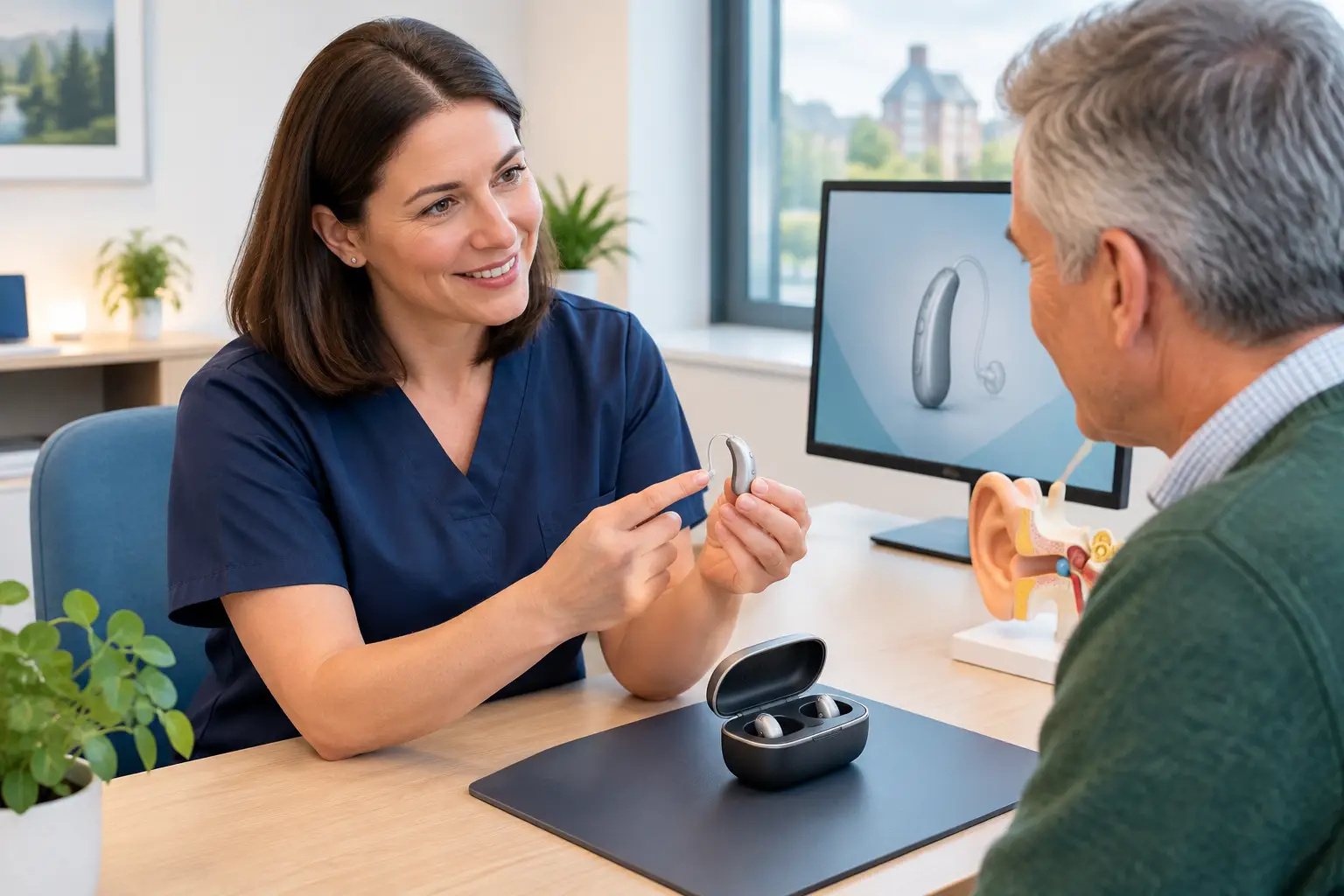
If you are researching Phonak Eon Sphere hearing aids, the first step is to confirm the precise model name. Hearing-aid terminology can be confusing, particularly when product ranges, platforms and retailer descriptions are discussed online. Many people searching this phrase may be referring to Phonak’s Sphere technology, including the Audéo Sphere Infinio range, which is designed to improve speech understanding in demanding background noise.
That distinction matters because the right hearing aid is not selected from a name alone. It should follow a detailed hearing assessment, a discussion about the listening situations that cause difficulty, and professional fitting with verified settings. For someone struggling to follow family conversation in a busy restaurant, hear colleagues in meetings or feel less confident in social settings, the technology can be highly promising. It is not, however, a substitute for expert diagnosis and rehabilitation.
What are Phonak Eon Sphere hearing aids?
At the time of your appointment, a qualified audiologist can confirm the current Phonak product names and which technology is available. If “Eon Sphere” is the term you have encountered, it is sensible to bring the advertisement, quotation or product information with you. This avoids comparing one platform with another or making a decision based on an inaccurate description.
Phonak’s Sphere-based hearing technology has attracted attention because it uses dedicated processing intended to separate speech from surrounding noise. Conventional hearing aids have long used directional microphones and noise-management programmes to make conversation clearer. The challenge is that real-life noise is unpredictable: several people may be speaking, plates may be clattering, music may be playing and the speaker may be beside rather than directly in front of you.
Advanced artificial intelligence processing aims to make better use of the sound information reaching the microphones, identifying speech and reducing the prominence of competing noise. The practical goal is not to remove the world around you. It is to make speech easier to access while retaining enough environmental sound for the setting to feel natural and safe.
Why background noise is the real test
Many adults hear reasonably well in a quiet room yet still have significant hearing difficulty. This is especially common with age-related sensorineural hearing loss, where clarity can decline even when sounds are loud enough. People often describe hearing others speak but not catching the words, particularly when a voice is soft, fast or competing with background noise.
This is where premium hearing-aid platforms can offer a meaningful advantage. More sophisticated processing may support speech understanding in cafes, group conversations, workplaces, family gatherings and while travelling. It can also reduce the effort required to keep up. Listening fatigue is a genuine concern: when the brain has to work hard to fill in missing speech information, socialising and concentrating can become exhausting.
There are limits. No hearing aid can make a crowded room sound like a quiet lounge, and no system can perfectly isolate one voice in every situation. The benefit depends on the degree and configuration of hearing loss, the quality of the fitting, the wearer’s expectations and the acoustics of the environment. A careful clinician will discuss these trade-offs rather than promise a complete cure for difficult listening situations.
Technology is only one part of the outcome
Even the most advanced device can disappoint when it is poorly matched to the hearing loss or left on manufacturer default settings. Hearing aid fitting is a clinical process, not simply a purchase. Your audiologist should establish the nature of your hearing difficulty, inspect the ear canals, measure hearing thresholds and assess speech understanding where appropriate.
The physical fit also deserves close attention. Receiver-in-canal devices may be discreet and comfortable for many wearers, but the dome or custom earpiece needs to suit the ear shape, hearing-loss level and acoustic requirements. An open fitting can feel natural and reduce the sensation of a blocked ear, while a more closed fitting may be needed to provide sufficient amplification for certain losses. Each option involves compromises in comfort, sound quality and control of feedback.
Verification is particularly important. Using real-ear measurement, an audiologist can check that the hearing aids are delivering the prescribed amplification in your own ear canal. This is more reliable than assuming that a programmed setting is correct. Follow-up appointments then allow the settings to be refined as you experience everyday life.
Who may benefit from Sphere-based Phonak technology?
A person who regularly avoids restaurants, misses contributions in meetings or relies heavily on a partner to repeat speech may be a suitable candidate for advanced noise-management technology. It may also appeal to people who lead active professional or social lives and want support across a wide variety of listening environments.
However, a premium model is not automatically the best choice for everyone. If your hearing needs are mainly in quiet conversation at home, a different Phonak technology level or style may provide excellent results at a lower cost. Manual dexterity, vision, rechargeability preferences, Bluetooth requirements, tinnitus symptoms and the condition of the outer ear all influence the recommendation.
For people with troublesome tinnitus, hearing aids can sometimes reduce the contrast between tinnitus and silence by restoring access to ambient sound. Yet tinnitus requires its own assessment. If tinnitus is new, one-sided, pulsating, associated with sudden hearing loss, dizziness or neurological symptoms, prompt medical advice is essential. Hearing aids may form part of a tinnitus management plan, but they are not the only consideration.
Questions to ask before choosing a hearing aid
Before proceeding with any quoted device, ask whether the name and specification have been clearly confirmed. You should understand why that particular technology level has been recommended for your hearing profile and the situations you find most difficult.
It is also reasonable to ask how the fitting will be verified, how many adjustment appointments are included and what aftercare is provided. Hearing changes, wax build-up, changes in health and new listening demands can all affect performance over time. Ongoing access to qualified audiologists is valuable, especially during the first weeks of wearing hearing aids, when the brain is adapting to sounds it may not have heard clearly for some time.
Ask about practical matters as well: battery life or charging time, phone connectivity, maintenance, warranty arrangements and what happens if one aid requires repair. If you use custom earplugs for work, music or swimming, mention this too. Your clinician can advise on how this fits around your hearing-care plan.
A clinical assessment should come first
Hearing loss can result from several causes, including wax blockage, middle-ear problems, noise exposure, ageing and certain medical conditions. Buying a device without first establishing the cause risks missing an issue that needs treatment or medical referral. Sudden changes in hearing should never be treated as a routine hearing-aid matter.
At Tragus-The Ear Specialists, an expert hearing assessment can establish whether hearing aids are appropriate and whether a premium Phonak platform is likely to offer worthwhile benefit. The focus should be on clear hearing in the places that matter to you, not on a product label or a generic promise.
If you are considering Phonak technology, bring your questions and be specific about the moments you want to hear better. A precise assessment and carefully verified fitting give you the best chance of returning to conversation with greater clarity, comfort and confidence.