
A missed instruction in a busy meeting can look like a concentration problem when it is really a listening problem. The right workplace hearing adjustments can make communication clearer, reduce the effort of getting through the day and protect confidence at work. They are not about lowering expectations. They are about removing avoidable barriers so a person can contribute fully.
Hearing loss, tinnitus and sound sensitivity affect people differently. One employee may manage well in a quiet office but struggle in an open-plan space. Another may hear speech clearly one-to-one yet find video calls, group discussions or phone conversations exhausting. A useful adjustment starts with the person’s actual listening demands, rather than a standard checklist.
Workplace hearing adjustments start with a clear assessment
Before asking an employer for support, it helps to understand what is affecting hearing and when. A comprehensive hearing assessment can identify the type and level of hearing loss, but the clinical picture is only one part of the conversation. The practical question is: which situations create difficulty, and what would make those situations more manageable?
Keep a short record for one or two working weeks. Note whether difficulty occurs in meetings, on the telephone, at reception, during training, in a noisy canteen or while travelling between sites. Also record the effect: perhaps you miss key details, feel drained by mid-afternoon, withdraw from discussion or need colleagues to repeat themselves. This gives a manager or occupational health team a clearer basis for considering support.
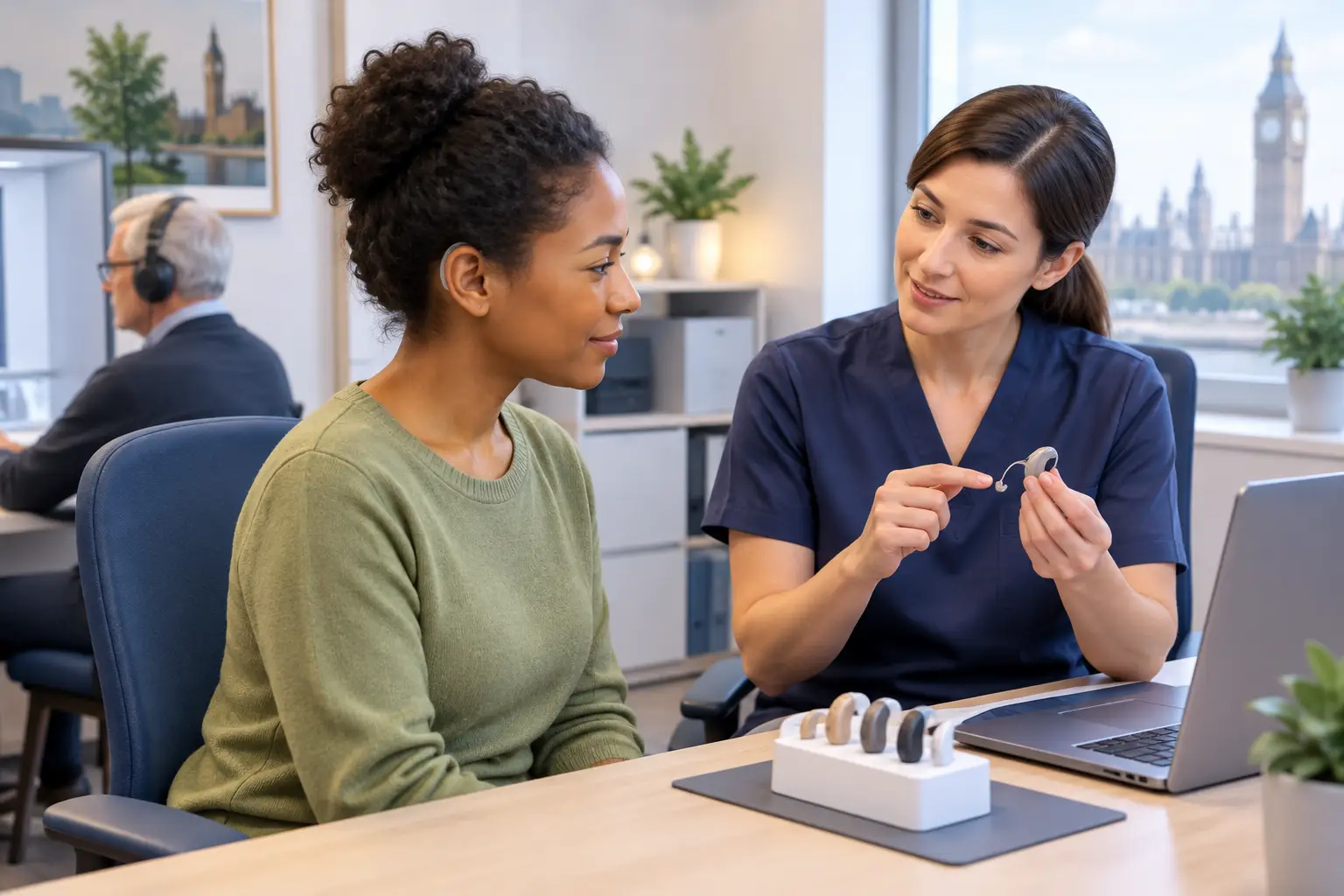
For people who use hearing aids, an audiologist can check that the devices are appropriately programmed for their hearing profile and daily needs. Hearing aids can be highly effective, but they are not a complete solution to poor room acoustics, overlapping voices or rapid speech. Tinnitus and hyperacusis may need an equally individual approach, especially where workplace noise causes distress or symptoms worsen after a busy day.
An expert assessment also helps distinguish hearing difficulty from earwax blockage, fluctuating middle-ear problems or other concerns that may require treatment. Do not assume that reduced hearing is simply something to put up with.
Choosing workplace hearing adjustments that fit the role
Under the Equality Act 2010, employers may have a duty to make reasonable adjustments for disabled employees, including people whose hearing loss has a substantial and long-term impact on everyday activities. What is reasonable depends on the role, the organisation and the adjustment required. A conversation with a manager, HR professional or occupational health adviser can help turn broad concerns into practical action.
The most effective arrangements are usually simple, specific and reviewed after they have been tried. Depending on the working environment, helpful measures may include:
- providing a quieter desk position, away from printers, kitchen areas, doors or constant footfall;
- using live captions for video meetings and choosing platforms that allow participants to see each speaker clearly;
- circulating agendas, papers and key decisions in writing before or immediately after meetings;
- ensuring meeting rooms have good lighting, so facial cues and lip patterns are visible;
- supplying an appropriate amplified telephone, headset or other compatible communication equipment; and
- allowing short breaks from high-noise environments where listening effort, tinnitus or sound sensitivity is causing fatigue.
Not every adjustment is suitable for every job. A quieter desk may help an administrator but be irrelevant to a clinician moving between rooms or a manager spending most of the week on site visits. Similarly, captions are valuable for many online meetings, but they can mishear technical terms, names or fast discussion. They work best alongside clear speaking, written follow-up and the opportunity to ask for clarification.
Small changes to communication habits often have an outsized benefit. Colleagues should gain attention before speaking, face the listener where possible, avoid talking from another room and take turns rather than speaking over one another. Rephrasing a sentence is usually more useful than simply repeating it more loudly. These are considerate professional habits, not special treatment.
Make meetings easier to follow
Meetings are a frequent pressure point because speech competes with background noise, poor acoustics and multiple voices. Agreeing a few ground rules can reduce the burden considerably. A chairperson can invite one person to speak at a time, repeat questions from the room before answering and pause briefly after key decisions.
For larger meetings, seating matters. Sitting where you can see the chair and most participants offers better visual information and helps you identify who is speaking. If an in-person room has an echo or heavy background noise, moving to a smaller space may be more effective than simply increasing volume.
Written notes should not be treated as an afterthought. A concise action list, shared promptly, gives everyone a reliable record and avoids the awkwardness of having to chase a colleague later for information that was missed. It is good meeting practice for the whole team.
Address noise, not just volume
Many workplaces are designed around collaboration but create a constant layer of sound: keyboards, calls, air conditioning, music and informal conversation. For someone with hearing loss, louder noise does not make speech clearer. It can make speech less distinct.
Practical changes might include acoustic panels, quiet rooms for concentrated work, noise-reducing headsets or protected times for calls and complex tasks. In some roles, custom hearing protection may be appropriate, particularly where exposure to loud sound is part of the job. However, earplugs should be selected carefully. Over-protection can make speech harder to hear and, for some people with hyperacusis, may reinforce sensitivity if used when sound levels are safe. Specialist advice is worthwhile where noise exposure or sound intolerance is involved.
Share only what is necessary
Some people worry that disclosing hearing difficulty will affect how colleagues perceive their capability. That concern is understandable. You do not have to share every medical detail to request a practical change. It is often enough to explain the functional impact: for example, that background noise makes group conversations difficult, or that captions and written actions will support accurate communication.
A manager does not need to become an audiologist. Their role is to listen, handle information sensitively and help create workable conditions. Where a fuller explanation is useful, an audiologist’s report or occupational health recommendation can provide clear, professional evidence of the adjustments that may help.
If you are self-employed, work from home or regularly attend client sites, the same principles apply. Consider your typical communication environments, ask for meeting papers in advance and choose spaces where you can hear and be heard. Remote working can reduce some noise challenges, but poor-quality microphones and audio fatigue can create new ones.
Review support as work changes
A good adjustment is not a one-off conversation. Roles change, offices move, teams grow and technology develops. Hearing needs can change too. Agree a review point after a few weeks and discuss what has improved, what still creates difficulty and whether the arrangement needs refining.
Pay attention to listening fatigue. If you are arriving home depleted after meetings, avoiding conversation or relying on guesswork to fill gaps, further support may be needed even if you are technically managing. Hearing well at work is not only about catching every word. It is about being able to participate without using all of your energy simply to keep up.
For people in Kent who want clinically informed advice, Tragus-The Ear Specialists can assess hearing concerns and provide personalised recommendations that reflect real workplace demands. A qualified audiologist can help you understand whether hearing rehabilitation, tinnitus support, earwax removal or a practical communication plan is the right next step.
You should not have to choose between protecting your wellbeing and performing well in your role. The right support makes it easier to bring your experience, judgement and voice to the work that matters.