
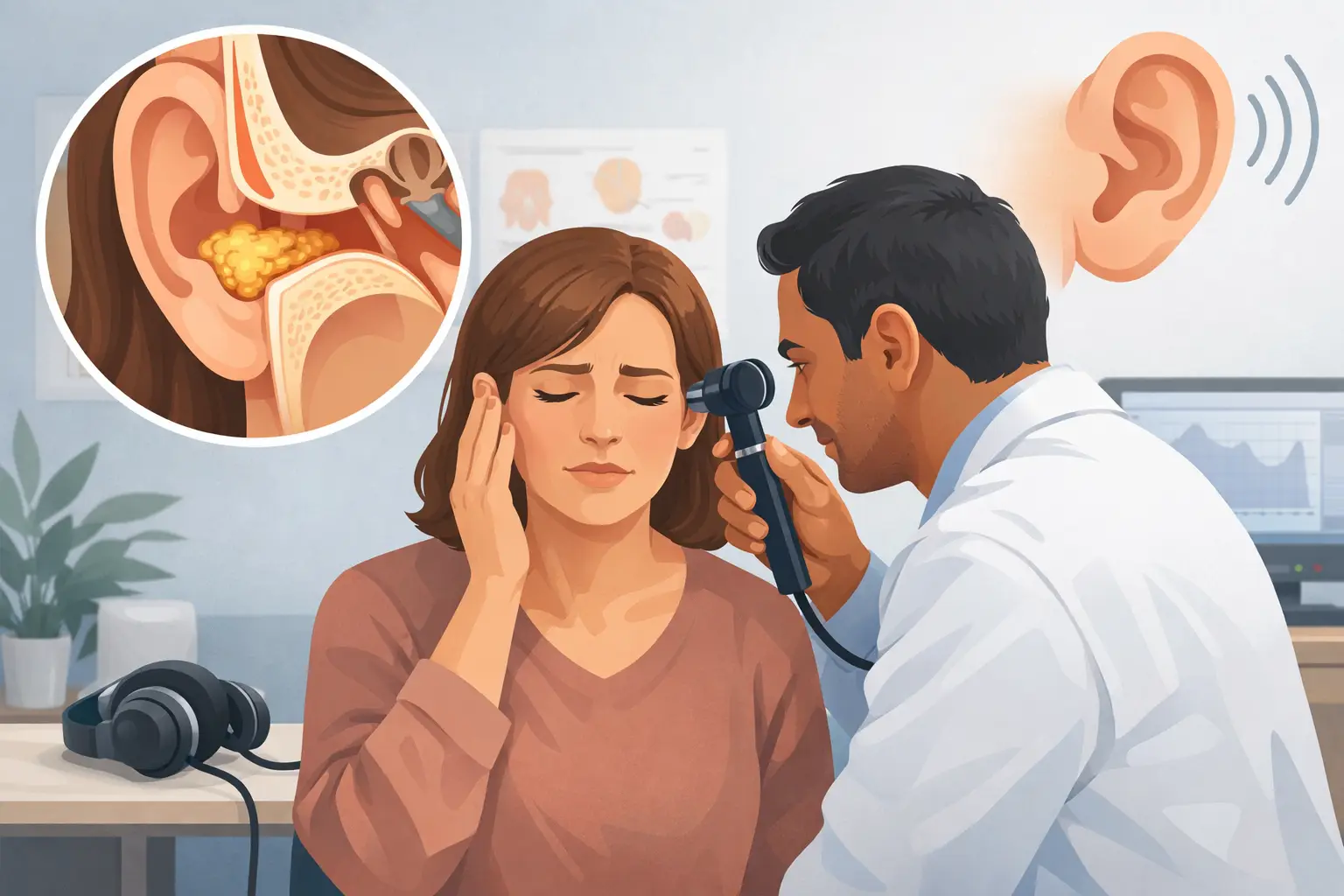
You wake up, one ear feels blocked, and suddenly voices sound distant, tinny or oddly muffled. It is no surprise that many people ask, can earwax cause hearing loss? The short answer is yes – earwax can reduce hearing when it builds up enough to block the ear canal. The reassuring part is that this type of hearing loss is often temporary and, with the right care, hearing clarity can usually be restored.
That said, not every change in hearing is caused by wax. This is where expert assessment matters. Assuming it is only earwax can delay diagnosis if the real issue is infection, Eustachian tube dysfunction, sudden sensorineural hearing loss, or another underlying ear condition.
Can earwax cause hearing loss or just muffled hearing?
Earwax can absolutely cause a noticeable drop in hearing. Clinically, this is usually a conductive hearing loss, which means sound is being physically blocked from travelling efficiently through the ear canal to the eardrum. Some people describe it as having water in the ear. Others say one ear sounds switched off compared with the other.
The degree of hearing change depends on how much wax is present, where it sits in the canal, and whether it has become impacted. A small amount of wax may cause no symptoms at all. A dense plug of wax sitting against the eardrum, however, can reduce hearing quite significantly.
People often notice the problem becomes worse after using cotton buds, wearing in-ear headphones, or after a shower. Moisture can cause wax to swell, while attempts to clean the ear often push it deeper. Instead of removing wax, many home methods compact it.
Why earwax builds up in the first place
Earwax is not dirty or harmful by default. It is a normal protective substance produced by the ear canal. It helps trap dust and debris, moisturises the skin, and provides a degree of defence against infection.
In most ears, wax moves out naturally with jaw movement and skin migration. Problems arise when this self-cleaning process is disrupted. Some people simply produce more wax than others. Some have narrower or more curved ear canals, which makes natural clearance less efficient. Hearing aids, earbuds and earplugs can also interfere with wax migration and gradually contribute to blockage.
Age can play a part too. In older adults, wax may become drier and harder, making impaction more likely. In children, wax can also obstruct the canal, though symptoms are not always obvious. A child may seem inattentive or ask for repetition when the real issue is reduced hearing from a simple blockage.
What earwax-related hearing loss feels like
A wax blockage does not always feel dramatic. Sometimes it develops gradually enough that people adapt without realising. More often, patients report one or more of the following sensations: muffled hearing, a blocked or full feeling in the ear, tinnitus, sound distortion, mild dizziness, itching, or discomfort.
Tinnitus is especially common. When the ear canal is obstructed, internal sounds may become more noticeable. That can present as ringing, buzzing or humming. This does not necessarily mean there is a serious inner ear problem, but it does warrant assessment if it is new, persistent or only on one side.
Pain is less typical with wax alone. If there is significant earache, discharge, fever or marked dizziness, another cause may be present and should not be ignored.
When it is probably not just wax
One of the most important clinical points is that hearing loss should never be self-diagnosed with complete confidence. Wax is common, but so are other ear conditions. If hearing changes suddenly, particularly in one ear, you should seek urgent professional advice. Sudden sensorineural hearing loss is a medical priority and should not be mistaken for simple blockage.
Similarly, if the ear feels blocked but hearing fluctuates with colds, flying or sinus symptoms, pressure problems in the middle ear may be involved. If there is pain and discharge, infection may be the main issue. If hearing loss has been gradual in both ears over time, age-related hearing loss may be contributing, even if wax is also present.
This is why an otoscopic examination is so valuable. Looking into the ear allows a qualified clinician to confirm whether wax is the cause, whether the eardrum can be seen clearly, and whether onward hearing assessment is needed.
How earwax is removed safely
If earwax is causing hearing loss, the safest treatment depends on the type and position of the wax, the condition of the ear canal, and your medical history. In specialist practice, microsuction is often preferred because it allows the clinician to remove wax under direct vision with precision and control.
Microsuction does not involve flushing the ear with water. That makes it particularly useful for people with a history of ear infection, perforated eardrum, previous ear surgery, or those who simply want a cleaner, more controlled method. It is usually quick, and many patients notice immediate improvement in hearing afterwards.
Sometimes ear drops are recommended first to soften hard wax. Softening can make removal easier, but it is not suitable in every situation. If you have had ear surgery, a known perforation, or active infection, you should not put products into the ear unless advised to do so by a qualified clinician.
Ear syringing is still discussed frequently, but it is not always the best option and is now used less commonly in specialist settings. The key point is that wax removal should be tailored to the ear in front of the clinician, not treated as a one-size-fits-all procedure.
What you should avoid doing at home
Cotton buds remain one of the biggest reasons simple wax becomes impacted wax. They tend to push material further into the canal, sometimes tightly against the eardrum. The same applies to hair grips, tissue corners and other improvised tools. These can abrade the canal skin, increase the risk of infection, and make matters worse.
Ear candles are another method best avoided. There is no good clinical basis for their use, and they carry risk without reliably removing wax.
Over-the-counter drops can help in selected cases, but they are not a diagnosis. If hearing loss is marked, one-sided, painful, recurrent, or associated with tinnitus or dizziness, booking an expert assessment is the more sensible step.
Can hearing return to normal after wax removal?
In many cases, yes. If the hearing loss is entirely due to wax blocking sound, hearing often improves as soon as the obstruction is removed. Patients sometimes describe the result as instant relief.
But it depends on whether wax is the only problem. Occasionally, wax has been masking an existing hearing loss underneath. Once the canal is cleared, hearing may improve, but not fully. That is not a failure of wax removal – it simply means further investigation is needed.
This is where a specialist audiology clinic can offer real value. If symptoms persist after wax removal, hearing can be assessed properly rather than left uncertain. For adults and children alike, accurate diagnosis is what leads to the right treatment.
When to book an assessment
You should arrange a professional ear examination if your hearing has become muffled, one ear feels blocked, tinnitus has started or worsened, or home measures have not helped. You should also seek prompt advice if symptoms are one-sided, sudden, painful, recurrent, or linked with discharge or dizziness.
For families, it is worth paying attention to subtle changes in children. Turning the television up, mishearing instructions, or seeming distracted can sometimes reflect reduced hearing rather than behaviour. A proper ear and hearing assessment can clarify that quickly.
At a specialist clinic such as Tragus-The Ear Specialists, the advantage is not simply wax removal. It is knowing whether wax is truly the cause, whether hearing needs testing, and whether anything more complex needs attention.
The clinical bottom line on can earwax cause hearing loss
Yes, earwax can cause hearing loss – usually a temporary conductive loss caused by blockage in the ear canal. It can also trigger tinnitus, discomfort and the frustrating sense that sound has lost its sharpness. What matters is not guessing, but confirming the cause and choosing safe, clinically appropriate treatment.
If your hearing has dulled and your ear feels blocked, do not keep pushing it to the back of your mind. Clear hearing affects conversation, confidence, concentration and quality of life more than most people realise – and sometimes the simplest explanation is one that can be treated quickly and expertly.