
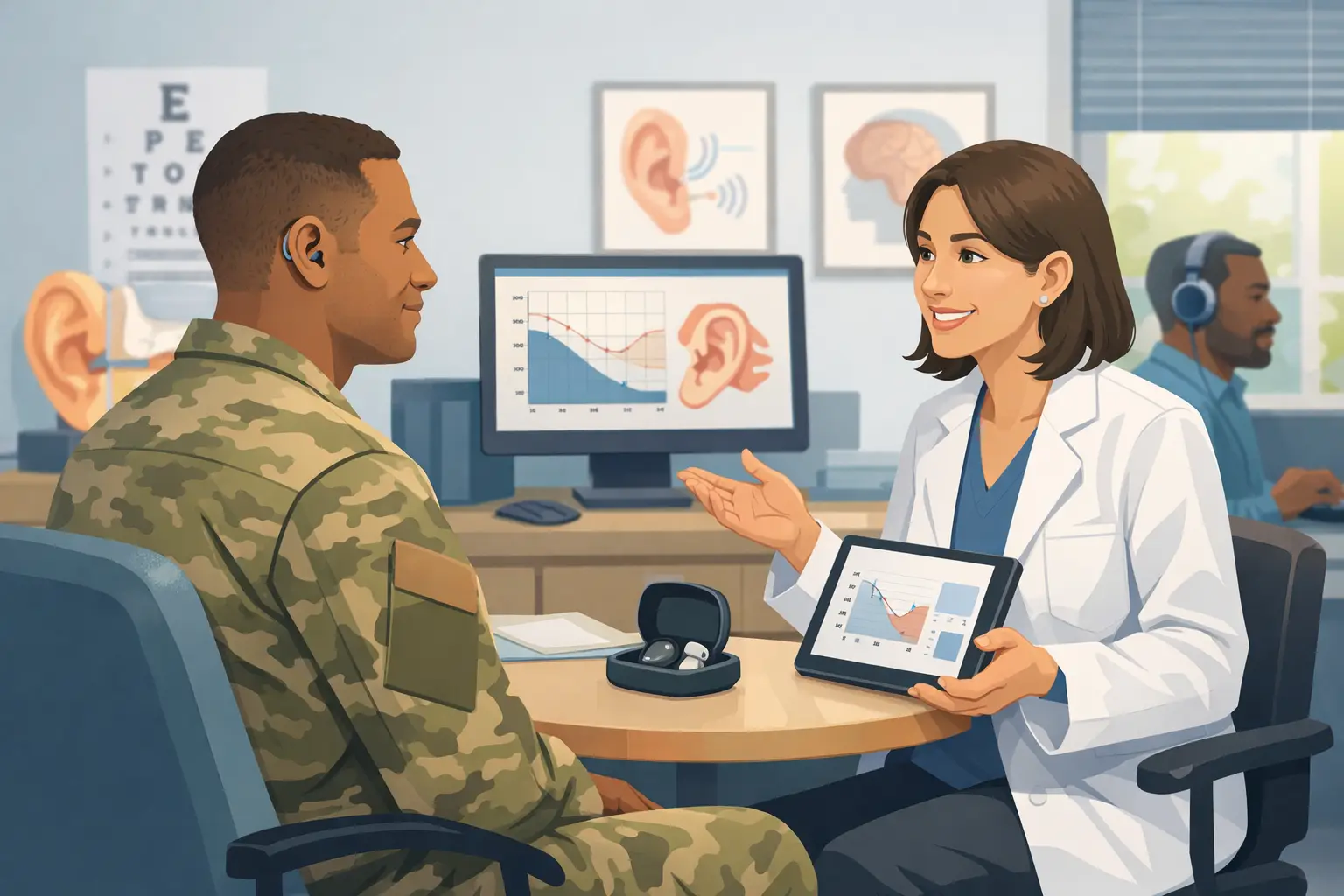
A former service member may have lived for years with the after-effects of weapons training, engine noise, aircraft, heavy machinery or repeated exposure to sudden blasts before deciding to seek help. That delay is common. Military hearing loss support is often needed not only for reduced hearing, but for tinnitus, sound sensitivity, listening fatigue and the strain that follows at home, at work and in social settings.
The difficulty is that hearing damage linked to military service is not always straightforward. Some people notice obvious hearing loss. Others hear sound perfectly well in a quiet room but struggle to follow speech in restaurants, meetings or family gatherings. Many describe constant ringing, buzzing or hissing that becomes more intrusive at night. What matters is not simply whether hearing has changed, but how those changes affect daily function.
What military hearing loss support should include
Effective military hearing loss support starts with proper clinical assessment, not assumptions. Noise-induced hearing loss can sit alongside tinnitus, hyperacusis, wax build-up, middle ear problems or age-related change. If the problem is treated as a single issue without testing, the support offered may miss what is really driving symptoms.
A specialist audiology assessment should look at more than whether tones can be heard through headphones. It should also explore speech understanding, symptom history, exposure patterns and the wider effect on concentration, sleep and wellbeing. That is particularly important for people who have spent time around gunfire, explosives, communications headsets, armoured vehicles or aircraft, where exposure may have been repeated over many years.
There is also a practical point here. Two people with similar test results can have very different support needs. One may be managing well with small adjustments. Another may be withdrawing from conversations, avoiding busy places and finding tinnitus hard to tolerate. Good care recognises that hearing healthcare is not one-size-fits-all.
Common signs after military noise exposure
The clearest sign is reduced hearing, especially when trying to understand speech in background noise. People often say that others seem to mumble, or that they can hear a voice but not make out the words. High-pitched sounds may be harder to detect, which can affect clarity more than volume.
Tinnitus is another frequent concern. It may be constant or intermittent, soft or intrusive, and it can become more noticeable during quiet periods. Some people also experience hyperacusis, where ordinary environmental sounds feel uncomfortable or overly sharp. Others report a sense of blocked hearing after noise exposure, even when no wax or infection is present.
These symptoms do not always arrive dramatically. They can build gradually, which is why many former military personnel normalise them for years. By the time help is sought, communication may already be affecting work, relationships and confidence.
Why people often leave it too long
There is a culture in many service environments of getting on with things, even when symptoms are persistent. Hearing problems may be seen as less urgent than other health concerns, or simply as part of the job. Some people are also reluctant to wear hearing aids because they associate them with old age or severe disability.
In clinic, that hesitation often fades once the problem is explained clearly and a realistic treatment plan is offered. Modern hearing care is far broader than simply issuing a device. It may involve detailed counselling, tinnitus support, hearing technology, communication strategies or protective solutions for ongoing noise exposure.
Assessment comes before treatment
Before any treatment is considered, it is worth establishing exactly what is happening. A thorough hearing assessment can identify whether the pattern fits noise-induced damage, whether tinnitus is present, and whether there are additional issues such as earwax blockage or middle ear dysfunction. That level of detail matters because support is shaped by the diagnosis.
If hearing loss is confirmed, the next step is deciding what will actually improve day-to-day life. Some patients benefit from hearing aids. Others need tinnitus management first because the distress from tinnitus is greater than the hearing difficulty itself. In some cases, both need to be addressed together.
This is where a specialist ear and hearing clinic can add real value. Patients with hearing loss linked to military service often have mixed symptoms rather than a single complaint. Access to qualified audiologists with experience in hearing diagnostics, tinnitus assessment and hearing rehabilitation allows support to be built around the person rather than around a standard product pathway.
Treatment options for military hearing loss support
Hearing aids are often part of the picture, but not always in the way people expect. Their purpose is not simply to make everything louder. Properly fitted devices are programmed to improve clarity, reduce listening effort and make speech easier to follow in realistic environments. For someone with high-frequency hearing loss after noise exposure, this can make a significant difference to communication.
That said, hearing aids are not a cure for every problem. If tinnitus is the main concern, management may involve education, sound therapy, hearing devices with tinnitus features, or structured support to reduce the emotional and attentional impact of the sound. If hyperacusis is present, treatment needs careful handling. Overprotection from sound can sometimes make tolerance worse, while unmanaged exposure can feel overwhelming. It depends on the individual pattern and severity.
Communication strategies are also underrated. Facing the speaker, reducing competing noise where possible, choosing better seating in restaurants and letting others know what helps can all reduce strain. These changes sound simple, but they are often the difference between coping and avoiding situations altogether.
The role of hearing protection now
Not everyone seeking support has left noisy environments behind. Some continue to work in shooting, engineering, transport, construction or security roles, or spend time in loud leisure settings. In those cases, management should also include prevention.
Custom earplugs can be especially useful where standard protection is uncomfortable, inconsistent or impractical. The right protection depends on the setting. Too little protection leaves the ear vulnerable. Too much can isolate the wearer, interfere with communication and lead to poor compliance. This balance matters, particularly for people who already live with hearing loss or tinnitus.
Tinnitus and military service
Tinnitus deserves separate attention because it is so common after military noise exposure and so often misunderstood. It is not a disease in itself but a symptom that can arise when the auditory system has been stressed or damaged. For some, it is mildly annoying. For others, it is exhausting.
The severity of tinnitus is not measured only by loudness. A quieter tinnitus can still be distressing if it disrupts sleep, concentration or emotional wellbeing. That is why expert tinnitus assessment is important. Good care looks at triggers, hearing status, coping patterns and the factors that keep the problem active.
There is rarely a single quick fix, and honest clinical advice matters here. But there are effective ways to reduce tinnitus distress and make it easier to live with. When hearing loss is treated properly and tinnitus is addressed as part of the same rehabilitation plan, many patients notice meaningful improvement.
When to book an expert assessment
If hearing seems worse than it used to be, if conversations are becoming effortful, or if ringing in the ears is persisting, it is sensible to arrange an assessment. The same applies if family members are commenting on the television volume, if background noise has become especially difficult, or if sound sensitivity is making ordinary places uncomfortable.
A specialist clinic is particularly worthwhile when symptoms are complex, longstanding or affecting quality of life. For patients in London and Kent looking for medically credible care rather than a quick retail sale, that difference in approach can be significant. An expert assessment gives you clarity on what is happening and what can realistically help.
At Tragus-The Ear Specialists, that means care led by qualified clinicians who understand that hearing loss is not just about the ear. It is about communication, confidence, sleep, concentration and daily ease.
The most helpful step is often the first one – getting the problem measured properly, named accurately and treated with the seriousness it deserves. You do not need to keep pushing through poor hearing in silence.