
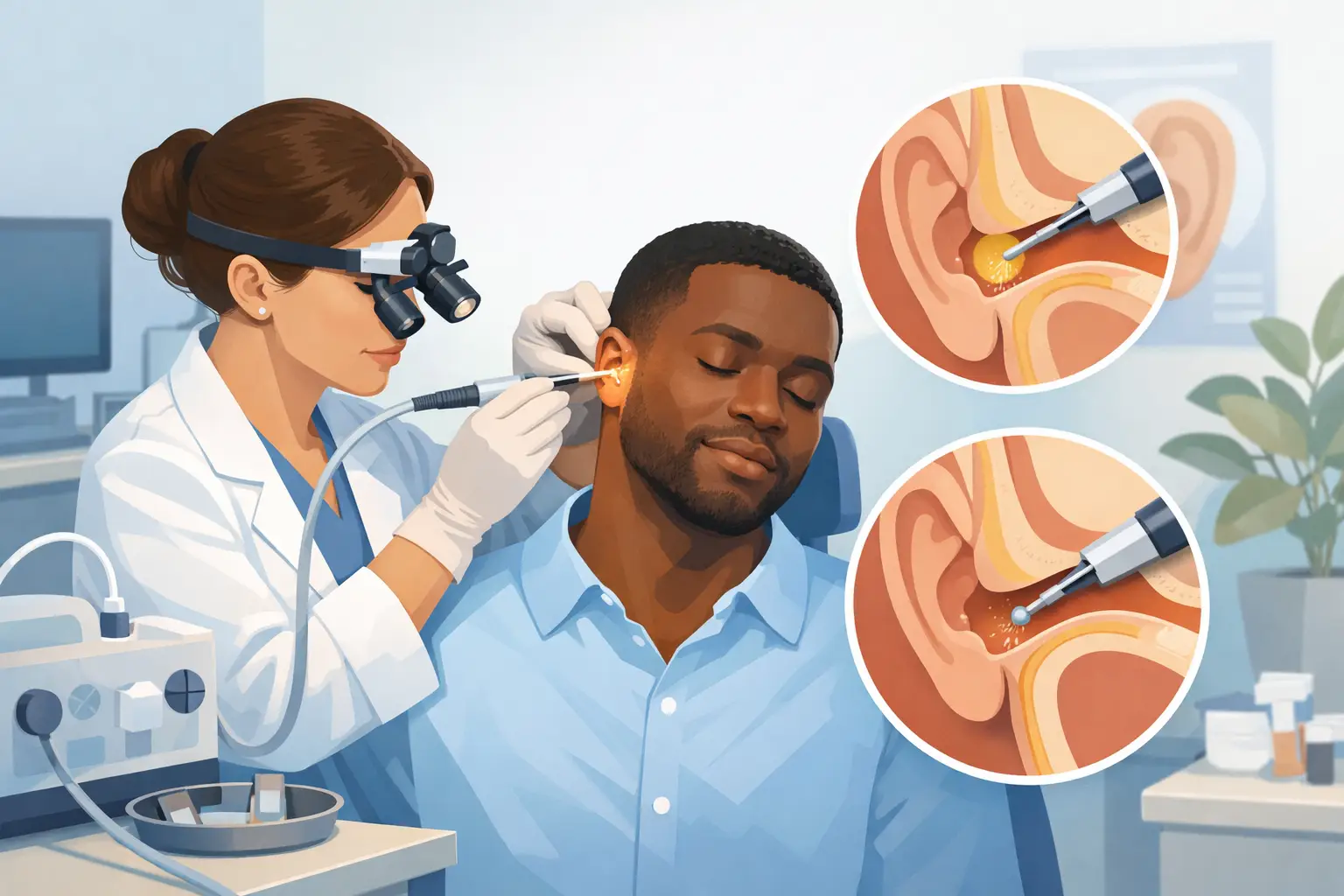
When your hearing suddenly feels muffled, your own voice sounds oddly loud, or one ear seems blocked after using drops, the cause is often simple – earwax that has built up in the wrong place. Microsuction earwax removal is a clinical method of clearing that blockage under direct visual guidance, with precision and without flushing the ear with water.
For many patients, that difference matters. Earwax removal is often treated as a quick convenience service, but the ear is delicate, symptoms can overlap with infection or hearing loss, and not every blocked ear should be approached in the same way. A specialist assessment helps ensure the problem is identified properly before treatment begins.
What is microsuction earwax removal?
Microsuction earwax removal is a procedure in which a qualified clinician uses a fine medical suction device to remove wax from the ear canal while viewing the area clearly through magnification and illumination. Because the clinician can see what they are doing throughout the procedure, it is regarded as a precise and controlled method of wax removal.
Unlike ear syringing or irrigation, microsuction does not rely on pushing water into the ear canal. That makes it particularly useful for patients who may not be suitable for irrigation, including some people with a history of ear surgery, recurrent ear infections, a perforated eardrum, or ongoing ear discomfort. It is also often preferred by patients who want a cleaner, more targeted approach.
That said, suitability always depends on the ear itself. Very hard wax, a narrow canal, sensitive skin, or an inflamed ear can all affect how straightforward the appointment is. Good clinical care means adapting the method to the patient, not forcing the same process for everyone.
Why people choose microsuction over other methods
The main reason is accuracy. With microsuction earwax removal, the clinician is working under direct vision rather than relying on pressure or guesswork. This allows wax to be removed in a measured way, especially when it is sitting close to the eardrum or stuck against the canal wall.
There is also a comfort and safety aspect. Irrigation can work well in selected cases, but it is not ideal for every ear. Some patients dislike the sensation of water in the ear, while others are not suitable candidates for it at all. Microsuction avoids that issue and is often the better option when there is a need for careful clinical judgement.
Another reason is speed of symptom relief. When wax is the cause, patients often notice an immediate improvement in hearing clarity and a reduction in pressure, fullness, or the blocked sensation. If symptoms do not improve after removal, that is clinically useful too, because it suggests the problem may not have been wax in the first place.
What symptoms can earwax cause?
Earwax is normal and protective. It traps debris, helps keep the ear canal healthy, and usually works its way out naturally. Problems arise when wax becomes impacted or is pushed deeper into the ear.
Common symptoms include reduced hearing, a blocked or full feeling in the ear, discomfort, ringing in the ears, dizziness, itchiness, or hearing aid feedback. Some patients also notice that telephone calls are harder to follow, speech sounds dull, or background noise becomes more intrusive because one ear is no longer hearing clearly.
These symptoms are not exclusive to wax. Infection, Eustachian tube dysfunction, sudden hearing loss, middle ear problems, and skin conditions can produce similar complaints. That is why ear examination matters. If the symptoms are not caused by wax, removal alone will not solve the issue.
What happens during the appointment?
A proper appointment begins with assessment. The clinician will ask about your symptoms, any pain or discharge, previous ear problems, surgery, infections, use of hearing aids, and whether you have tried drops. The ear is then examined to confirm whether wax is present and whether microsuction is appropriate.
If treatment goes ahead, a small suction tube is used to remove the wax while the ear canal is viewed under magnification. In some cases, fine instruments may also be used to loosen or lift wax, particularly if it is dry or adherent. The process is usually quick, but there is no advantage in rushing. Careful removal is more important than fast removal.
Patients often ask whether it hurts. In most cases, microsuction earwax removal is well tolerated, though it can feel unusual. You may hear a suction noise, and if the wax is very hard or close to sensitive skin, there can be temporary discomfort. An experienced clinician will work gently and explain what is happening throughout.
Afterwards, the ear is checked again. If hearing remains reduced, if the canal is inflamed, or if the eardrum looks abnormal, you may be advised to have further assessment. This is one of the benefits of attending a specialist ear clinic rather than a purely transactional wax service.
Do you need olive oil drops first?
Often, yes – but not always for long. Ear drops can soften wax and make removal easier, especially when the build-up is dry, hard, or tightly impacted. Olive oil is commonly recommended because it helps lubricate and soften the material without aggressively irritating the canal.
However, more is not always better. Overuse of drops can sometimes swell the wax or leave the ear feeling more blocked before the appointment. If the ear is already producing discharge, is painful, or has a history of perforation or surgery, you should not assume drops are appropriate without advice.
For many patients, a few days of preparation is enough. Others may need longer, and some do not need pre-softening at all. It depends on the type of wax and the condition of the ear canal.
When microsuction earwax removal may not be straightforward
Not every appointment ends with both ears fully cleared. That can be disappointing, but it is not necessarily poor treatment. If wax is extremely impacted, the canal skin is sore, or the patient is in discomfort, it may be safer to remove the wax over more than one visit rather than pushing on aggressively.
There are also times when wax is only part of the picture. A patient may present with a blocked sensation, but examination reveals infection, eczema, a foreign body, or a hearing issue unrelated to wax. In children especially, symptoms can be harder to interpret, so specialist assessment is valuable.
This is where clinician experience matters. A premium ear clinic should not simply remove what it can and send the patient away. It should recognise when further investigation, medical review, or hearing assessment is the more appropriate next step.
Is microsuction safe?
When carried out by appropriately trained clinicians using suitable equipment, microsuction is considered a safe and effective method of earwax removal. As with any ear procedure, there are limits and risks, but they are reduced when treatment is based on examination, clear visibility, and good technique.
Possible temporary effects include mild sensitivity, a tickling cough reflex, dizziness, or increased awareness of sound immediately after the ear is cleared. These usually settle quickly. More significant problems are uncommon, but ears that are infected, recently operated on, anatomically complex, or very inflamed require extra caution.
For that reason, qualifications and clinical setting should not be an afterthought. If you already have hearing concerns, tinnitus, or a history of ear disease, it makes sense to be seen by professionals who understand the wider picture of ear and hearing health.
When to book an expert ear assessment
If you have persistent blockage, reduced hearing, ear discomfort, troublesome wax despite using drops, or repeated wax build-up with hearing aids, it is sensible to book an expert assessment rather than keep trying home remedies. You should also seek prompt advice if symptoms are one-sided, painful, associated with discharge, or come on suddenly.
For patients in Dartford, Sevenoaks and surrounding areas, attending a specialist service such as Tragus-The Ear Specialists can offer more than wax removal alone. It means the ear is assessed by qualified audiologists with a broader understanding of hearing, tinnitus, ear canal health, and when symptoms point to something more than simple wax.
Clear hearing should not feel like a luxury, and nor should safe ear care. If your ears feel blocked, your hearing has dulled, or you are tired of temporary fixes, the right treatment starts with an accurate look inside the ear.