
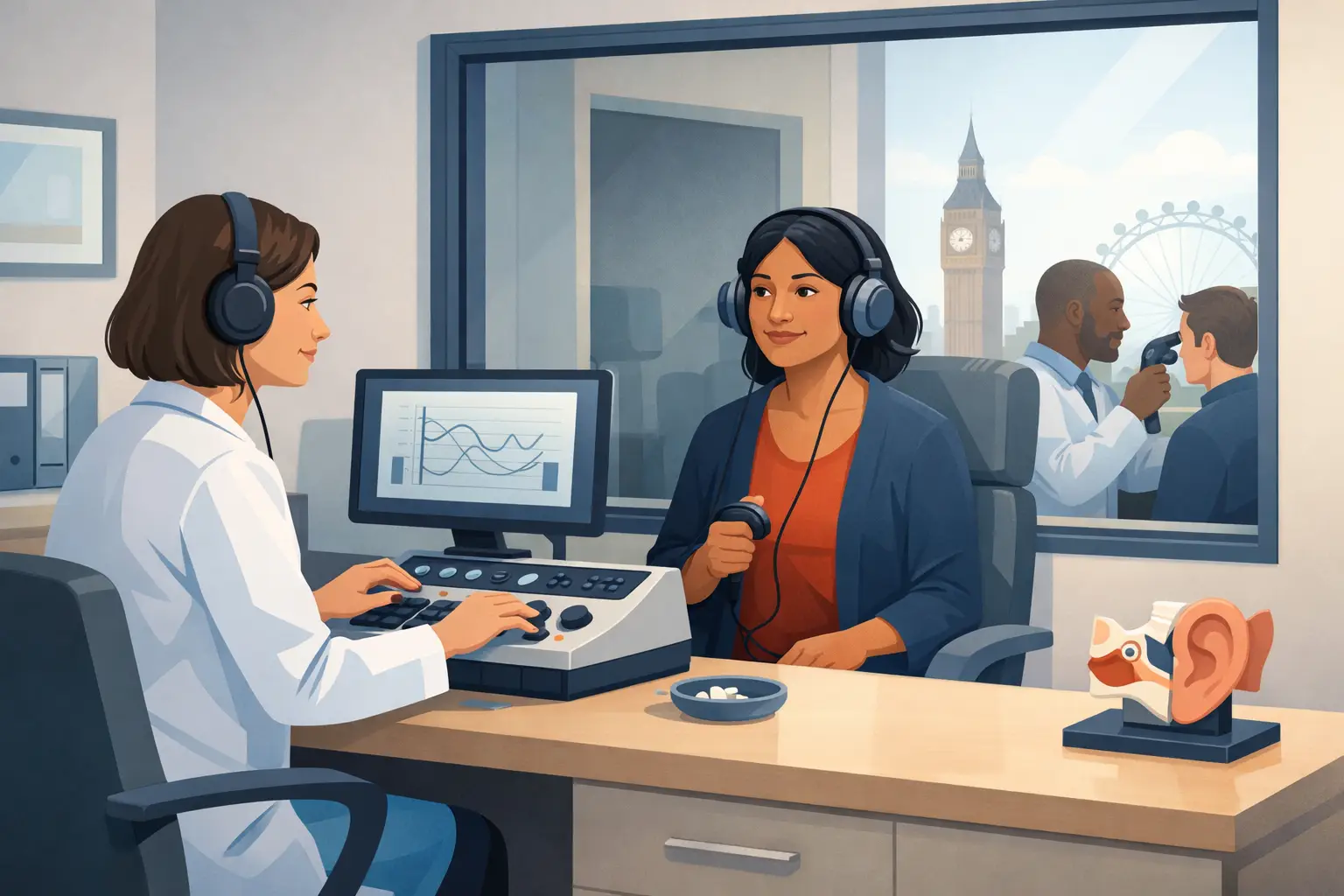
When conversation starts to feel harder than it should, most people do not need more volume – they need clearer answers. A private hearing test London patients choose should do more than confirm whether hearing has changed. It should identify what is happening, explain why it matters, and set out the right next step with confidence.
That distinction matters. Hearing difficulty is not always simple age-related hearing loss. It can be linked to wax obstruction, middle ear problems, noise exposure, tinnitus, sound sensitivity, asymmetrical hearing changes, or a more complex auditory pattern that needs specialist interpretation. In children, the picture can be even more nuanced, with hearing concerns affecting speech, behaviour, attention, and learning.
Why choose a private hearing test in London?
The main reason people seek private care is straightforward – they want prompt access to expert assessment in a clinical setting focused on accuracy, time, and clear recommendations. A private appointment usually allows more room to discuss symptoms properly, ask questions, and understand the findings rather than simply being told that hearing is normal or reduced.
That does not mean every person needs private audiology. If your symptoms are mild, stable, and not affecting daily life, routine routes may be appropriate. But when hearing changes are interfering with work, communication, family life, or confidence, faster assessment can be worthwhile. The same applies if you have tinnitus, blocked ears, dizziness, one-sided symptoms, or a child whose hearing needs specialist review.
A private clinic can also be the better choice when you want continuity. Seeing qualified audiologists who work within a specialist ear and hearing service means your testing, interpretation, treatment planning, and rehabilitation can be joined up. If the issue is wax, it can be managed appropriately. If it is hearing loss, the discussion can move on to rehabilitation. If the pattern suggests something that needs medical input, that can be explained without delay.
What happens during a private hearing test London patients book?
A thorough assessment starts before any beeps are played through headphones. Your clinician should first ask about the symptoms themselves – when they started, whether one ear is worse, whether there is tinnitus, fullness, pain, sensitivity to sound, dizziness, or difficulty hearing in noise. They should also ask about work and lifestyle factors such as noise exposure, previous ear infections, family history, and any hearing aid use.
The ears are then examined. This is an important step because hearing can appear reduced for very different reasons. Impacted earwax, inflammation, a perforated eardrum, or signs of middle ear dysfunction can all change what testing means. Skipping that basic clinical check risks missing the cause.
From there, the hearing test itself is tailored to the patient. For most adults, pure tone audiometry is used to assess the quietest sounds that can be heard across different pitches. Speech testing may also be carried out, particularly when the main complaint is understanding speech rather than simply hearing sound. This often provides a more realistic view of everyday listening difficulties.
Where appropriate, tympanometry may be included to assess middle ear function. This can be particularly useful if there is pressure, popping, fluctuating hearing, or a history of colds and ear infections. In children, the appointment may involve age-appropriate methods depending on developmental stage and attention.
At a specialist clinic, the process should not end with a graph. The value is in the interpretation. Patients need to know whether the hearing levels are within normal limits, whether there is conductive or sensorineural loss, whether the result is symmetrical, and what that means for treatment or monitoring.
What makes a specialist assessment different?
Not all hearing tests are equal. Some are designed primarily to support hearing aid retail. Others are rooted in clinical audiology and ear health. The difference is significant when symptoms are complex or when the patient wants medical-grade reassurance.
A specialist assessment is broader in scope. It does not start from the assumption that every problem leads to a hearing aid. Sometimes the right answer is wax removal. Sometimes it is tinnitus assessment and therapy. Sometimes it is advice, monitoring, or onward referral. And sometimes hearing aids are absolutely the right intervention – but only after the hearing profile, communication needs, and listening environments have been properly assessed.
This is particularly important for people with tinnitus or hyperacusis, where hearing changes and sound tolerance issues often overlap. It also matters for parents. A child who seems to ignore instructions may have normal hearing, fluctuating middle ear issues, auditory difficulties, or something unrelated to hearing altogether. Good testing helps narrow that down rather than creating false reassurance.
Who should book a private hearing test?
Many adults wait far too long. They compensate by lip reading, turning up the television, avoiding noisy places, or asking people to repeat themselves. By the time they book, the problem has often been affecting confidence and communication for months or years.
It is sensible to arrange an assessment if you notice speech sounding muffled, struggle in background noise, rely heavily on subtitles, experience ringing in the ears, or feel one ear is not hearing as well as the other. Sudden hearing change is different – that requires urgent medical attention rather than a routine appointment.
A private hearing test can also be valuable for people with high listening demands. Teachers, healthcare professionals, musicians, office workers in busy environments, and anyone on frequent calls may notice subtle deficits earlier because their work depends on listening accuracy.
For families, paediatric assessment is worth considering when a child has delayed speech, inconsistent responses to sound, frequent ear infections, school concerns, or a failed screening result. Children need testing that is adapted to them, both technically and in the way the clinician engages them.
What happens after the test?
The best next step depends entirely on the findings. If hearing is normal, that can still be useful. It rules out one cause and may point towards wax, auditory strain, tinnitus management, or another explanation for the symptoms. If there is hearing loss, the clinician should explain the degree and type clearly, not bury it in technical language.
For some patients, the right plan is monitoring with repeat testing after a defined interval. For others, hearing rehabilitation should be discussed straight away. That might include hearing aids, communication strategies, tinnitus support, or middle ear management. If the pattern is medically concerning – for example, asymmetrical loss or symptoms suggestive of underlying pathology – you should be advised on onward referral.
This is where a premium ear clinic adds real value. Joined-up care is more efficient and more reassuring than moving between multiple providers. A patient with blocked ears, hearing loss, and tinnitus may need more than one intervention, and the sequence matters.
How to choose the right clinic for a private hearing test in London
Look beyond convenience. The most central location is not always the best fit if the appointment is rushed or overly sales-led. Qualifications, clinical background, and service scope matter more.
A good clinic should be clear about who carries out the test, what is included, and whether they assess both adults and children if needed. It should also be able to explain what happens if the test identifies wax, tinnitus, hearing aid needs, or findings that require medical follow-up. That breadth is often a sign that you are dealing with a genuine specialist service rather than a narrow transaction.
It is also worth considering whether you want a clinic that understands the overlap between hearing and wider ear symptoms. Many patients do not present with hearing loss alone. They come with discomfort, blocked ears, sound sensitivity, or anxiety about a recent change. A clinician who can assess the whole picture is usually better placed to guide the next step.
For patients travelling from London or nearby parts of Kent, that specialist approach can be more important than being on the nearest high street. Tragus-The Ear Specialists reflects this model of care, combining diagnostic audiology with broader ear health expertise for adults and children.
Private hearing test London: cost versus value
Price matters, but value matters more. A cheaper test is not necessarily better if it offers limited examination, minimal explanation, or no clear pathway afterwards. On the other hand, a higher fee should be justified by clinical depth, specialist interpretation, and access to appropriate follow-on care.
The real question is what you are paying for. If the appointment gives you a precise diagnosis, a proper explanation, and a sensible treatment plan, that has value. If it simply confirms that hearing is reduced without addressing the cause or the consequences, it may not.
Good hearing care should leave you with clarity. You should understand your results, know whether treatment is needed, and feel confident about what comes next. If hearing has been affecting your day-to-day life, do not wait in silence – the right assessment can be the point where things finally start to make sense.