
Missing parts of conversation is rarely dramatic at first. More often, it starts with asking people to repeat themselves, turning the television up a little further, or feeling unusually tired after meetings and family gatherings. A hearing test for adults is designed to identify what is happening early, accurately, and without guesswork.
For many people, the hesitation is not about the test itself. It is about what the result might mean. That is understandable. Hearing changes can affect confidence, work, relationships and general wellbeing. The value of a specialist assessment is that it gives you clear answers and a sensible next step, whether the issue is hearing loss, earwax, tinnitus, sound sensitivity, or something that needs medical follow-up.
When should adults book a hearing test?
A common mistake is waiting until hearing difficulties become obvious to everyone else. In reality, many adults adapt gradually. They lip-read without realising it, avoid noisy restaurants, or blame poor acoustics when speech becomes harder to follow. By the time hearing loss feels undeniable, it may already be affecting day-to-day life more than expected.
If speech sounds muffled, people seem to mumble, or background noise makes conversation disproportionately difficult, it is worth arranging an assessment. The same applies if one ear seems worse than the other, you have persistent tinnitus, or you notice strain and fatigue after listening for long periods. A hearing test is also sensible if family members have commented on your hearing, even if you are not fully convinced.
Age is only one factor. Noise exposure, previous ear infections, certain medications, cardiovascular health, and family history can all play a part. Some adults in their thirties and forties benefit from testing just as much as someone in later life. It depends on symptoms, risk factors and how much your hearing is affecting communication.
What a hearing test for adults actually involves
A proper adult hearing assessment should feel methodical, not rushed. It is not simply a matter of putting on headphones and pressing a button. The appointment usually begins with a detailed case history. Your audiologist will ask about symptoms, how long they have been present, whether the problem affects one or both ears, and whether you also experience tinnitus, dizziness, pain, pressure or sound sensitivity.
The ears are then examined, often with otoscopy, to check the ear canal and eardrum. This matters because hearing difficulty is not always caused by permanent hearing loss. Impacted earwax, inflammation, or middle ear problems can all change hearing levels and need to be identified before moving forward.
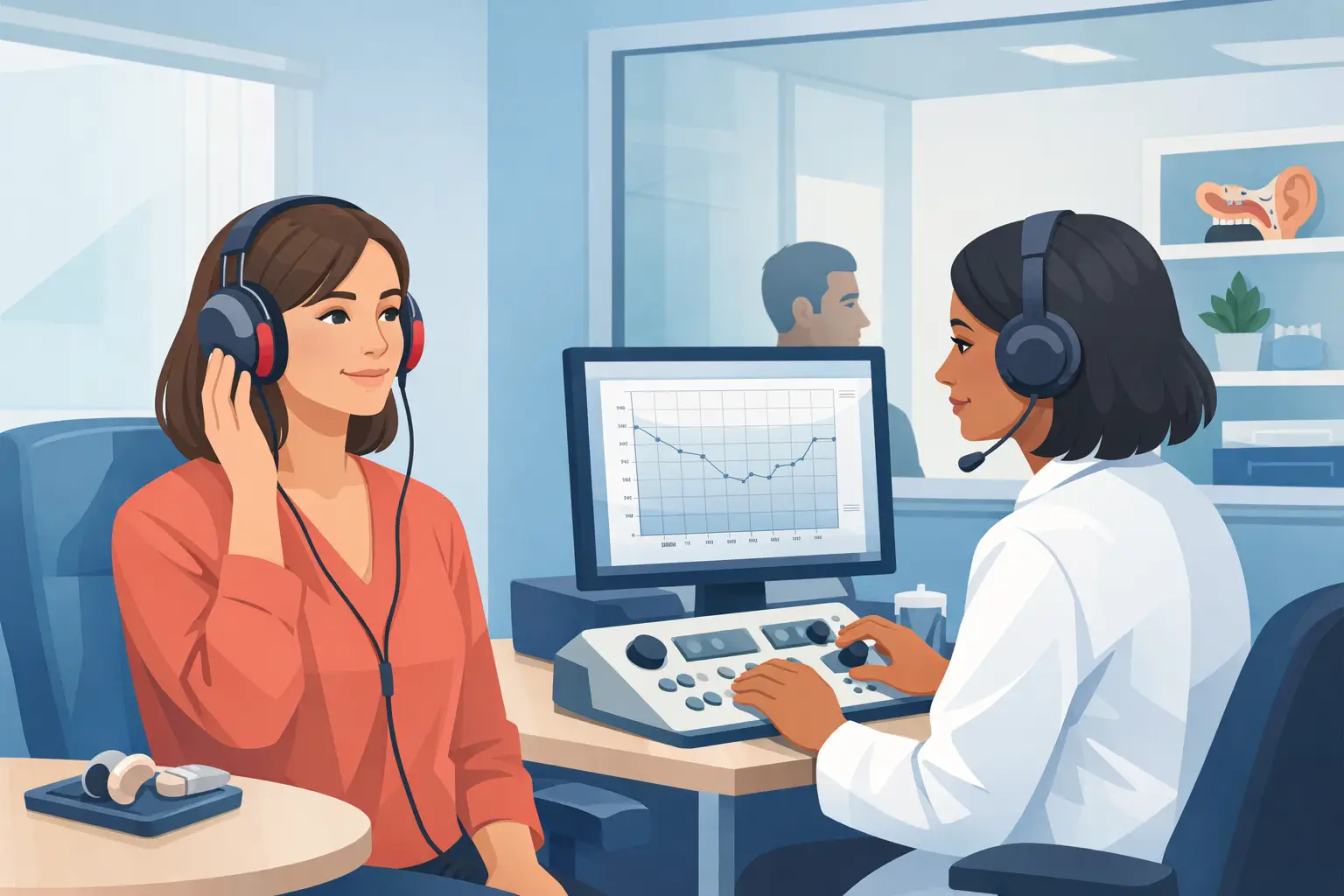
Pure tone audiometry is the part most people associate with a hearing test. You listen to tones at different pitches and volumes through headphones and indicate when you hear them. This helps map your hearing thresholds across the frequency range. It gives important information, but it is only part of the picture.
Speech testing may also be included, particularly when someone says, “I can hear sound, but I cannot make out the words.” That distinction matters. Some adults have relatively mild threshold changes but significant real-world difficulty understanding speech, especially in noise. Speech measures can help explain why.
Middle ear testing, such as tympanometry, may be used to assess eardrum movement and middle ear function. In some cases, additional tests are appropriate if symptoms suggest tinnitus, hyperacusis, asymmetric hearing loss, or more complex auditory issues. A specialist clinic will tailor the assessment rather than forcing every patient through the same narrow pathway.
What your results can show
The result of a hearing test for adults is not simply “pass” or “fail”. Hearing exists on a spectrum, and interpretation should always be linked to your symptoms and your listening needs.
Some people have normal hearing thresholds but still need help because tinnitus, auditory fatigue, or sound sensitivity is affecting quality of life. Others have a mild high-frequency hearing loss that explains difficulty hearing speech clearly in busy environments. Some have conductive issues linked to earwax or middle ear dysfunction, while others have sensorineural hearing loss related to inner ear change.
This is where clinical expertise matters. Two adults with similar audiograms may need different advice. Someone who works in meetings, uses the phone constantly, or is responsible for hearing subtle cues at work may feel the impact of relatively modest hearing changes much more than someone with lower listening demands. Good audiology is not just about the graph. It is about what that graph means in everyday life.
Why specialist assessment matters
There is a difference between a quick retail screen and a comprehensive diagnostic assessment. Screening can be useful in some settings, but it is limited. It may confirm that hearing is reduced without properly explaining why, how much, or what should happen next.
A specialist-led appointment offers more clinical depth. It can distinguish between hearing loss and other ear-related causes of communication difficulty. It can also identify red flags that should not be ignored, such as sudden hearing changes, unilateral symptoms, troublesome tinnitus, dizziness, or ear pain. Those situations may require urgent medical attention rather than routine monitoring.
For adults who value accuracy, reassurance and properly qualified care, that distinction is significant. At a premium ear clinic, the aim is not to rush you towards a product. It is to establish a clear diagnosis, explain the findings in plain English, and recommend treatment or rehabilitation that genuinely fits your needs.
If hearing loss is found, what happens next?
Not every hearing loss needs immediate hearing aids, and not every patient wants the same approach. Sometimes the right next step is wax removal, medical referral, monitoring over time, or support for tinnitus alongside hearing management. Sometimes hearing aids are appropriate and can make a marked difference to communication, concentration and listening comfort.
The best approach depends on the type of hearing loss, its severity, your lifestyle, and how much it is affecting you. Mild losses can still have a disproportionate impact in demanding listening environments. On the other hand, someone with measurable hearing loss may cope reasonably well in quiet one-to-one settings and only need support in specific situations.
If hearing aids are recommended, fitting should be based on your hearing profile and listening goals, not a one-size-fits-all sales process. Adults often worry that amplification will sound unnatural or feel overwhelming. Modern hearing technology can be highly effective, but only when it is selected carefully, programmed accurately, and supported with proper follow-up.
Common concerns before a hearing test
Many adults put off testing because they assume it will be uncomfortable, embarrassing, or lead to pressure to commit to treatment. A well-run clinical appointment should feel none of those things. The tests are non-invasive, and the purpose is information first.
Another common concern is whether hearing difficulties are simply part of getting older and therefore not worth addressing. Age-related change is common, but common does not mean insignificant. If hearing strain is making social situations harder, reducing confidence, or leaving you exhausted by the end of the day, it deserves professional attention.
There is also the question of timing. People often ask whether they should wait until the problem becomes more obvious. Usually, that only prolongs the frustration. Earlier assessment can make treatment easier, reduce uncertainty, and help preserve better communication habits before withdrawal and coping strategies become ingrained.
Hearing tests and wider ear health
Hearing does not sit in isolation from the rest of ear health. Adults who book a hearing assessment may discover that wax build-up is contributing to the problem, or that tinnitus needs dedicated support rather than being dismissed as something to tolerate. Others may need advice on protecting their hearing from occupational or recreational noise, especially if they are regularly exposed to loud music, machinery, or shooting environments.
This is why a broader ear-health clinic model is often beneficial. It allows hearing assessment to connect directly with therapeutic ear care, rehabilitation, tinnitus support and, where needed, onward referral. For patients across Kent and South East London who want expert assessment without a fragmented experience, that joined-up approach can save time and reduce uncertainty.
At Tragus-The Ear Specialists, that specialist focus is central to care. The goal is not just to measure hearing, but to understand the person behind the symptoms and provide a clear path forward.
Book when your hearing starts changing, not when life shrinks around it
If hearing has become harder work than it used to be, trust that instinct. A hearing test for adults is a straightforward step, but it can answer questions that have been quietly affecting your confidence, concentration and connection with other people. The earlier you seek expert assessment, the sooner you can hear the world in high-definition once more.